
It Was Strategic When We Approved It. Is It Still Worth Protecting?

Two years ago, leadership approved a multi-year supply-chain transformation for good reasons.
The economics were credible. The strategic case was clear. The first phases have broadly delivered what was expected, and the remaining rollout should still create value.
Now a new opportunity appears.
A major customer expansion has become commercially credible, with a realistic path to material revenue growth, but capturing it requires some of the same scarce operations leadership, data capability and change capacity already committed to the transformation.
Both claims are defensible.
The transformation has not failed. The customer opportunity does not automatically outrank it. And simply adding more budget does not solve the problem if the real constraint is a small group of people or capabilities the organisation cannot duplicate quickly.
Leadership now faces a harder question:
Should the existing investment still be protected to the same extent?
Often, the real choice is not whether the whole investment should continue. It is which next commitment within it still deserves protection before scarce resources become difficult to redirect.
That is different from deciding whether to stop a failing programme. It is also different from simply refreshing the business case.
The difficult case begins when an investment can still justify continuation on its own terms, but continuation at the same scope, pace and level of protection is no longer obviously the best use of resources that now have other credible claims on them.
Here, protection means what leadership continues to preserve for the investment against competing claims: future funding, scarce capacity, timing, scope and organisational attention.
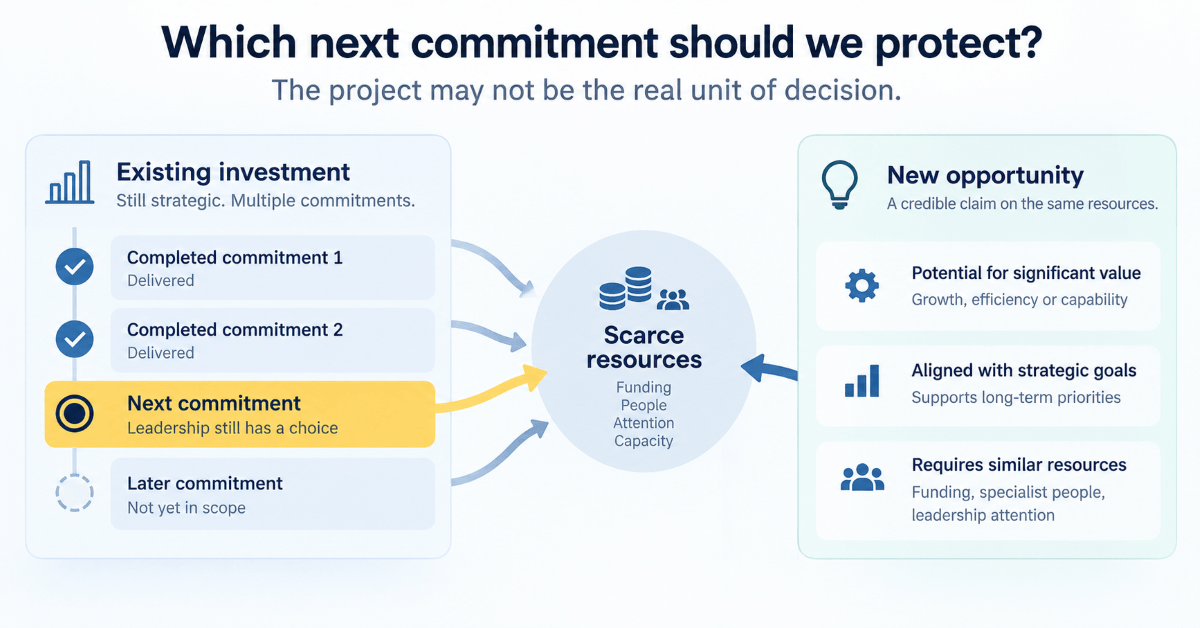
Still worthwhile is not the same as still worth protecting to the same extent
Finance already understands that a positive standalone investment case does not settle capital allocation; as the CFA Institute notes, a project can be profitable on its own while still being uneconomic against alternatives or from the firm's broader strategic perspective.1
The harder issue is what happens after approval, when the incumbent still passes its own test.
There are now two different questions:
Is this investment still worthwhile?
and:
Given today's alternatives and constraints, should it still receive this amount of resource, at this pace and in this form?
The first answer can be yes while the second remains uncertain.
In the supply-chain example, nothing has to change inside the transformation for the allocation question to change. The remaining rollout can still be valuable. The new customer opportunity can also be valuable. The real problem is that both need some of the same scarce capability over the same period.
This is not a clean-sheet comparison. Contracts, dependencies, completion value and the practical ability to redeploy capacity still matter.
But the incumbent does not have to deteriorate first.
The original decision can still be right
An approval is made with the opportunities, constraints and information leadership has at the time.
Later, the investment itself may remain broadly unchanged while the comparison around it changes. A new opportunity becomes executable, funding tightens, a scarce capability becomes the limiting factor, or another commitment now needs resources that were not part of the original choice.
That does not make the first decision wrong. It means today's decision is being made inside a different comparison.
Giroud and Mueller's research on internal resource allocation shows the underlying mechanism: when an investment opportunity improved in one part of a financially constrained firm, headquarters reallocated capital and labour elsewhere.2
When a real constraint binds, an improved opportunity somewhere can change resource allocation elsewhere.
The original approval explains why the existing investment deserved resources then. It does not settle every future commitment of funding, capacity and attention under materially different conditions.
The current comparison must include the consequences of changing course
An active investment is not simply another option on a spreadsheet.
The organisation may have supplier commitments, completed enabling work, dependencies, teams already assembled and business units preparing for the next stage. Slowing or reshaping the work can therefore create real losses that belong in today's decision.
That is different from allowing sunk expenditure to dictate the answer.
The useful distinction is between:
- what has already been spent and cannot be recovered; and
- consequences that exist now because of previous commitments.
Investment theory makes a related point: once commitments become difficult to reverse, future choices are not equivalent to those available before the investment began.3
So leadership should not compare the incumbent with the new customer opportunity as though the organisation were starting from zero.
Suppose the core supply-chain platform is already contracted and the next six months of enabling work unlock substantial value from what has been built. Stopping that work may destroy value.
But suppose the next geographic rollout has not yet begun, and the scarce operations and data team assigned to it might be redirected for six months.
Deferring the rollout could delay benefits in a major geography, create remobilisation cost and push value realisation into the next planning cycle. Redirecting the team may also create more disruption than leadership first assumes. Establishing what can genuinely move without destroying too much value is part of the decision, not a given.
Now the distinction becomes practical.
Some of the incumbent is effectively fixed.
Some of it remains genuinely open to change.
And the decision is about the part that can still change.
When should leadership reopen the question?
This is not an argument for reopening every commitment whenever something new appears. Stable execution matters. But allowing yesterday's allocation to persist automatically after the decision itself has changed creates the opposite problem.
A meaningful reconsideration needs three things.
1. The comparison has materially changed
Something must have changed enough that the preferred use of a genuinely constrained resource could plausibly differ.
In the example, the customer opportunity has moved from possibility to an executable option, and it requires some of the same scarce capability as the next transformation rollout. Identifying what is genuinely constrained matters: budget and headcount totals can conceal specialist skills, operational demands and decision bottlenecks that limit the choices leadership can actually make.
The test is not:
Did something change?
It is:
Could this change alter what we would choose to support from the resources that are actually constrained?
2. A commitment is approaching that will reduce flexibility
This condition answers why now?
A decision point exists when an approaching commitment will materially narrow future choices.
That may be signing a supplier agreement, starting a rollout, allocating a scarce team, committing the next funding tranche or taking another step that is expensive to reverse.
In the example, the relevant point is not the original transformation approval two years ago.
It is the decision to commit the scarce team to the next rollout now.
A formal review point and a real economic decision point are not necessarily the same thing.
The practical implication is not another review cycle. It is to surface the choice before the next commitment makes meaningful alternatives materially harder to pursue. A scheduled committee can meet when little remains contestable, while a genuine loss-of-flexibility point can arise between formal gates.
What decision becomes unavailable, or materially more expensive, if we do nothing before the next commitment?
3. Materially different feasible choices still remain
This condition answers is there actually a choice?
A large future expenditure is not necessarily a large current decision. What matters is whether leadership still has meaningful discretion over what happens next.
In the transformation example, the core platform and enabling work may be effectively fixed. But the next rollout date and the deployment of a scarce team may still be changeable.
That leaves materially different feasible choices:
- protect the rollout as planned;
- defer it for six months and redirect the scarce team;
- narrow the rollout while preserving the core work;
- or reshape the customer opportunity instead.
If almost nothing remains changeable at tolerable cost, there may be little allocation decision left. That is a boundary condition, not a reason to assume the incumbent normally wins.
The important point is the conjunction:
Reopen the decision when all three are true:
- The comparison changed.
- Flexibility is about to narrow.
- Meaningfully different choices still remain.
Without all three, reopening may create more noise than value.
With all three, simply carrying the previous allocation forward is itself a decision.
The next commitment is often the useful unit precisely because it is where the changed comparison, approaching loss of flexibility and remaining discretion meet.
The better unit of decision is often the next commitment
The supply-chain transformation can remain strategically valid and still receive different protection.
Leadership might decide to protect the core platform and the enabling work already under way, defer the next rollout despite the cost of delay, and temporarily redirect the scarce operations and data team to the customer opportunity.
Nothing about that decision says the transformation was a mistake.
Nor does it say the new opportunity was automatically better.
It says the organisation chose a different combination of commitments from the point where meaningful discretion still existed.
Leadership may therefore be comparing different combinations of commitments, not deciding which whole investment wins.
Protection is divisible. Leadership can preserve some commitments while changing the timing, scope, capacity or conditions attached to others.
That is why the better unit of decision is often not the project.
It is the next commitment within it.
A positive overall business case can justify continuation without settling every subsequent commitment the investment entails.
The same logic extends beyond transformation programmes. A facility expansion may remain attractive while leadership delays one construction phase. A market-entry investment may remain strategically sound while the next tranche of commercial capacity is redirected. A major customer commitment may still be worth pursuing while its timing or delivery scope changes.
The goal is a better current decision, not more movement
Resource reallocation can create value, but movement itself is not the objective. McKinsey analysis over a 15-year period associated greater resource reallocation with higher shareholder returns, although heavier reallocators could underperform more stable peers over shorter horizons.4 More recent work cautions that large, discontinuous reallocations can carry performance costs.5
The practical distinction is between stable execution between real decision points and automatic continuation when the decision itself has changed. The question is whether the current protection still survives the comparison leadership needs to make now.
What should we still protect from here?
Sophisticated organisations already have investment committees, stage gates, forecasts and portfolio reviews. The problem here is narrower.
An existing commitment still makes sense. Another credible claim now competes for the same constrained resources. Something consequential is about to become harder to reverse. And materially different feasible choices still remain.
At that point, the useful question is:
Given what is genuinely changeable, the other claims now competing for the same constrained resources, and the real consequences of changing course, what should we still protect from here?
There is no automatic answer in favour of the incumbent or the challenger.
The decision is not whether the original investment was right.
It is which commitment leadership is choosing to protect next.
Are you reconsidering an existing commitment because something else now needs the same resources?
If an existing investment still makes sense but its current scope, pace or resource protection may need reconsidering, a Decision Review is a 30-minute confidential conversation to explore whether TransparentChoice could help.
You do not need to share sensitive details. We can start with the situation at a high level: what kind of decision you are facing, where the tension sits, and what you are trying to work out. You can share as much or as little detail as you feel comfortable with.
If there appears to be a fit, we can discuss what deeper analysis might involve and what information, if any, would be useful later.
There is no fee, no data preparation and it is not a software demo.
See whether a Decision Review would be useful.
References
- CFA Institute, "Capital Investments and Capital Allocation", 2026. ↩
- Xavier Giroud and Holger M. Mueller, "Capital and Labor Reallocation within Firms", The Journal of Finance, 2015. ↩
- Robert S. Pindyck, "Irreversibility, Uncertainty, and Investment", Journal of Economic Literature, 1991; NBER working paper version, 1990. ↩
- Stephen Hall, Dan Lovallo and Reinier Musters, "How to Put Your Money Where Your Strategy Is", McKinsey Quarterly, 2012. ↩
- Tomoki Hayata, "Pacing and Path Dependence: How Strategic Consistency in Capital Reallocation Shapes Firm Performance", Journal of Business Research, 2026. ↩