
NHS Capital Planning 2026/27: A Longer Horizon Is Not a Settled Programme

The NHS in England employs more than 1.5 million staff and is one of the world's largest employers, making a significant change in how it plans capital worth examining closely. 1
For 2026/27 to 2029/30, NHS England is allocating operational capital envelopes directly to individual providers for the first time, with firm operational capital allocations through 2029/30, planning assumptions for a further five years, and a requirement to submit four-year capital plans. 2
Multi-year NHS capital allocations and forward planning are not new. 3 What changes is that individual providers now have a longer and firmer horizon within which future capital choices are represented.
This sits within a broader move towards longer-term capital certainty. DHSC's 10 Year Capital Plan says longer-term certainty should support providers and systems to “plan confidently over longer-term horizons”. 4
That longer horizon creates a practical question for boards: how should they use the extra visibility without allowing future choices to harden before they need to?
The opportunity: use that horizon as a sequence of decision points, not simply as a set of future years to fill. Boards can commit enabling work early where later investments depend on it, while keeping downstream choices open where uncertainty still matters.
The risk: once a scheme has a year and an expected allocation in the programme, it can gradually acquire the status of a commitment before leadership has deliberately decided that it should.
A capital scheme appearing in a multi-year capital plan does not necessarily tell the board how final that decision should be.
Operating well in this environment therefore requires a distinction between planning status and decision status.
In brief
- A longer capital horizon is not the same as a settled programme. A scheme can appear in the plan without being equally final or irreversible.
- The key judgement is when choices should become commitments. Commit too early and useful flexibility disappears; commit too late and capacity, dependencies, cost or benefits may suffer.
- Where genuine choice remains, compare programmes, not just individual schemes. The decision includes what proceeds, what waits and what remains exposed.
- Make decision status visible. Boards should be able to see what is committed, what remains open, why, and what could cause a later-year choice to change.
Separate planning status from decision status
NHS England says plans for 2026/27 and 2027/28 are expected to “fully commit operational capital allocations”, while final plans for later years should include at least 80% of operational capital allocations. 2
The same guidance also allows providers and ICBs to over-programme operational capital by up to 5% at plan stage, provided there is a clear plan for elements to be scaled back or deferred if necessary. That flexibility does not apply to national programme capital. 2
That sets an expectation for how much of the allocation should be committed in the submitted plan. It does not, by itself, mean that every underlying scheme is contractually irrevocable or equally difficult to change.
That is the distinction between planning status and decision status.
Planning status describes how a scheme appears in the multi-year programme: for example, the year in which it is expected to proceed and the allocation associated with it.
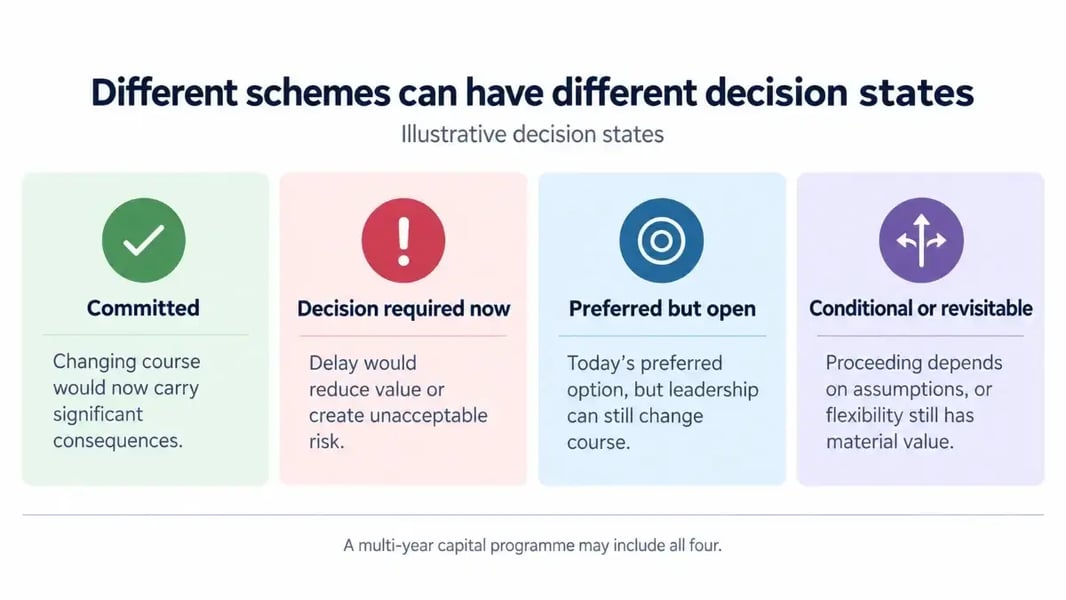
Decision status describes how far the underlying choice has actually progressed: whether it is already committed, requires a decision now, remains preferred but open, or is still conditional or revisitable.
A useful practical test is to ask what would happen if leadership changed course today. Would significant expenditure be lost? Would contracts, delivery capacity or dependencies be disrupted? Would delay itself destroy value or create unacceptable risk?
For practical board discussion, it can be useful to distinguish four decision states:
- existing commitments, where changing course already carries substantial consequences;
- decisions required now, where delay would itself destroy value or create unacceptable risk;
- preferred but still open choices, where the programme reflects today's best judgement but leadership can still change course;
- conditional or revisitable choices, where proceeding depends on assumptions or where retaining flexibility still has material value.
The key point is that decision status should not be inferred from where a scheme appears in the programme.
Making it explicit lets leadership see what can still change, what cannot, and where flexibility is approaching the point at which it will disappear. This can be shown through existing capital papers, approvals and review points.
Treat commitment timing as a decision
Keeping every future choice open would be as unhelpful as fixing every choice early.
Early commitment can secure scarce delivery capacity, preserve dependencies, address safety risks, avoid rising costs or prevent benefits being delayed.
But committing too early can lock the organisation into a scope, sequence or assumption before important uncertainty has resolved.
So the risk runs in both directions:
- commit too early, and useful flexibility disappears before leadership needs to surrender it;
- commit too late, and the organisation may lose capacity, increase costs, disrupt dependencies or delay benefits.
The real judgement is:
Where does committing now create more value than retaining flexibility, and where is the flexibility still worth preserving?
This is consistent with the Green Book's treatment of sequential decisions, including choices that are “irrevocable or expensive to reverse”, and of flexibility that can be exercised as new information emerges. 5
A Year 3 scheme may need procurement or development decisions long before most of its expenditure occurs. Another Year 3 scheme may be better kept conditional until a dependency, service requirement or cost assumption becomes clearer.
The longer horizon allows boards to plan the timing of commitment rather than allowing choices to harden passively.
The objective is deliberate commitment, not maximum flexibility. If a previously worthwhile scheme later faces a stronger competing claim, Capital Allocation: Revisit Existing Investment looks at three conditions for reopening the allocation, centred on the next hard-to-reverse commitment.
Where genuine choice remains, compare programmes rather than schemes
An individually worthwhile scheme does not establish that the programme containing it is the preferred use of constrained capital. The Green Book similarly recognises the need to consider projects and programmes in aggregate when appraising options. 5
Where genuine discretion remains, compare a small number of credible programmes under the same real constraints. Two or three materially different alternatives may be enough.
For each alternative, make clear:
- what proceeds, waits or changes scope;
- what leadership protects and what remains exposed;
- the combined capital, revenue, delivery and dependency consequences;
- what is committed now and what remains open;
- which assumptions could make another programme preferable.
The purpose is not to identify a universally “best” programme. It is to make the trade-off visible enough for leadership to choose deliberately.
How to operate in a longer-horizon environment
For each material later-year choice, the board should be able to see:
- its decision status and why that status is appropriate now;
- the credible alternative, where genuine choice remains, and how its consequences differ;
- what could change the decision and when that condition will be reviewed.
1. What genuinely needs to be committed now?
Separate what is already committed from what merely appears in the plan.
For anything leadership proposes to fix early, ask:
- What value does committing now create?
- What happens if the decision is delayed?
- What flexibility disappears once we commit?
- Is that trade worth making now?
A later-year position in the programme should not answer those questions by default.
2. If the choice is still open, what materially different programme could we choose?
Any alternative must fit the same capital, revenue, approval and delivery constraints. Those constraints may sit outside the capital envelope itself; Beyond Headcount and Budget looks at specialist skills, operational dependencies, governance, infrastructure and other forms of capacity that can become binding.
Then compare consequences:
- What would another programme protect?
- What would it defer or leave exposed?
- What funding or capacity would it consume or preserve?
- Which dependencies would change?
If there is no genuinely different feasible alternative, there may be no meaningful programme-level trade-off left to make.
If alternatives remain, leadership should be able to explain why it prefers one pattern of consequences to another. The RNLI case study shows this kind of choice in another safety-critical setting: existing and new initiatives competed for scarce specialist capacity, several credible portfolios were compared, and the portfolio was later rebalanced when priorities changed.
3. What would cause us to reconsider a later-year choice?
Calling something conditional or revisitable is not enough.
Identify:
- the assumption, event or threshold that could change the decision;
- when it will be reviewed;
- who will see that the condition has changed;
- whether changing course will still be realistic at that point.
A review point has value only if it can still change the decision. Where appropriate, funding, approval or delivery milestones can act as genuine decision gates before further capital is committed, with the ability to continue, defer, rescope or stop.
Those gates should also force a fresh look at the case for continuing as evidence accumulates: what has been learned, which assumptions still hold, whether expected benefits remain credible, and whether the next commitment is still justified. For a deeper discussion of staged funding and post-initiation continuation review, see our Portfolio Management: Influencing the Weather? webinar with Steve Jenner and Stuart Easton.
A review scheduled after contracts, dependencies or delivery decisions have already closed the option does not preserve meaningful flexibility.
Identifying uncertainty is not the same as governing it.
Make the decision status visible
A useful multi-year capital programme should show not only where capital is expected to go, but what is fixed, what remains open, why, and what could change it.
That is the opportunity created by a longer horizon: not simply to plan expenditure further ahead, but to make future decision points visible before they disappear.
A longer funding horizon is not a settled programme.
Where capital choices remain open
Some decisions can be worked through in existing capital papers and governance. Where several workable programmes remain, leadership may need to compare what each would protect, defer or leave exposed.
TransparentChoice helps leadership teams compare feasible alternatives against their priorities, funding, capacity and other constraints, so they can see what each choice protects, defers or leaves exposed.
If your board is working through a similar choice, we can explore it together in a 30-minute Decision Review. There is no fee, the conversation is confidential, and no preparation or sensitive project details are needed.
References
- NHS England, "Review of NHS performance and delivery", published 27 March 2025. ↩
- NHS England, "Capital guidance 2026/27 to 2029/30", published 17 November 2025 and updated 11 February 2026. ↩ ↩ ↩
- NHS England, "Capital guidance update 2024/25", published 3 May 2024 and updated 29 January 2025. ↩
- Department of Health and Social Care, "10 Year Capital Plan for Health and Social Care", published 8 July 2026. ↩
- HM Treasury and Government Finance Function, "The Green Book 2026", updated 5 February 2026. ↩ ↩
💚 If you enjoyed this article, please consider following us. It’s a small gesture that means a lot to us and encourages us to keep sharing what we learn. See the ways to follow us below ↓