
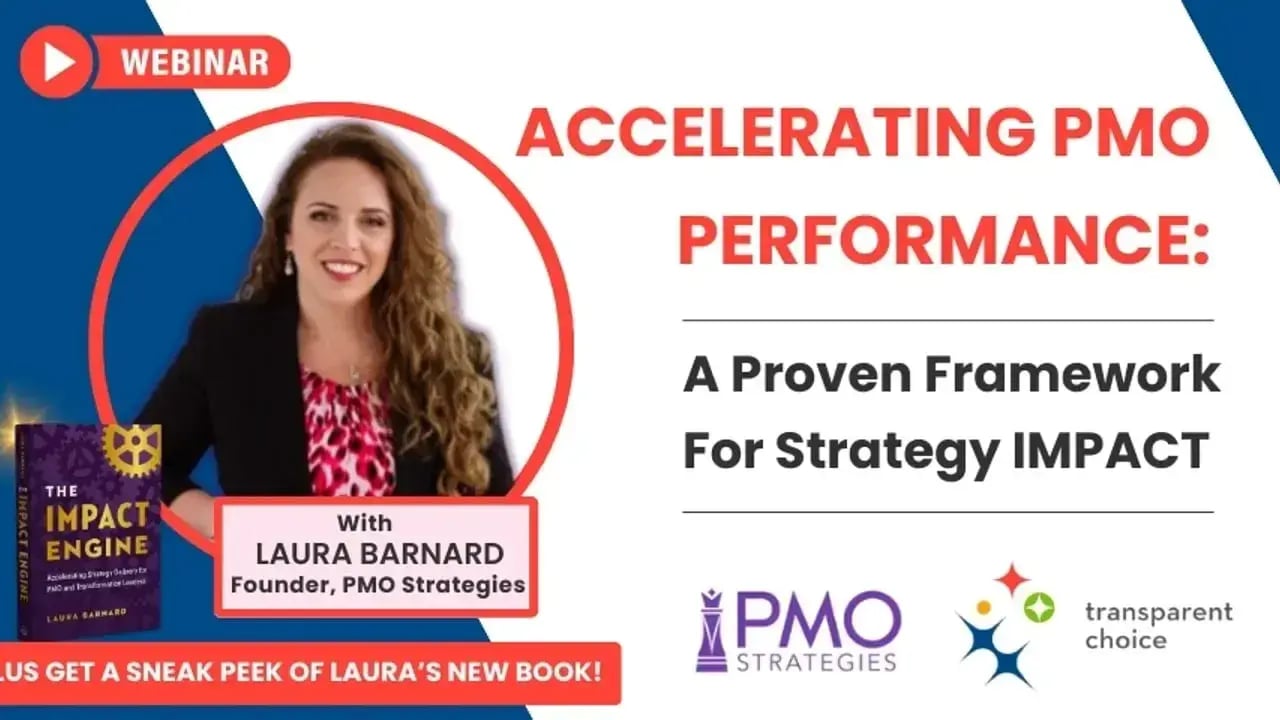
Accelerating PMO Performance: A Proven Framework for Strategy IMPACT
About this webinar
Laura Barnard's central argument is that PMOs earn credibility by solving business problems, not by leading with project-management process.
Laura joins Stuart Easton to explain the six-stage IMPACT Engine System and how PMO leaders can move from stakeholder pain to strategy delivery and visible business impact.
What you'll hear
- Start with the business problem. Laura argues that executives care less about PMO templates, processes and technical expertise than whether the PMO helps solve problems they care about. Understand stakeholder goals, pain points and root causes first, then shape what the organisation needs from its PMO around them.
- Work across the whole strategy lifecycle. Laura connects Strategy Definition, Strategy Execution and Strategy Realization, arguing that PMO leaders need to engage before projects start and stay connected through to the outcomes the organisation is trying to create.
- Look upstream when resources appear to be the problem. When everything is treated as a priority and too much work starts at once, Laura argues that the underlying issue may be prioritisation rather than simply a shortage of people. That changes the question to which work should receive scarce resources.
- Use 90-day cycles with 30-day checkpoints. Laura describes a delivery and reporting rhythm designed around the monthly and quarterly cycles executives already use, creating regular opportunities to show progress, learn and adjust.
- Lead with outcomes, not methodology. Laura advises against naming a PMO after Agile, Waterfall or another methodology. She suggests letting executives name it, because the name they choose is more likely to reflect the results they expect from it.
Book update: The recording refers to The IMPACT Engine as a forthcoming release. The book is published and available in hardcover, ebook and audiobook formats.
How this connects to TransparentChoice
Laura explicitly points to TransparentChoice's software when she describes executives trying to fit more projects into the organisation than available resources can support. Later, she says she uses AHP and pairwise comparison with clients to reduce the influence of the “squeaky wheel”; one client told her the process helped them have conversations they should have been having all along.
TransparentChoice still uses AHP and pairwise comparison to structure leadership judgement. The resulting priorities can then be considered alongside funding, capacity and other modelled constraints to compare feasible portfolio choices.
Learn more
Join the next live webinar

Explore more webinar recordings
Continue with practical discussions on portfolio decisions, prioritisation, capacity, strategy and delivery. Explore the webinar library.
Speakers

Laura Barnard, PMP, CAL, Prosci, IES is the Founder and CEO of PMO Strategies and author of The IMPACT Engine: Accelerating Strategy Delivery for PMO and Transformation Leaders. Recognized as the 2021 World PMO Influencer of the Year, she has nearly three decades of experience helping organizations close the strategy-to-execution gap. Laura is also host of the PMO Strategies Podcast and Co-Founder of Project Management for Change, where she champions raising the profile of project management worldwide.

Stuart Easton is Founder & CEO of TransparentChoice. He works with leaders and portfolio teams on decisions about which investments and initiatives to fund, continue, change, defer or stop when priorities compete for limited funding and capacity. His work combines structured decision-making with practical portfolio choices.