
Breaking the Cycle of Overload: How PMOs Move from Firefighting to Strategic Leadership
About this webinar
Leadership says “just get it done”, but the portfolio is already overloaded. What if the firefighting starts with the decisions being made above delivery?
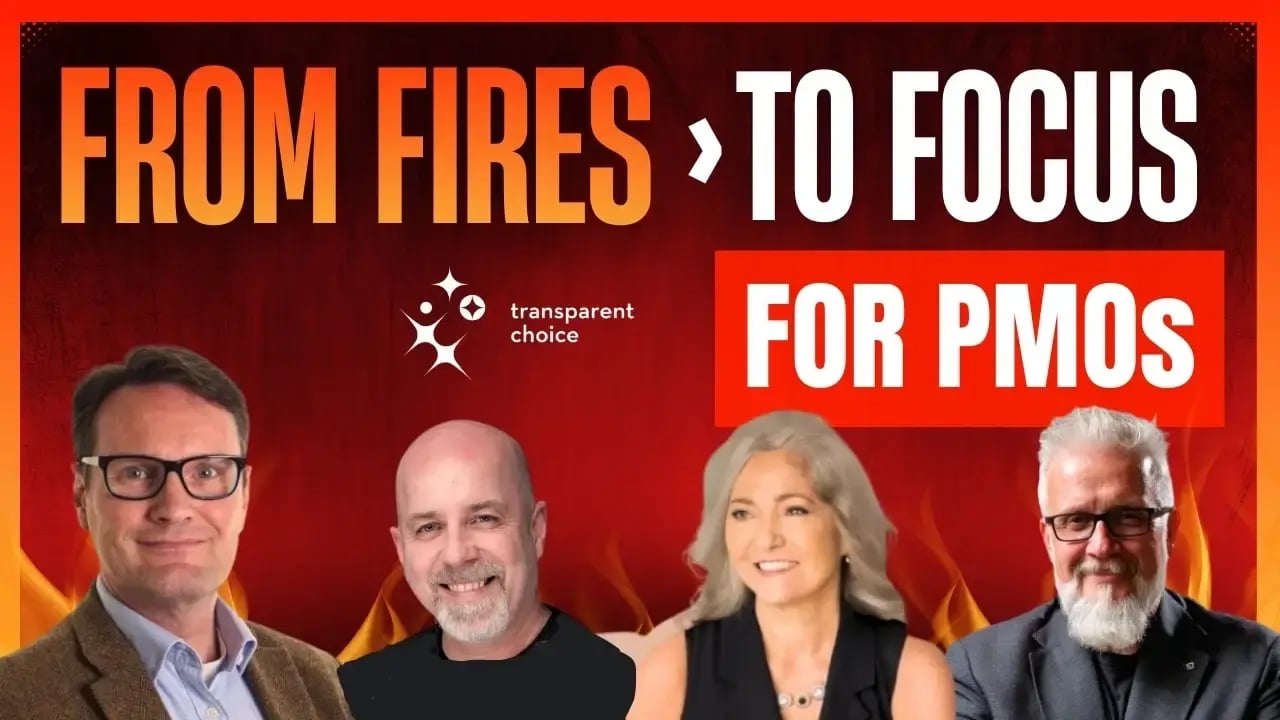
Rebecca Reynolds, Mike Hannan, Frederic Casagrande and Stuart Easton look at the gap from both sides. Rebecca describes leadership as the head, delivery as the body and communication between them as the connection that has to carry clarity both ways. Frederic shows how hierarchy and repeated filtering can distort a business question before it reaches the people expected to act on it. Mike argues that PMO leaders get further by meeting executives on their turf, starting from business objectives and root causes rather than project-management language.
What you’ll hear
- Why firefighting starts above delivery. When executives pull in different directions, the PMO can end up choosing which leader to disappoint, usually the one with the least power. Mike argues that executives rarely realise this is happening below them.
- Too many projects, not too little effort. Stuart recounts an NHS PMO being handed 120 projects and told to “figure it out”; about 20 were completed. His conclusion is that this is a governance and decision-making problem, not a project execution problem.
- Meet executives on their turf. Why asking leaders to experience a “day in the life” of delivery misses the point, and how starting from their objectives, what must become true to achieve them, “how might we…” questions and root-cause analysis can turn a complaint into a shared business problem.
- Getting in when the door is shut. Frederic challenges the assumption that PMO leaders can simply get access to executives, describing cultures where senior leaders may not engage with anyone at VP level or below. The panel explores routes that can work in different contexts: small visible fixes, a head-heart-heartbreak case for change, using failure to expose the root cause, or an outside voice whose message leadership will hear.
Research in context
The panel traces firefighting to leaders pulling in different directions and a weak connection between executive intent and delivery. Independent research finds both problems well beyond this panel.
- Executives name conflicting priorities ahead of talent or finance. In Deloitte’s 2022 survey of 1,364 C-suite executives, 72% cited conflicting priorities as a barrier to expected outcomes from corporate investments, more than cited lack of talent (62%) or finance (56%).
- The sharpest alignment break can happen just below the top team. In MIT Sloan research across 124 organisations published in 2018, just over half of top-team members in the typical organisation could list its strategic priorities, falling to 22% among the executives reporting directly to them. Top teams also rated their organisation’s strategic alignment higher than managers below them did, on every measure.
How this connects to TransparentChoice
The panel’s sharpest point is that when leaders pull in different directions, the PMO ends up deciding by default whose priority wins. TransparentChoice puts that choice back in front of leadership.
Leaders can weigh what matters independently or together, so differences in priorities become visible before resources are committed, rather than surfacing later as competing demands on delivery. Those priorities are then tested against funding and against capacity by role, skill or team, to show which combination of work the organisation can actually support, what has to wait, and when supported work can realistically start.
If an executive insists that a project stays in, the portfolio is recomputed to show what it displaces elsewhere. “Just get it done” becomes a visible trade-off leadership can own.
Learn more
Join the next live webinar

How do you turn the diagnosis into a case leadership will act on?
In The PMO Value Leak: Find It, Show It, Fix It, Rebecca Reynolds joins Ben Chamberlain and Fadi Bayoud to show how to find where value is leaking, put it in leaders’ terms and bring strategy, finance and operations into one executive case.
What does overload actually do to portfolio flow?
In The Most Valuable Portfolio Management Skill They Never Taught You, Mike Hannan and Stuart Easton go deeper into bottlenecks, utilisation and staggered starts, and why starting work differently can change how work moves through a constrained portfolio.
What if budget and headcount are not the real capacity limit?
Rebecca Reynolds’ deeper look at organisational capacity covers scarce skills, operational dependencies, governance, infrastructure and social licence that headline resource numbers can miss.
Speakers

Frederic Casagrande is a strategic leader with 25+ years in project, program, and portfolio management. He has directed multi-billion-dollar portfolios, led diverse teams, and delivered transformation across sectors from nuclear energy to technology. An award-winning PMO leader, he is recognized for bridging strategy and execution and developing project management talent.

Rebecca Reynolds is a reinvention expert, systems innovator, and author with over 30 years of experience guiding leaders and organizations through large-scale transformation. She has developed and applied innovative models for advancing change capability across government, non-profits, and communities. Her new book, Thresholds of Change: The Way Through Transformational Times, distills her proven approach to navigating disruption with clarity and confidence.

Mike Hannan is a co-author of the PMBOK® Guide – Eighth Edition and lead author of The CIO’s Guide to Breakthrough Project Portfolio Performance. He brings more than 25 years of project management experience across portfolio, programme, process and technology roles, including work with government agencies and Fortune 500 companies.

Stuart Easton is Founder & CEO of TransparentChoice. He works with leaders and portfolio teams on decisions about which investments and initiatives to fund, continue, change, defer or stop when priorities compete for limited funding and capacity. His work combines structured decision-making with practical portfolio choices.