
Bridging the Strategy–Execution Gap
About this webinar
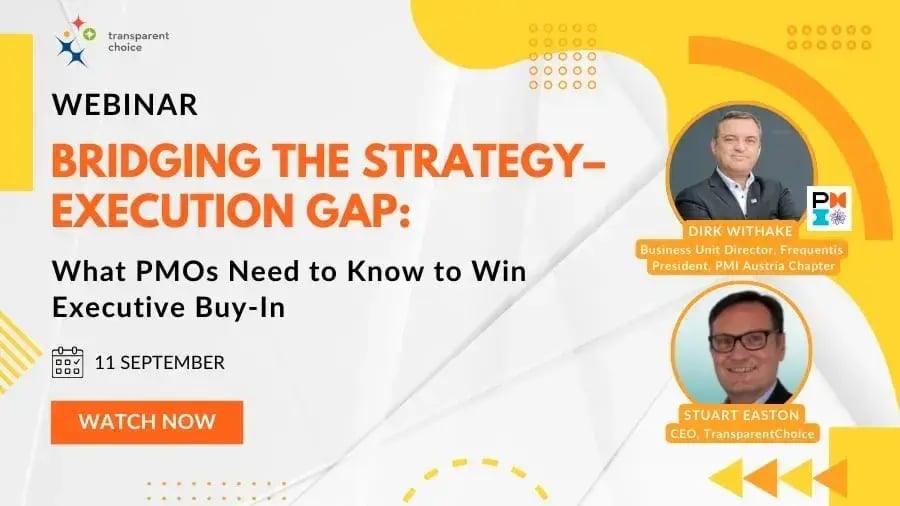
Stuart Easton sits down with executive leader Dirk Withake to explore how organisations can bridge the gap between strategy and execution. They discuss why strategy means deciding what not to do, how leaders can turn broad goals into an explicit priority order, and why those priorities need to be tested against the funding and capacity available to deliver them.
Drawing on Dirk's experience as both a business executive and a PMO leader, the conversation explores how PMOs can connect strategic goals to portfolio choices, make delivery constraints visible to leadership, and help executives decide what takes precedence when they cannot do everything.
What you’ll hear
- Strategy requires choices about what not to do. A useful strategy does more than describe what the organisation wants to achieve. It establishes what will receive attention and what will not.
- Make relative priorities explicit. Translate strategic direction into goals and compare their relative importance so leadership has a clear priority order when goals compete.
- Use structured comparison to build shared priorities. Pairwise comparisons and AHP can help executives understand different perspectives, test their judgements and develop greater agreement about what matters most.
- Connect priorities to actual commitments. Compare the project portfolio and resource allocation with the stated strategic goals so leadership can see whether what the organisation is funding and supporting reflects what it says matters.
- Treat capacity as part of the decision. Resource bottlenecks, multitasking and capacity constraints that sit behind headline budgets and headcount can undermine an otherwise well-aligned portfolio.
- Make the consequence of adding work visible. Stuart and Dirk discuss a simple technique: when capacity is already committed and leadership wants another initiative, show the existing demands and ask what would have to stop or give way.
The PMO helps leadership make that priority order explicit and connect it to the work the organisation is actually funding and supporting.
Research in context
In a 2022 Deloitte survey of 1,364 C-suite executives, more than 60% selected seven or more of ten listed priorities, and 25% selected all ten.
Dirk makes the same problem concrete in the recording: a list of 17 priorities, he argues, is no priority order at all, because it does not say what takes precedence when funding and capacity cannot support everything.
How this connects to TransparentChoice
TransparentChoice provides a way to carry leadership's agreed priorities into the portfolio decision, so their implications can be tested against actual commitments, funding and capacity.
- Use leadership priorities in the portfolio model. Leaders can set and weight priorities together, using pairwise comparison (AHP) where useful, and initiatives can be assessed against them. That lets the PMO compare the work being supported with what leadership says matters, rather than treating strategic alignment as a label.
- Compare combinations that fit funding and capacity. Existing commitments and new proposals can be considered together against available funding and capacity, so the PMO can bring leadership feasible portfolio alternatives rather than a priority list that still assumes everything can proceed.
- Show what gives way when something is added. In the recording, Stuart and Dirk make this trade-off visible with resource data and a waterline. In TransparentChoice, the new commitment can be modelled alongside existing work and, if leadership wants it included, the portfolio recomputed to make displaced work or value and the funding and resource implications visible.
TransparentChoice supports the analysis; leadership decides what to commit to. See how the software works.
Learn more
Join the next live webinar

Explore more webinar recordings
Continue with practical discussions on portfolio decisions, prioritisation, capacity, strategy and delivery. Explore the webinar library.
Speakers

An expert in program/PMO/project management across multiple industries, Dirk is the current president of the PMI Austria Chapter and a Business Unit Director (VP of Aeronautical Information Management) at Frequentis AG, leading up to 150 internal and external resources across four locations (Austria, Germany, Czech Republic, Romania).

Stuart Easton is Founder & CEO of TransparentChoice. He works with leaders and portfolio teams on decisions about which investments and initiatives to fund, continue, change, defer or stop when priorities compete for limited funding and capacity. His work combines structured decision-making with practical portfolio choices.