
Unlocking the secrets of high-impact PMOs
About this recording
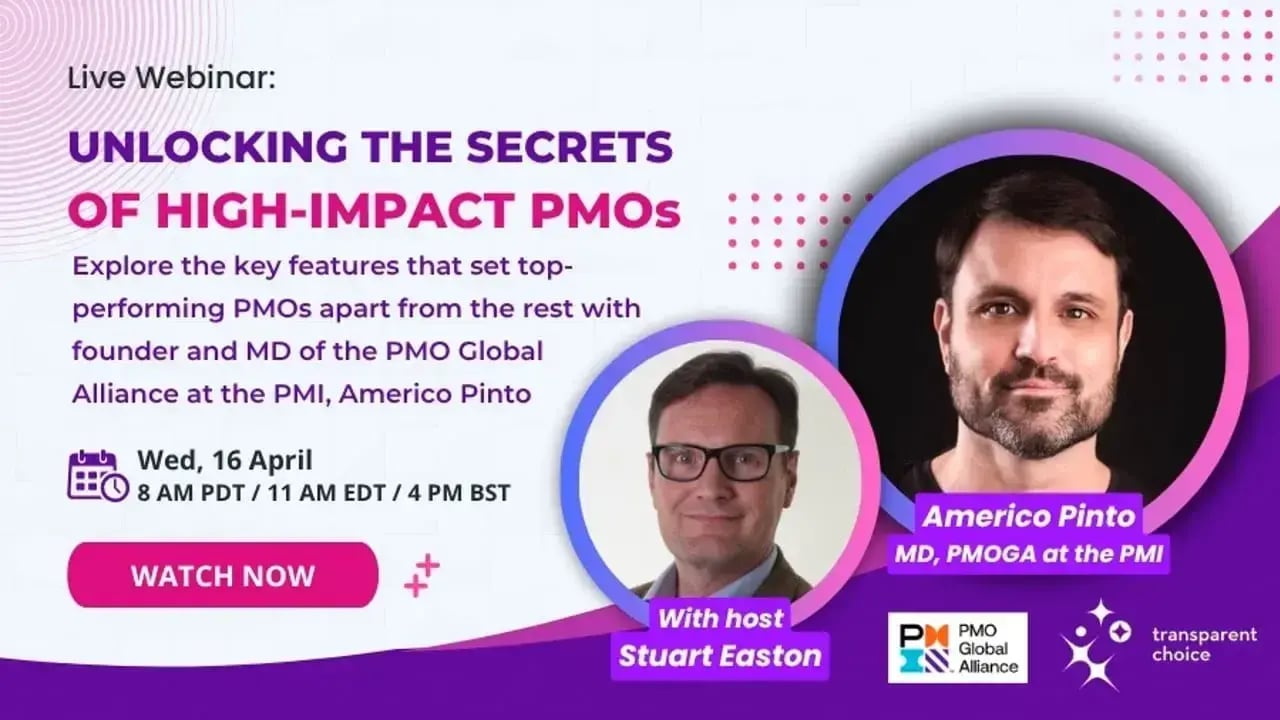
A PMO can deliver an excellent service and still solve the wrong problem. That is the challenge Americo Pinto puts at the heart of this conversation with Stuart Easton.
Drawing on the experience behind PMI's PMO Practice Guide, Americo describes a forest of very different PMOs. There are common lessons to learn, but no single PMO operating model to copy. He also discusses how the PMO Global Alliance community helps practitioners learn from one another.
What makes a PMO valuable to the people it serves?
- Diagnose before prescribing. Americo compares PMO services to medicine: even the best treatment is useless if it addresses the wrong pain. Start with the customer's problem, not a predefined menu of services.
- Look at value across different customers. A service that helps executives may create extra work for project managers. Producing a useful output is not the same as delivering a benefit that stakeholders recognise, and the effects on different customers need to be understood together.
- Question whether every PMO should be strategic. Stuart proposes maximising portfolio ROI as a unifying PMO purpose. Americo challenges that assumption: operational and tactical services can also create genuine value when they meet the organisation's needs.
- Design the right services before automating them. Americo distinguishes PMO leaders, who must understand needs and design tailored solutions, from project managers focused on delivery. AI may make existing services faster, but speeding up a service that solves the wrong problem does not make it valuable.
Research in context
500 PMOs, no universal template
Americo's argument against copying another PMO has an interesting parallel in research. In a study of 500 PMOs, Brian Hobbs and Monique Aubry found wide variation in structures and functions. Familiar characteristics such as industry, geography and organisational size did not produce consistent PMO types.
The practical implication: knowing what kind of PMO worked elsewhere is not enough to design yours. Hobbs and Aubry argue for starting with the host organisation and its leadership's view of how it should operate. That reinforces the importance of understanding context before choosing a model, while Americo takes the discussion further into diagnosing customer problems and selecting services.
Source: Hobbs and Aubry (2008), What research is telling us about PMOs, PMI Global Congress.
How this connects to TransparentChoice
Americo gives a revealing example: a PMO produces a map connecting projects to strategy, yet executives still cannot make the decisions they need to make. The information may be useful, but the decision remains unresolved.
When that decision is about which initiatives to support with limited funding and capacity, TransparentChoice can help. It structures leadership's judgement about competing priorities, evaluates feasible combinations of initiatives against constraints, and makes it possible to compare what receives support and what gives way. Leadership makes the final choice.
Learn more
Which PMO services should you actually provide?
Turn Americo's diagnosis-first principle into a practical service-selection exercise. This article organises PMO services into three groups, shows how to select them around real organisational problems, and explains why the service mix should be revisited as needs change. Read: PMO Service Catalogue Template.
How do you earn executive trust without becoming project police?
Continue the discussion about competing PMO customers with a practitioner panel on the tension between leadership decisions and delivery-team trust. Hear why ranking 800 projects changed no commitments, and how shared capacity, governance and stakeholder involvement affect the PMO's credibility. Watch: From Project Police to Strategic Partner.
Speakers in this recording

Americo Pinto is a globally recognized thought leader in the Project Management Office (PMO) domain and Managing Director of the PMO Global Alliance at PMI. With over 25 years of experience as an executive, consultant, author, and speaker across four continents, he has shaped PMO practices worldwide. Founder of the PMO Global Alliance, now part of PMI, Americo has been honored with the PMI Distinguished Contribution Award and holds multiple certifications, including PMP, PMO-CP, PMO-CC, and IPMA-A.

Stuart Easton is Founder & CEO of TransparentChoice. He works with leaders and portfolio teams on decisions about which investments and initiatives to fund, continue, change, defer or stop when priorities compete for limited funding and capacity. His work combines structured decision-making with practical portfolio choices.