
Noise in Decision-Making: Your decisions undermined daily!

This isn’t the usual article about decision-making. You know the type; “you need better data so invest in Big Data” or “ artificial intelligence is the answer to everything.” No, it’s about how your people are making it impossible to make reliable decisions… and you probably don’t even realize it.
All because of something called Noise.
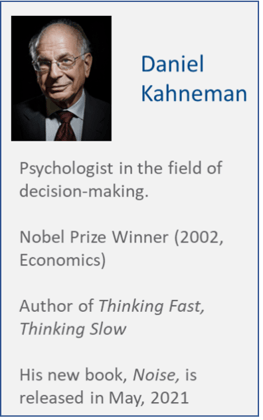
Every decision is a judgement call that requires professionals and leaders to balance competing needs, assess risk and uncertainty and to come up with… an answer! Every major business decision involves judgement, and as Nobel Laureate, Dan Kahneman says, “Wherever there is judgement there is Noise – and usually more of it than you think!”
 Noise is the randomness in decision-making.
Noise is affecting all levels of your organization today.
Noise means that even the best decision-makers are only as good as the Noise allows them to be.
Noise can be “turned down” and doing so will significantly reduce both the risk and the waste in your organization.
What is Noise?
In Noise, published in 2021, we learn about “Noise”.
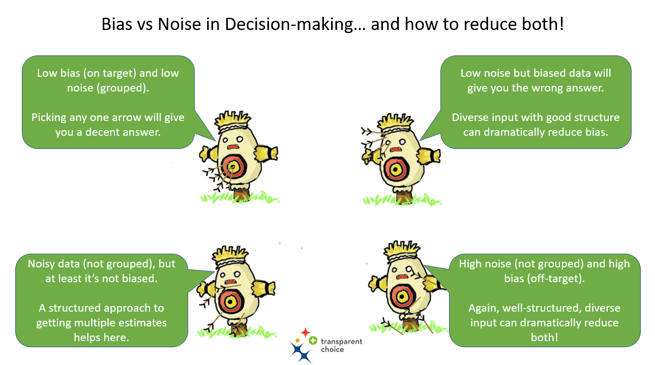
We’ve all heard about bias in decision-making. Noise is every bit as insidious, but is less well understood by most managers. This picture shows the difference between noise and bias and gives an idea how to fix both.
Noise is a very real issue. Kahneman cites¹ software developers who were asked to estimate a particular task on two separate days. On average, the estimates varied by 71%. That difference is Noise and it totally undermines the “accuracy” of decision-makers.
Another example from Kahneman’s book (Noise, released in May 2021) is in the area of insurance underwriters. Managers were willing to accept up to 10% difference between the estimates of risk from different underwriters.
But the real difference in estimates was 55%.
That is Noise in action. It was totally invisible, but represented a heavy drag on the organization’s performance.
6 things you need to know about Noise and how to reduce it
1. Noise is Killing Your Bottom Line TODAY
So, Noise is real and it’s really messing with your decisions, right now, right across your organization. And it’s costing real money. Kahneman estimated the cost, on one decision-type in a financial services company, as billions of dollars. That hurts!
2. Noise is Usually Invisible
At a global engineering company we worked with, different engineers scored a particular project for complexity. Half gave it the lowest possible score while the other half gave it the highest possible score.
Often Noise is invisible. We all assume that our professional’s estimates are accurate – of course we do – but the data tells us they are not. We all trundle along, therefore, making good decisions based on faulty input and don’t even know it.
3. Do a Quick Noise Audit
You can do a quick Noise Audit. Simply ask different experts to make the same judgement and if you get different answers, you have a noise problem.
4. Noise is Randomness in Decision-making
Your best decision-makers are only as good as the input they get. If your estimates have a significant level of randomness, and the data tells us they do, then your decisions are being shuffled like cards in a deck undermining business outcomes.
5. You CAN Reduce Noise
Getting multiple people to make a judgement can help reduce both bias and Noise. By comparing “estimates”, and by discussing them, you can usually identify a more balanced and reliable estimate.
6. Judgements Must be Independent
Don’t estimate anything as a group. Group dynamics kick in and reintroduce bias and Noise into the process. Make sure your “analyses” are independent by getting people’s judgements BEFORE talking them through as a team.
Flag-waving
Normally in these posts, I don’t talk too much about TransparentChoice, but this is different.
TransparentChoice provides collaborative decision-making software that helps reduce Noise and bias in decision-making. Kahneman’s book could have been written about us – it wasn’t; we have no relationship to the learned Professor – because his “tips” for reducing noise fit our software perfectly (or the other way around).
TransparentChoice's software is based on the Analytic Hierarchy Process (AHP), a renowned decision-making methodology. AHP offers a structured framework for evaluating alternatives and reducing the impact of noise in decision-making. By utilizing AHP principles, TransparentChoice empowers organizations to make informed decisions with reduced noise and increased accuracy. To learn more about the Analytic Hierarchy Process and how it can effectively mitigate noise, explore our comprehensive Guide to Analytic Hierarchy Process.
1. https://hbr.org/2016/10/noise