
How to Identify YOUR PMO's Value Proposition
About this webinar
What should your project management office (PMO) actually do for your organisation? In this conversation, Hussain Bandukwala, then of Parwaaz Consulting, joins Stuart Easton to explore why a PMO's value proposition must start with what its stakeholders need, rather than a standard list of services or someone else's successful PMO model.
Hussain challenges the assumption that value must always be expressed in financial or numerical terms. He recalls a PMO leader in Toronto who wanted more quantitative performance measures, while her organisation cared more about qualitative contributions. His point is that the PMO must understand what its stakeholders genuinely value, at that particular time. Its maturity also needs to match the organisation's: a PMO that is too far ahead of it, or behind it, will struggle to be accepted.
When executives ask for a PMO just like one they have admired elsewhere, Hussain argues that they are copying the wrong thing. Instead of reproducing another PMO's structure, they should learn from the process used to discover what that organisation needed.
Hussain's seven-step Discovery Funnel
Hussain walks through a practical framework for discovering, defining and continuing to demonstrate the PMO's contribution:
- Identify stakeholders. Look across organisational levels and functions, not just the senior executives sponsoring the PMO.
- Prepare tailored questions. Ask different stakeholders about the challenges they understand, using open-ended questions rather than prescribing answers.
- Meet and investigate. Speak with stakeholders individually where possible, listen to their concerns and probe the underlying causes.
- Assess and recommend. Group and prioritise the findings, then use PMO expertise to recommend appropriate responsibilities and where to begin.
- Choose meaningful measures. Derive a manageable set of performance measures from those responsibilities, rather than starting with a generic KPI catalogue.
- Build the business case. Explain why the PMO should exist, what it proposes to contribute and how that contribution will be introduced.
- Monitor, communicate and revisit. Show progress and repeat the discovery as organisational needs and priorities change.
If stakeholders complain that projects never finish, the underlying problem could be weak project-management skills, frequent reassignment of resources, inefficient processes or slow leadership decisions. Each would call for a different response. Hussain also explains why he prefers individual stakeholder conversations: quieter people get heard, and the PMO leader begins to recognise potential supporters and sources of resistance.
Listening to stakeholders is not the same as taking orders
Stuart challenges whether executives should dictate the PMO's responsibilities or describe the results they need and let the PMO leader recommend how to achieve them. Hussain agrees, drawing on the idea that organisations should listen to the capable people they hire. Stuart pushes the discussion further, arguing that prospective PMO leaders should establish whether they will have room to exercise that judgement before accepting the role.
Hussain adds an important practical qualification: agreement from every stakeholder may be unrealistic, but the prospective leader can test expectations with their future boss and learn about the organisation's culture during interviews. Even someone leading a PMO for the first time needs to take ownership of the expertise others expect them to bring.
Toward the end, Hussain names problems he frequently finds when setting up PMOs: delivery control, project intake and prioritisation, and visibility of resource commitments. What the PMO should do about them depends on the organisation. He recommends repeating stakeholder discovery as its needs change.
Research in context
PMO structures vary considerably. In a paper presented at PMI's 2008 Global Congress, J. Brian Hobbs and Monique Aubry reported findings from a survey of 500 PMOs worldwide. They found substantial differences in PMO structures and functions. Familiar categories such as industry, geographic region and organisational size did not produce consistent PMO types.
Knowing what another organisation's PMO looks like does not establish what will fit your own. Hobbs and Aubry argued that PMO design should begin with the organisation's circumstances and its leadership's view of how it should operate, rather than a standard model.
How this connects to TransparentChoice
Hussain identifies project intake, prioritisation and resource visibility as problems a PMO might uncover. When that diagnosis reveals more worthwhile work than funding and capacity can support, the question becomes which commitments leadership can actually make, not simply how to rank projects.
TransparentChoice supports that decision. It structures judgements about initiative value, models existing and proposed work against funding and resource constraints, and compares feasible portfolios. Leaders can change priorities or assumptions to see what stays, waits or gives way before deciding what to commit to. See how TransparentChoice software works.
Learn more
Join the next live webinar

How do you turn diagnosed problems into the right PMO services?
A service catalogue gives you options, but it should not become a list of everything your PMO must do. Start with the problems you have identified, then choose a manageable mix of portfolio management, project delivery and Centre of Excellence services. Explore how to choose PMO services
What happens when different PMO customers value different things?
A service executives appreciate might create extra work for project managers. Americo Pinto explores how to understand value across different PMO customers, why one standard operating model cannot fit every organisation and where he disagrees with Stuart Easton about portfolio ROI as a universal PMO objective. Watch the discussion with Americo Pinto
How do you win and sustain executive support for your PMO?
Identifying what the PMO should contribute is only the beginning. Alexander David explains how to develop a living Case for Change, demonstrate early improvements through 90-day cycles and keep executives engaged after the initial approval. Watch how to win executive buy-in
Speakers

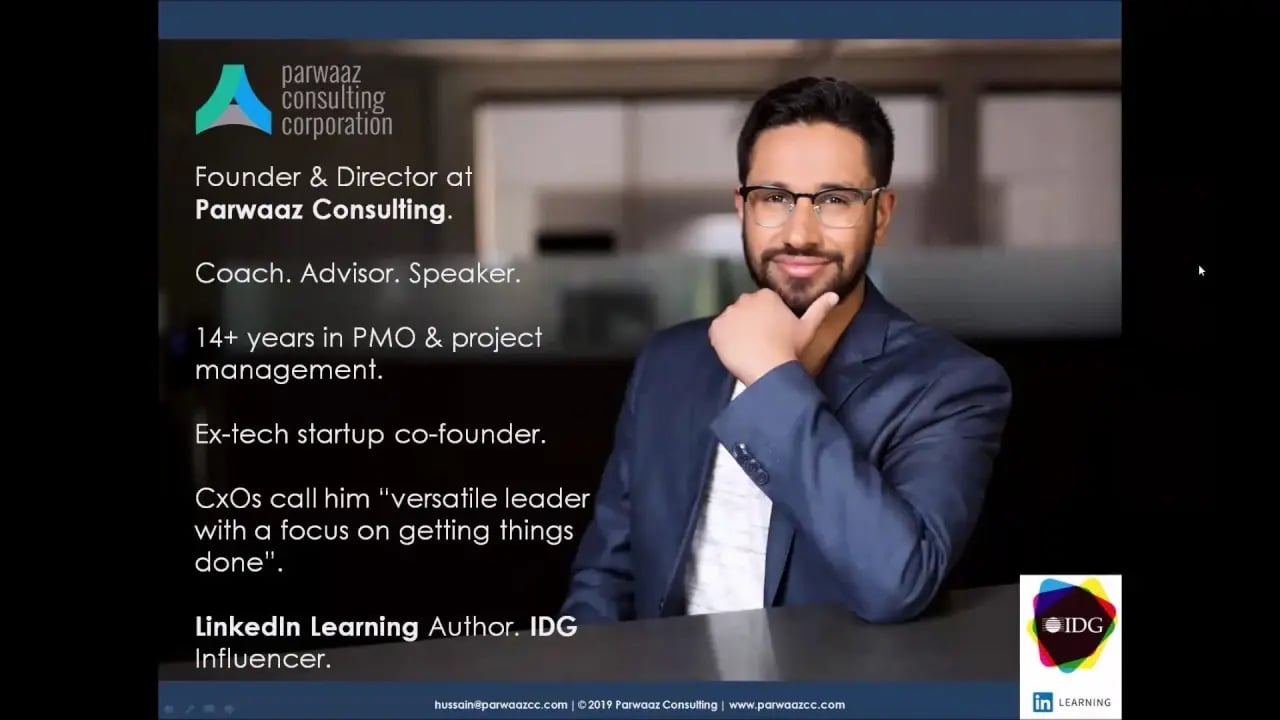
Hussain Bandukwala is the Founder and Principal Advisor of Parwaaz Consulting Corporation, where he helps organisations establish and improve PMOs, strengthen portfolio governance and deliver complex transformations. With more than 20 years of experience in project management and PMO leadership, he is also a LinkedIn Learning instructor and a two-time World PMO Influencer of the Year finalist.

Stuart Easton is Founder & CEO of TransparentChoice. He works with leaders and portfolio teams on decisions about which investments and initiatives to fund, continue, change, defer or stop when priorities compete for limited funding and capacity. His work combines structured decision-making with practical portfolio choices.