
Mastering Project Prioritization
About this webinar
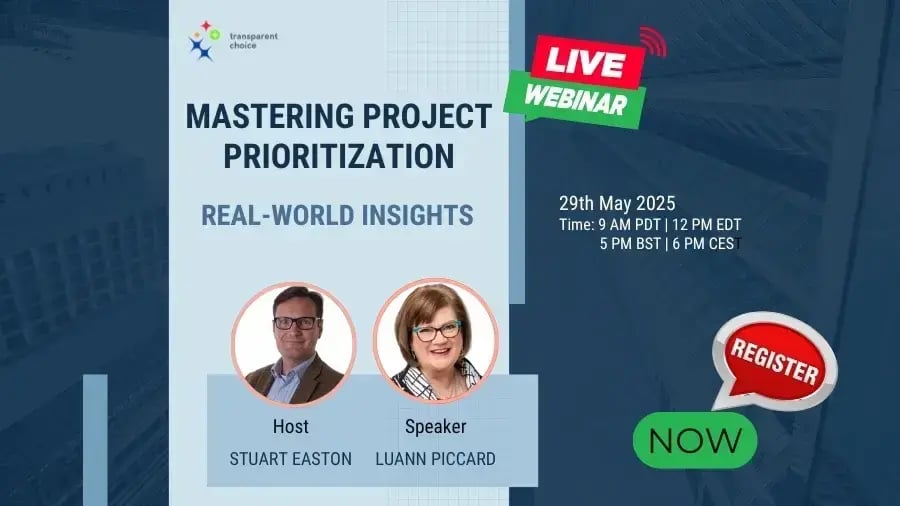
You can’t support everything. So what gives way? In this product demo, Stuart Easton shows LuAnn Piccard, former PMI Board Chair, TransparentChoice for the first time, from strategy to a portfolio the organisation can actually support.
LuAnn brings the view from the top. At HP she managed a very large global portfolio, and she describes the quarterly “waterline”: work above it gets done, work below it waits, and the “messy middle” right at the line is where leaders spend their time. Her point: unfinished work isn’t just zero value, it’s negative, because the time and resources can’t go to work that matters more. And because conditions keep changing, the list is never static.
The first part sets up the problem and LuAnn’s experience. The demo starts about 28 minutes in.
What you’ll see
- Turn strategy into priorities. Leaders weigh what matters using pairwise comparisons, so the logic is visible and can be challenged.
- Get the right people scoring. Finance, technical and business specialists assess the parts they know.
- Go beyond a ranked list. Apply capacity and funding limits to find a portfolio you can actually support.
- Change the answer live. Alter constraints, assumptions or must-do work and recompute during the discussion.
- See the trade-offs across portfolios. Explore value against spend and how scarce capacity is shared.
- Sequence the work. Time the selected projects against available capacity to cut overload and hotspots.
LuAnn closes on what this enables: delivery teams using the same criteria at decision points, flagging work that is no longer delivering, and taking evidence to their sponsors.
Research in context
Does leadership agreement actually matter? A 2011 meta-analysis in the Journal of Business Research of 23 samples found a modest positive link between management agreement on strategy and organisational performance, clearest when the agreement was about priorities.
That is the same question Stuart tackles when leaders weigh priorities before projects are assessed.
Learn more
Join the next live webinar

See how RNLI compared credible portfolio choices
In its case study, RNLI surfaced hidden work, brought leaders and engineers into one shared-criteria process and compared several credible portfolios. When priorities changed, they reweighted and rebalanced. Read the case study
What happens when another priority crosses the waterline?
Dirk Withake and Stuart Easton on the moment a new executive request lands on a portfolio that is already full: show what’s committed, then decide what stops, waits or gives way. Watch the webinar
Put the portfolio decision inside the wider planning system
See where the decision fits: strategy, funding, capacity, sequencing and regular review in one planning process. Explore the Strategic Planning guide
Speakers

LuAnn Piccard, PMP served as the 2024 Board Chair of the Project Management Institute (PMI). She has held senior and executive leadership roles at Hewlett Packard and Advanced Energy before moving into academia. Today, she develops future leaders in project management and engineering while actively serving on non-profit boards.

Stuart Easton is Founder & CEO of TransparentChoice. He works with leaders and portfolio teams on decisions about which investments and initiatives to fund, continue, change, defer or stop when priorities compete for limited funding and capacity. His work combines structured decision-making with practical portfolio choices.