
PMBOK® Guide – Eighth Edition: What It Means for Enterprise PMOs
About this recording
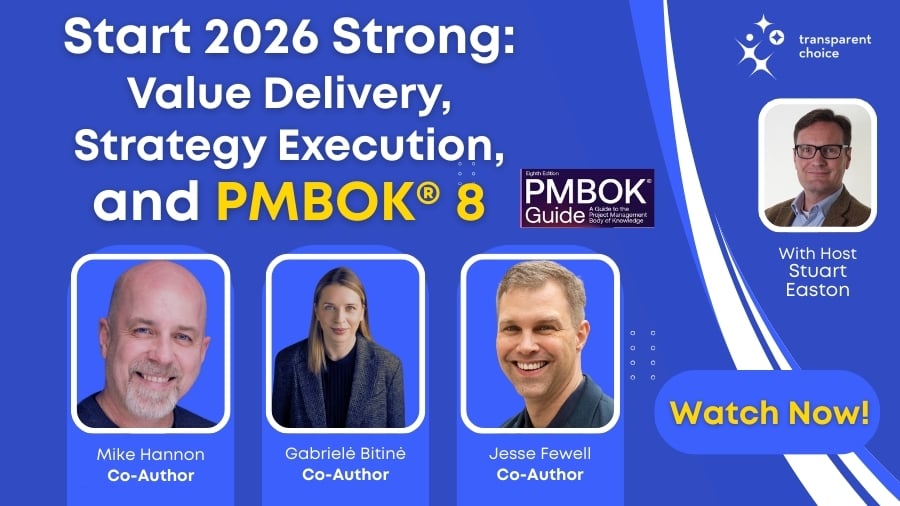
PMBOK® Guide – Eighth Edition brings back familiar project-management processes without abandoning the Seventh Edition's focus on principles and value. Three members of the writing team, Jesse Fewell, Gabrielė Bitinė and Michael Hannan, join Stuart Easton to explain why that balance matters and what PMO leaders can take from it.
Why process guidance returned
Jesse describes the challenge left by the Seventh Edition. Its emphasis on project management as a system for delivering value was important, but many practitioners missed the recognisable processes and practical guidance of earlier editions. The Eighth Edition responds to both needs. According to Jesse, the team considered 48,000 data points collected through surveys before development: the feedback supported retaining principles and value delivery while reintroducing modernised guidance around initiating, planning, executing, monitoring and controlling, and closing.
That does not mean every project must follow one methodology. Jesse argues that those activities matter across predictive, agile and hybrid approaches, while the way they are carried out should fit the work. Nor does a new edition make older books worthless. When asked whether to discard Edition Five, Jesse describes an airport project leader who still uses it to train his teams; Gabrielė also values earlier editions as reference material.
A broader understanding of what counts as a project
Gabrielė explains why the revised project definition matters to people managing varied portfolios. She questions the old emphasis on a unique product, service or result: her company may install similar district-heating pipes and pumps repeatedly, but each assignment still has its own setting, goals, people, budget and timeframe. The output need not be unprecedented for the work to call for project management.
She also discusses the move from the word “endeavor” to “initiative” and the importance of language that practitioners across industries and countries can recognise. For PMOs, this opens a practical question about what belongs in the portfolio. Internal supply-chain changes and other organisational initiatives can create substantial value even when they do not resemble a traditional capital project.
Manage delivery constraints in service of value
Mike challenges the assumption that staying within the original scope, schedule and cost baseline is always the best outcome. Suppose spending more would bring a valuable result forward by a month. Might that produce a better return on investment? Rather than dismiss the alternative for exceeding the budget, project leaders should understand what stakeholders are trying to achieve.
Jesse notes that this move beyond the traditional triple constraint is not new: the Fourth Edition already recognised multiple constraints, including risk, quality and compliance. Mike adds that stakeholders have always wanted projects to deliver value, even if the profession has not consistently met that expectation.
Jesse uses the Sydney Opera House and Boston's Big Dig to question whether delivery performance alone tells the whole story of a project's value. Stuart makes a similar distinction with his duck-and-eggs analogy: stakeholders want the value produced by the work, not the project-management machinery for its own sake.
Make different kinds of value discussable and measurable
In response to a question about a common currency for value, Mike contrasts an investment expected to earn profit with one intended to improve employee morale or welfare. Both may matter, but the second cannot automatically be converted into a reliable profit estimate. Comparing them therefore requires leaders to surface their judgement about what matters and how much benefit they believe each option could produce.
Jesse adds a practical way to make that discussion concrete: look for measures in three categories. Money might involve return on investment or cost reduction. Mission might mean metric tonnes of carbon removed from the air or people fed through a public programme. Organisational mechanics might involve the operational KPIs teams are already held to, such as hiring lead time or manufacturing cycle time. There is no universal index that converts all of these into one measure, but, as Jesse explains, there are numbers that can help make the case for each kind of value.
Mike argues that the aim is to maximise benefits, not just realise them. Some investments will fall short of their expected benefits for reasons beyond anyone's control, so other investments need to outperform their targets. Like an investor, leadership should balance risks and aim to maximise the return across the portfolio, even when the return is not financial.
Mike offers another practice that he explicitly says is not prescribed in the Eighth Edition: define both the value a project aims to achieve and a minimum acceptable level. The target encourages ambition; the minimum is a point below which the work should be stopped.
What changes for the PMO
Gabrielė points to the new PMO appendix and argues for moving beyond progress reports, procedures and compliance as the PMO's whole identity. A PMO can help question whether proposed work contributes to strategic objectives, bring a broader range of initiatives into view and support decisions about value. But she resists one prescribed model: the PMO's services, tools and responsibilities should fit what its organisation actually needs. A value delivery or transformation office may perform relevant work without using the PMO title.
Stuart extends the discussion from individual projects to the portfolio. He argues that portfolio management is integral to project management, not an optional extra: it is the first step that sets the stage for project work. If value matters, it matters which initiatives are authorised in the first place, because that choice shapes the value the project teams can go on to deliver.
How to start applying the guide
Gabrielė recommends focusing on competencies, responsibilities and accountable leadership rather than assuming everyone doing project-management work has the same job title. She also values examples that help practitioners understand how guidance works on real projects.
Jesse's closing advice is deliberately modest. Many project managers may never have encountered the PMBOK Guide directly, so now is an opportunity to introduce both its nearly 40-year heritage and its contemporary guidance. It is a guide to what to consider and why, not a cookbook to follow unchanged. A PMO leader could start with a team discussion or lunch-and-learn about the guide and its relevance to the people doing project work.
How this connects to TransparentChoice
The Q&A raises a decision problem that connects directly to TransparentChoice: how do leaders compare investments when their contribution is expressed in different ways, such as financial return, employee outcomes, mission outcomes or operational measures?
TransparentChoice helps leadership structure those dimensions of value and make their relative importance explicit. Those priorities can then be considered alongside funding, capacity and other modelled constraints when comparing feasible portfolio choices.
This keeps two questions separate: how valuable is the work, and which combination can the organisation actually support? TransparentChoice can compare feasible alternatives against the priorities and constraints leadership has set. Leadership makes the final choice. See how TransparentChoice supports portfolio decisions →
Learn more
How can leaders compare investments when value is not all financial?
The panel distinguishes money, mission and organisational measures. This article explains how AHP can use criteria, pairwise comparisons and consistency checks to make financial and non-financial judgements more explicit. Explore value-based prioritisation beyond ROI →
How should a PMO choose the services its organisation needs?
Gabrielė argues against one prescribed PMO model. Drawing on Laura Barnard's approach, this article starts with leadership problems and root causes, then shows how to select a few fitting services and revisit the mix as needs change. Explore how to choose PMO services →
What changes when a PMO treats projects as investments?
Mike questions whether a budget overrun can be worthwhile when it brings value forward. In this earlier webinar, he develops that investor perspective through staggered project starts, pooled uncertainty in a project-level buffer and value-based selection. Watch Mike Hannan on speed, reliability and selection →
Speakers in this recording

Jesse Fewell is a transformation leader and executive consultant who has taught and coached thousands of leaders and professionals in fourteen countries on five continents. Jesse chairs the 8th edition of the PMBOK Guide (2025), the premier global standard from the PMI. His consulting firm, Fewell Innovation, has attracted clients from the Federal Reserve Bank to Duolingo to Washington DC public schools, and over 100 other global organizations.

Gabrielė Bitinė is Head of Project Management Department at Gijos, a co-author of PMBOK 8th edition, and a lecturer at Vilnius Gediminas Technical University

Mike Hannan is a co-author of the PMBOK® Guide – Eighth Edition and lead author of The CIO’s Guide to Breakthrough Project Portfolio Performance. He brings more than 25 years of project management experience across portfolio, programme, process and technology roles, including work with government agencies and Fortune 500 companies.

Stuart Easton is Founder & CEO of TransparentChoice. He works with leaders and portfolio teams on decisions about which investments and initiatives to fund, continue, change, defer or stop when priorities compete for limited funding and capacity. His work combines structured decision-making with practical portfolio choices.