
Solid Ground in Shifting Times
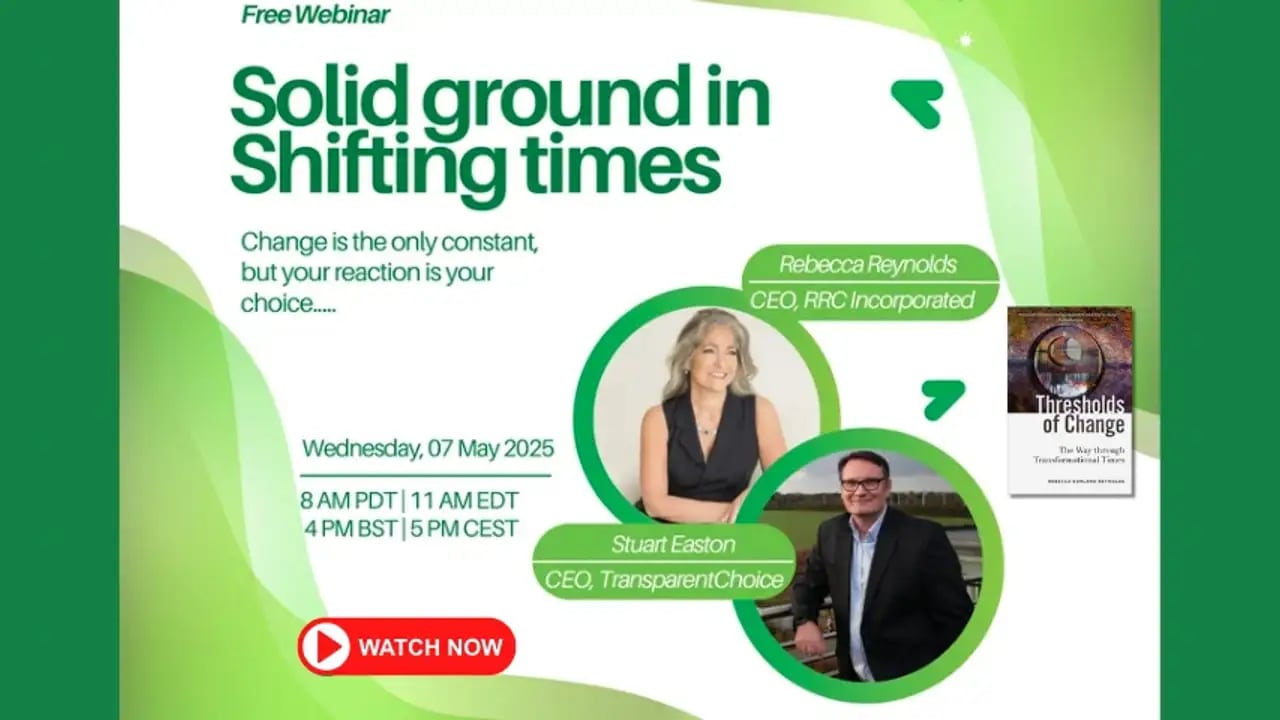
About this recording
What should leaders do when the old way of working no longer holds but the new direction is unclear? Rebecca Reynolds argues that people's reactions to change vary, but the process moves through recognisable stages. Recognising the stage and what it requires can redirect energy spent resisting change into working with it. She sees this ability as increasingly important as change grows in pace, reach and scale.
Recognise the stage before deciding what to do
Rebecca describes Thresholds of Change as a four-stage, iterative model. The conversation explores three stages in depth:
- Instigation: something that was stable or working no longer does. The signal may be sudden or emerge as a pattern over time. Notice it without assuming you already know what it means.
- The Liminal: the old state is no longer adequate, but a new answer has not emerged. Rebecca describes a receptive period for admitting uncertainty, asking questions and understanding the situation. Leaders can find it uncomfortable to say they do not know, yet rushing straight to options can close down discovery.
- Metabolization: new thinking and behaviour begin to take hold. Signs may include unexpected ideas, laughter where there was tension or people acting differently without recognising the shift themselves. Help people notice, own and reinforce those changes.
Build a shared map before choosing solutions
For Rebecca, strategic planning creates space to step outside day-to-day pressures and understand the terrain. Leaders need to agree what they are trying to achieve and build a shared frame of reference before choosing options. People closer to the work can reveal constraints, dependencies and possibilities that executives cannot see from the top.
Stuart Easton connects this to portfolio and transformation leadership. When an organisation is unclear about the impact it wants, it may start too much work at once instead of staggering commitments. The resulting resource collisions and change overload can contribute to project delays and overruns.
Bring people into change, including its difficult parts
Stuart suggests people may resist having change done to them more than change itself. Rebecca stresses that involving people is not necessarily easy. When change is unwanted, Instigation and the Liminal can be the hardest stages; when it is welcome, people may move through them quickly. In the same organisation, some may be impatient to proceed while others feel change is impossible. She describes numbness, defensiveness, anger and cynicism, and warns that serious change takes time and stamina. Some executives hesitate to involve people widely because they do not feel equipped to handle those emotions.
Rebecca compares leading organisational change to conducting an orchestra: the whole organisation, its groups and individual people are each navigating change, sometimes alongside significant changes in their personal lives. Leaders need to attend to those interacting experiences, not just issue a decision from the top.
She argues that the ability to navigate change, both one's own and other people's, should matter when hiring anyone responsible for leading people. It cannot sit only with the C-suite because change occurs at every level. Stuart adds that project managers should enable change rather than force it, bringing both the head and the heart to the work.
When raising concerns with executives, Rebecca advises being gentle: ask questions instead of assigning blame, and show the connection between what you are trying to accomplish and what you need from leadership to do it. Read the room. Where an executive team is closed to challenge, someone from outside may be better placed to speak frankly without the same career risk.
What this looked like in practice
- Federal land restoration: Rebecca describes working with Stuart and TransparentChoice to prioritise restoration projects across a 2.5-million-acre landscape of mixed jurisdictions. They needed both agreed strategic outcomes to guide priorities and hundreds of people, including technical specialists and local stakeholders, to contribute. Rebecca reports no pushback at the end of that particular process, which she calls unprecedented, but emphasises that it took time. Stuart notes that participants heard other perspectives and understood why their own priorities did not always come first. Rebecca adds that some could see how doing another area's work first might make their own project easier when its turn came.
- A CIO's change in behaviour: Rebecca recalls a CIO who had repeatedly struggled to secure his budget and later told her it had been approved. She helped him identify what he was doing differently so he could recognise and reinforce the emerging change.
Research in context
Rushing to an answer can create the appearance of certainty without producing a decision that lasts. Paul Nutt’s research on organisational decisions found:
- Imposed answers created “misleading clarity”. Only 35% of decisions implemented by edict were still fully used after two years, compared with 73% when managers used participation through task forces.
- Breadth of involvement mattered. Participation failed more often as a smaller share of affected people was involved.
That reinforces Rebecca’s argument and Stuart’s point about change being done to people: understand the problem and bring in different perspectives before forcing the decision.
How this connects to TransparentChoice
When too much starts at once, work collides over the same people and budgets. Leadership then has to decide what the available funding and capacity can actually support, and when.
TransparentChoice supports that allocation step:
- Make judgement explicit. Leadership priorities can be captured while relevant experts assess the parts of the decision they understand, independently at first so different views can be compared.
- Test what fits. Those judgements can be considered alongside funding, capacity, mandatory work and dependencies to compare feasible combinations rather than stop at a ranked list.
- Sequence and retest. Selected work can be sequenced against capacity over time, then recomputed when priorities, assessments or constraints change.
TransparentChoice supports the decision. Leadership decides what to commit to.
Learn more
Go deeper into the change framework
The recording explores three stages in Rebecca Reynolds’ model. For her fuller treatment of the process, continue with Thresholds of Change: The Way Through Transformational Times.
What does broad participation look like in practice?
In Belo Horizonte’s urban transport strategy, a large stakeholder workshop weighted the criteria and a wider group evaluated proposed measures, which were then organised into short-, medium- and longer-term implementation paths.
What constraints might leadership be missing?
Rebecca’s guest article Beyond Headcount and Budget looks at the specialist skills, hidden operational workload and other constraints that headline capacity numbers can hide.
Speakers in this recording

Rebecca Reynolds is a reinvention expert, systems innovator, and author with over 30 years of experience guiding leaders and organizations through large-scale transformation. She has developed and applied innovative models for advancing change capability across government, non-profits, and communities. Her new book, Thresholds of Change: The Way Through Transformational Times, distills her proven approach to navigating disruption with clarity and confidence.

Stuart Easton is Founder & CEO of TransparentChoice. He works with leaders and portfolio teams on decisions about which investments and initiatives to fund, continue, change, defer or stop when priorities compete for limited funding and capacity. His work combines structured decision-making with practical portfolio choices.