
The New Role of the PMO in a Disrupted World
About this webinar
Budget cuts and reorganisations force leadership to decide what can still be supported, while AI is changing where PMO effort adds value. Laura Barnard frames the stakes with a simple test: if your PMO disappeared tomorrow, would leadership lose reporting, or lose strategic decision-making capability?
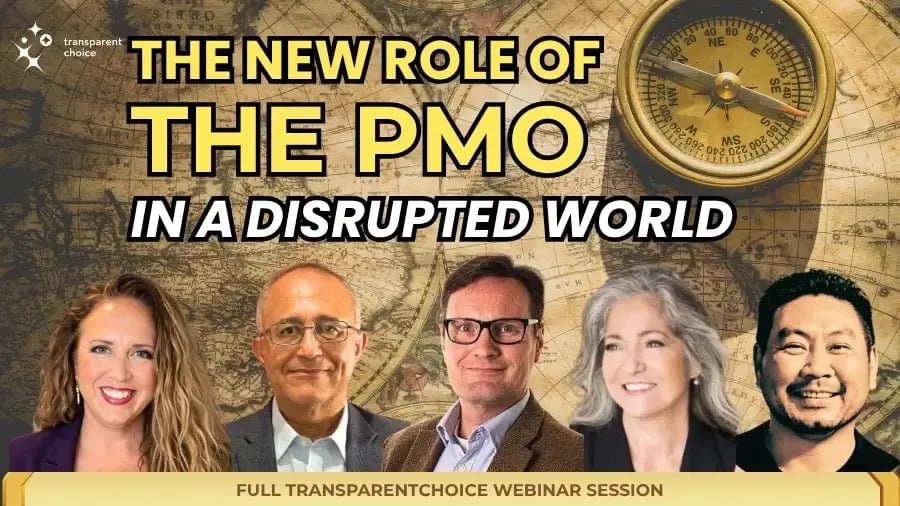
Laura, Rebecca Reynolds, Dr Al Zeitoun, Mickey Nakamura and Stuart Easton explore what it takes for a PMO to help leaders make business decisions by connecting strategic goals with capacity, value, options and consequences. Al sums up the opportunity as clarity, capacity and choices.
What you’ll hear
- Help make business decisions, not just report on projects. Laura argues that cuts can trace back to bets made without the PMO involved, and makes the case for giving leaders what they need to choose before work starts, not reports afterwards.
- Change the behaviour, not just the name. Laura warns that renaming a PMO without changing how it thinks, talks and works leaves the underlying problem in place.
- Make capacity visible. Rebecca and Al focus on making real capacity and constraints visible so leadership can see what the organisation can realistically support.
- Translate across the organisation. Mickey describes the PMO as a translator between leadership, middle management and delivery teams, while Al urges PMOs to speak in business outcomes rather than project terminology.
- Treat budget pressure as a portfolio choice. Stuart uses a duck-farm analogy: when feed runs short, spreading less across every duck means fewer eggs. Leadership may need to decide which work to keep supporting and which to stop.
- Treat AI as a change in where PMO effort goes. Al expects much of what PMOs are comfortable doing to be automated. Rebecca sees AI freeing the PMO for advising and enterprise thinking, while Mickey describes his PMO gaining a role in AI governance and rollout.
Mickey describes a merger of three organisations with no PMO in place. His team introduced what he describes as a PMO or transformation office, put about 1,100 projects and programmes through a stage gate and became what he calls an enablement office. He describes its role as driving value and cost savings rather than layoffs.
Rebecca Reynolds describes TransparentChoice as helping her make decision processes broad, inclusive and transparent, while Laura Barnard discusses how clients and students use it to start the executive conversations the panel is advocating.
Research in context
In PMI's 2026 report, based on its 2025 Global PMO Survey of 1,905 senior leaders and PMO leaders, 78% of senior leaders said strategic alignment should receive high or top priority in PMO resource allocation, while 68% of PMO leaders reported that it currently receives high or top priority.
That echoes Al's challenge to PMOs: check where your own time and effort actually goes.
How this connects to TransparentChoice
When funding is cut or a new priority arrives, a ranked list does not settle what the organisation can still support. TransparentChoice can bring leadership priorities together with existing and proposed commitments, funding, role-, skill- or team-level capacity and other represented constraints, then compare feasible portfolio choices.
Leaders can vary the funding level, change priorities or constraints and recompute to see what stays, what gives way and how modelled portfolio value changes as spend changes. Leadership decides what to fund, continue, change, defer or stop. See how the software supports these decisions.
Learn more
Join the next live webinar

The Evolving Role of PMOs: Transforming into IMPACT Engines
Laura Barnard's IMPACT Engine expands the role question across strategy definition, strategy execution and strategy realisation, including where a PMO may need to move upstream rather than only improve delivery. Read the article.
Bridging the Strategy–Execution Gap
Dirk Withake and Stuart Easton take the allocation question further: when capacity is already committed and a new priority arrives, make the current demands visible and ask leadership what stops or gives way. Watch the webinar.
Harbor Foods PMO: Winning Executive Buy-in Through Prioritization
Harbor Foods reports a backlog of 134 project requests, with business leaders rather than IT setting the criteria weights and scoring the work. Read the case study.
Speakers

Laura Barnard, PMP, CAL, Prosci, IES is the Founder and CEO of PMO Strategies and author of The IMPACT Engine: Accelerating Strategy Delivery for PMO and Transformation Leaders. Recognized as the 2021 World PMO Influencer of the Year, she has nearly three decades of experience helping organizations close the strategy-to-execution gap. Laura is also host of the PMO Strategies Podcast and Co-Founder of Project Management for Change, where she champions raising the profile of project management worldwide.

Rebecca Reynolds is a reinvention expert, systems innovator, and author with over 30 years of experience guiding leaders and organizations through large-scale transformation. She has developed and applied innovative models for advancing change capability across government, non-profits, and communities. Her new book, Thresholds of Change: The Way Through Transformational Times, distills her proven approach to navigating disruption with clarity and confidence.

Al Zeitoun is a global leader in strategy execution and programme management, with expertise in operational excellence, organisational development, and sustainable transformations. A PMI Fellow and trusted strategic advisor, he has supported Fortune 500 companies, government agencies, and global enterprises in delivering complex transformations. He is also an author, keynote speaker, and executive coach recognised for helping organisations achieve lasting impact.

Mickey Nakamura is a distinguished Technology, Digital AI Transformation, and PMO / TMO Organizational Change executive with over 25 years of success leading strategy, innovation, consulting, and award-winning organizations across healthcare, higher education, government, financial services, and Fortune 100 enterprises.

Stuart Easton is Founder & CEO of TransparentChoice. He works with leaders and portfolio teams on decisions about which investments and initiatives to fund, continue, change, defer or stop when priorities compete for limited funding and capacity. His work combines structured decision-making with practical portfolio choices.