
Another project failure? Time to align projects to strategy

Alright, let’s make this quick - I know this hurts. As a profession we still fail far too often. Project failure is a major source of waste and frustration in most organizations.
- In Wellingtone’s 2017 UK survey, only 37% of responding organisations reported mostly or always completing projects on time. 1
- In PMI’s 2017 research, a lack of clearly defined objectives and milestones was the most frequently identified factor behind failed strategic initiatives (37%). 2
Investigating project failure with a fishbone diagram
Across studies, some causes of project failure keep appearing:
- Insufficient resources
- Poor executive sponsorship
- Scope creep
- Poor risk control
- Poor governance
- Poor alignment to strategy
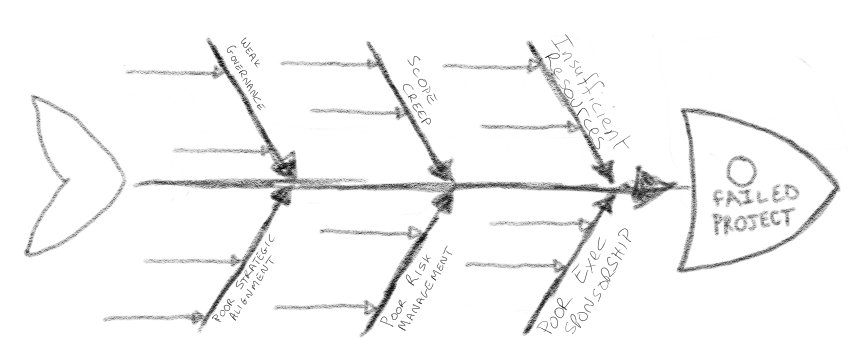
This is where the fishbone chart comes in. We imagine the head of the fish as the failed project and the causes of failure become the ribs of the fish. Like this...
Asking why again: where alignment keeps appearing
Now let’s take the fishbone one level deeper. We can go down each rib and ask, once again, why? I’ve added some possible answers to those questions.
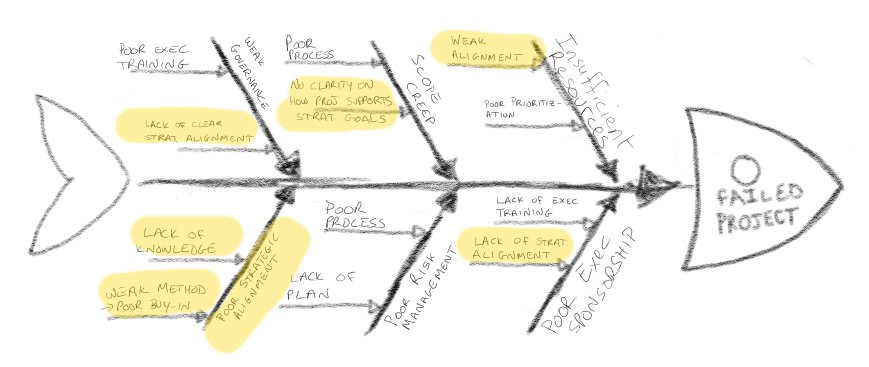
Strategic alignment keeps turning up under different ribs. What looks like several separate problems may have something in common, so it's worth investigating alignment rather than tackling each symptom in isolation.
Here are some ways that weak alignment can complicate project and portfolio decisions:
- Without a shared view of how projects support strategic priorities, prioritization becomes harder to defend
- Without that view, resource allocation tends to become a negotiation, and it is harder to see what should give way when funding or capacity runs short
- Without a clear rationale for each commitment, it is harder to challenge an overloaded portfolio and too many projects
- Without knowing what the project is FOR (its strategic goals), scope choices are harder to make
- Without a clear strategic case, it is harder to win executives’ attention, let alone their active sponsorship
Try testing the diagnosis on a troubled project. If it has both an overloaded team and weak sponsorship, ask which outcome justified the work, what else competed for those resources and who reconsidered the trade-off when capacity tightened. If nobody can name the outcome, or the project kept its people by default rather than by decision, the two symptoms probably share an alignment problem. If the case is clear and the trade-off was genuinely made, look for separate causes, such as a sponsor with no time. The second fishbone is a hypothesis, not a verdict.
The link between strategic alignment and project outcomes
PMI’s 2016 survey found an association between alignment and outcomes. Respondents who said identified project benefits were aligned extremely or very well with strategic goals reported better project results than those who said benefits were not aligned very well. Compared with the lower-alignment group, the proportion of projects achieving each outcome was: 3
- 57% higher for meeting goals and business intent (77% versus 49%)
- 50% higher for finishing on time (63% versus 42%)
- 45% higher for finishing within budget (68% versus 47%)
PMI’s 2017 research found a related association among organisations with an enterprise PMO: those whose EPMO was aligned to strategy reported 38% more projects meeting original goals and business intent, and 33% fewer projects deemed failures, than those with lower alignment. 2
Both comparisons are between survey groups; neither proves that alignment alone caused the different outcomes.

What is strategic alignment?
Strategic alignment is a measure of how well your project supports the strategic goals of your organization. Our Guide to Strategic Alignment explores the wider topic.
It is NOT return on investment or net present value. Increasing financial performance may be ONE of your strategic goals, but others might include growing market share, reducing customer churn, reducing your order-to-cash time, etc.
Stakeholders may disagree about which strategic goals matter most or how a project contributes to them. That makes it harder to judge alignment consistently.
Just calculating a score doesn’t solve the problem of project failure. You have to USE strategic alignment to make decisions and to maintain focus.
Seven ways to use strategic alignment
1. Project prioritization and selection
Don’t assess only the new proposals. Put live projects through the same strategic-alignment test, so they compete for people and funding on the same terms instead of keeping their place by default.
Bring that evidence into project prioritization and selection. It won’t make the temptation to cram in too many projects disappear, but it gives executives a clearer reason to challenge weak commitments and say “not now” when the portfolio cannot support everything.
2. Resource allocation and scheduling
Knowing how well projects support strategy makes the resource conversation more concrete. But even two well-aligned projects can compete for the same people or funding. You still need to compare expected contribution, available capacity, cost and timing before deciding what can proceed.
3. Portfolio health checks
Use strategic alignment scores alongside project performance and the remaining case for each commitment in portfolio health-checks. At governance meetings, ask whether the rationale still holds, what has changed and which other work may be displaced by continuing it.
4. Strengthen exec engagement
Help your execs be good sponsors. Don’t just show them a project’s alignment score. Show which strategic outcome it serves and where their decision is needed: choosing between competing projects, committing scarce people or funding, or removing an obstacle. Alignment gives that conversation a purpose, but sponsors still have to give time, make the decisions and help clear obstacles.
5. Better benefits realization
Start at the end: the strategic outcome the project is supposed to support. Then work backwards: what measurable benefit should result, who owns it, how will it be checked, and what must change in day-to-day work? Use those answers to shape milestones, resource choices and decisions during delivery. That keeps the team focused on benefit, not on features.
6. Improving scope management
Use your “strategic goals” to test the value of change requests. Changes that protect the intended benefit deserve attention, but mandatory requirements, costs and delivery risks matter too.
7. Delivering Change Management
Even a project with a sound strategic case can produce a process or system that people never adopt, and that’s a real value-killer. Use the strategic goals to show the people who must work differently why the change matters, then be clear how they’ll be involved and who will check whether the change has taken hold.
Getting started: a portfolio health-check
Plot your current projects on this map by strategic fit and project performance.
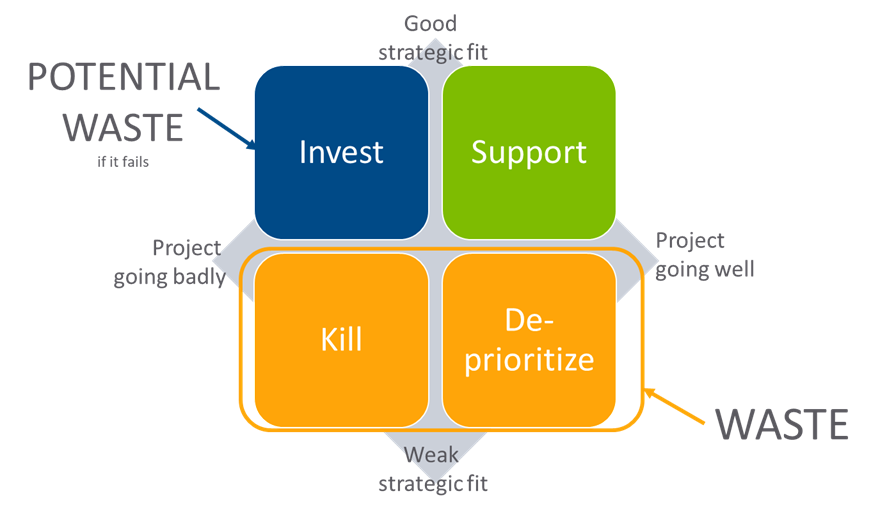
Look particularly closely at two uncomfortable cases: work that is going well but has weak strategic fit (the “De-prioritize” quadrant), and work going badly despite good strategic fit (the “Invest” quadrant). The first may need its place in the portfolio challenged; the second may need help, a change of plan or a fresh trade-off over scarce resources.
Use the matrix to start a discussion, not make the decision for you. Before changing a commitment, examine its expected benefits, remaining cost, available capacity, mandatory obligations and effects on other work. That is how you turn an alignment conversation into a realistic portfolio choice.
If that means stopping work already under way, see why weeding projects from a portfolio can be difficult even when the case for change is clear.
If your portfolio health-check raises difficult questions about which projects deserve support, bring the situation to a Decision Review. We’ll work through what is competing for resources, what is constraining the choice and what may need to change:
Start with a Decision Review →
Either way, pick one real portfolio decision and test it against your strategic goals.
As much as I like fishbone diagrams, I’d rather not have to use them to diagnose the causes of project failure.
References
- Wellingtone, The State of Project Management Survey 2017, Project Performance section. ↩
- Project Management Institute (PMI), Pulse of the Profession 2017, “PMOs and Strategic EPMOs” (p. 9) and “Driving Organizational Decisions and Outcomes” (p. 11). ↩, ↩
- Project Management Institute (PMI), The Strategic Impact of Projects: Identify Benefits to Drive Business Results, 2016, Figure 5, p. 15. ↩