
What We’ve Learned from Weeding Project Portfolios

Every gardener knows this: to help the best plants flourish, you pull weeds. Not because the flowers are weak, but because weeds steal light, water, and space.
Project portfolios are no different. When too many projects keep running, capacity fragments, priorities blur, and work that should advance strategy must compete with everything else. When everything runs, nothing moves.
The uncomfortable truth: most organisations would make faster progress by stopping the wrong work than by trying to do more of it.
Weeding isn’t destruction. It’s focus. Cut what doesn’t belong and you free scarce resources so the right work can grow.
In portfolios, the effect is the same. Misaligned projects quietly consume capacity, attention, and leadership bandwidth, stealing momentum from the initiatives that will actually move the organisation forward.
Reality check: 1 in 5 should stop
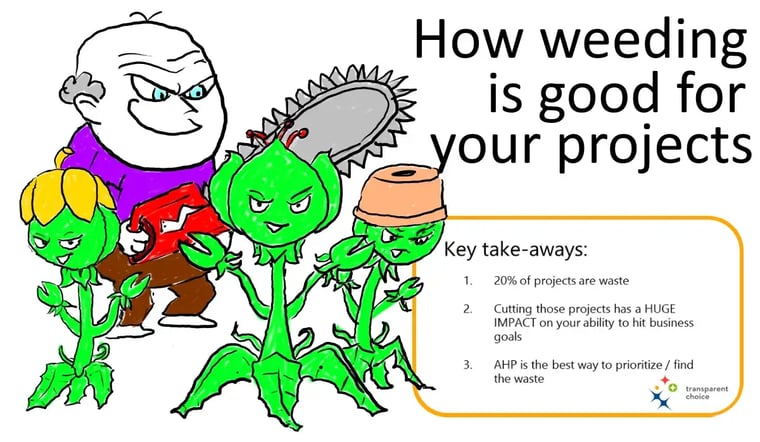
Research from organisations like PMI, and our work with PMOs and portfolio leaders, points to a consistent pattern: in a typical portfolio, about 20% of projects are so poorly aligned they should be stopped outright.
When I share this, PMO leaders often laugh, then say, “I wish it were only 20%.”
This misalignment is a significant waste of organisational resources. It burns people’s time, creativity, and energy while quietly diluting the impact of genuinely strategic work.
For the PMO, the consequences are reputational as well as operational. Executives grow frustrated:
“I give you all this budget and capacity, so why aren’t we delivering on our strategic goals?”
And because enabling strategy execution is the PMO’s core purpose, persistent misalignment ultimately undermines the PMO itself.
This isn’t a capacity problem. It’s a decision problem.
In theory, it’s simple: stop work that doesn’t advance your goals and focus resources where it does. In practice, most organisations struggle. Stopping projects isn’t a capacity problem, it’s a decision problem. Without a shared, defensible way to judge alignment, every project feels just important enough to keep alive.
The big one? Sunk cost. Once time, budget, and reputation are invested, stopping can feel like admitting failure, even when continuing is clearly worse.
Keep misaligned work and it quietly drains capacity from what matters most. Remove it and the remaining portfolio moves faster, with less friction and fewer trade-offs.
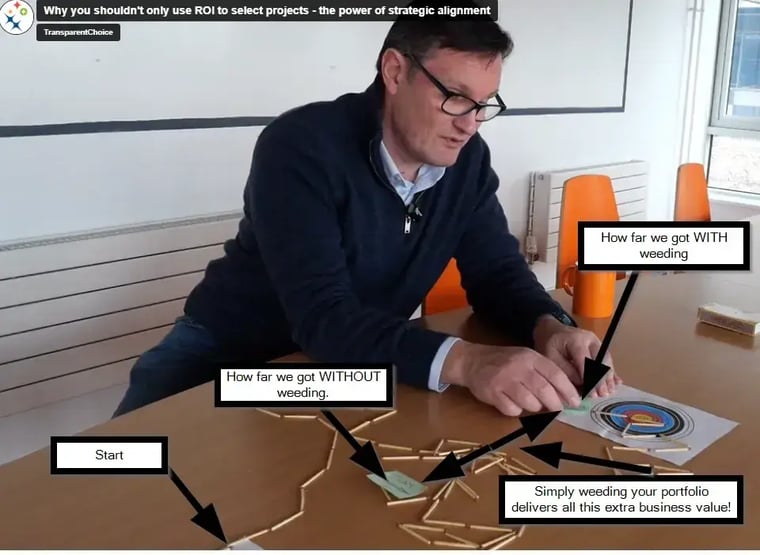
Try this experiment to see the effect of removing misaligned work.
You’ll need a flat surface, four Post-it notes, and a box of matches.
Label two Post-its “Start” and “Goal” about one metre (three feet) apart. Scatter the matches between them.
Each match is a project with positive ROI, but value isn’t enough. Match heads point towards or away from the goal.
Keeping each match’s orientation, line them up head-to-tail from “Start” and mark the end as “Before weeding.”
Now remove the 20% pointing away from “Goal.” Rebuild the chain and mark the end as “With weeding.”
The difference is rarely subtle. Removing misaligned projects often moves you twice as far toward the goal.
The experiment proves why stopping misaligned work matters. What it doesn’t show is how to make those stop decisions stick in the real world.
Why organisations struggle to stop work safely
By this point, the conclusion is clear: stopping misaligned projects matters. What’s far less clear is how to do it safely.
Most organisations are well equipped to start and run work. Where they struggle is stopping it, especially when doing so can feel like admitting failure or wasted effort.
It’s not a lack of data, tools, or frameworks. Most organisations already have more than enough. The real challenge is that stopping work forces leaders to confront trade-offs, challenge assumptions, and make decisions with political and personal consequences.
That’s why portfolios stay overloaded, even when everyone agrees there’s a problem.
What actually works is a disciplined decision process: one that creates a shared definition of value, makes trade-offs explicit, and gives leaders confidence that stop decisions are fair, transparent, and defensible.
In practice, that means combining:
- a clear strategic frame (what really matters right now),
- a structured way to compare very different initiatives,
- and experienced facilitation to keep decisions focused on value rather than politics.
Structured prioritisation methods play a supporting role here. We often use the Analytic Hierarchy Process (AHP) because it forces clarity on trade-offs and exposes hidden assumptions, but the method alone is never the point.
The real outcome is better decisions. Ones leadership teams can stand behind, communicate clearly, and act on without reopening the debate every quarter.
Three takeaways
- Most portfolios stay overloaded not because teams lack effort, but because stop decisions are hard to make safely.
- Progress comes from improving decision quality, not from adding more data, tools, or frameworks.
- Structured methods like AHP support better decisions, but only as part of a disciplined, facilitated process.
Weeding a garden isn’t about destruction. It’s about creating the conditions for the right things to grow. The same is true for your portfolio.
When alignment is visible, everything gets easier
Stopping the right projects unlocks significant value, clearer priorities, freed capacity, and faster progress. Many organisations still avoid it, not because the benefits aren’t real, but because the conversation feels hard.
It’s sensitive not because stopping is wrong, but because how you do it matters. When alignment isn’t visible, discussions slide into defending individual projects instead of choosing what matters most. Make alignment explicit and frame the trade-offs, and the debate shifts. What felt risky becomes calmer and more constructive. Stopping work stops being a fight and becomes a decision.
If you suspect “zombie projects” in your portfolio, work kept alive by sunk cost, history, or sponsorship, the most useful first step is to make the trade-offs explicit and define what would make stopping work safe in your context.
In a confidential conversation with a senior advisor, we’ll listen to what’s happening in your portfolio, share patterns we see in similar organisations, and help you judge whether there’s a realistic path to freeing capacity without turning it into a political battle.
No portfolio data. No preparation. No obligation.
If you want to explore whether this is worth tackling, and what “doing it safely” could look like, start here.