
Portfolio Management - Influencing the weather?
About this webinar
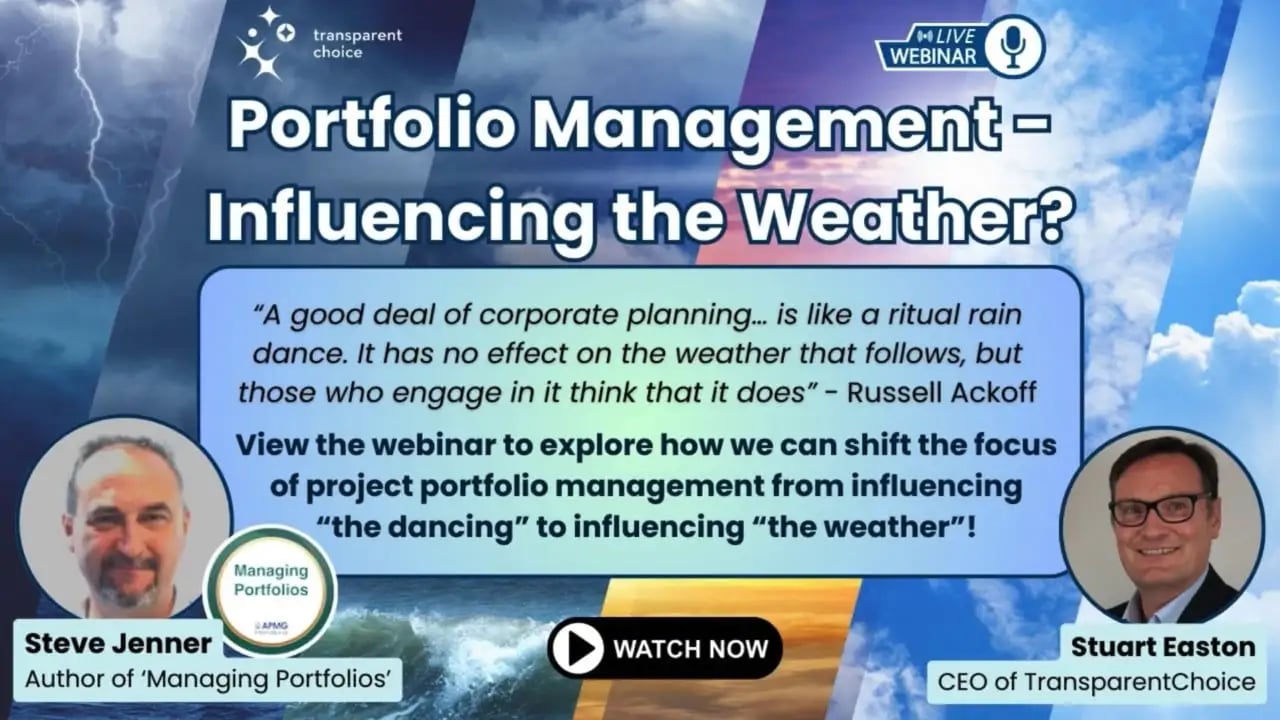
The session starts with Russell Ackoff's “rain dance” analogy: organisations can become very good at planning activity without changing what actually happens.
Steve Jenner and Stuart Easton use that idea to ask a harder question: does portfolio management actually change decisions and outcomes, or mainly produce better process and reporting?
Steve argues that benefits are the real test. Senior leaders still own investment decisions, but the PMO should behave as if outcomes are its responsibility: helping leaders make better choices, challenging weak assumptions and removing barriers to benefits realisation.
What you’ll hear
- Make reporting lead to decisions. RAG charts and portfolio reports matter when they change where money goes. Otherwise, they risk becoming more bureaucracy.
- Connect selection, delivery and timing. Portfolio management is not finished when projects are selected. The organisation still has to do the right things, do them well and do them at the right time.
- Separate unlike work before comparing it. Steve discusses strategic buckets for work with fundamentally different purposes. As Stuart puts it, you can compare apples with oranges, but not apples with elephants. The discussion also asks whether supposedly mandatory work really is mandatory.
- Challenge assumptions presented as facts. Steve argues that the PMO sometimes needs to be “wise enough to play the fool”: ask uncomfortable questions, test confidence in business-case assumptions and use qualitative as well as quantitative evidence.
- Treat the portfolio as a funnel, not a tunnel. Use staged funding and portfolio reviews to reconsider continuing work instead of turning initial approval into automatic continuation.
- Apply six success characteristics. Be benefits-led, evidence-based, fast & frugal, active, disciplined and transparent. Steve argues that transparency changes behaviour more than reaching for the accountability stick, and that senior managers come to value portfolio management by taking part in it.
Research in context
Steve's “funnel, not a tunnel” point targets a common weakness. In a 2015 survey of 7,600 managers in 262 companies, published in Harvard Business Review, eight in ten said their companies were too slow to kill unsuccessful initiatives or exit declining businesses. It underlines why Steve treats continuation, not just first approval, as a portfolio decision in its own right.
How this connects to TransparentChoice
Steve's test is whether portfolio management changes where money and people go, not just how well it reports. TransparentChoice works at that decision point: leadership priorities and initiative assessments are made explicit, then combined with funding, capacity, dependencies and genuinely mandatory work to compare portfolios the organisation can actually support.
Two of Steve's ideas map directly onto the model:
- Strategic buckets. Work with different purposes can be modelled as separate portfolios, each judged on criteria that fit its purpose. Funding or shared capacity can be divided between them before the work within each allocation is optimised, so keep-the-lights-on work does not have to be scored directly against growth bets.
- A funnel, not a tunnel. Existing commitments can sit in the same model as new proposals, assessed on the funding and capacity they still need rather than what has already been spent. When priorities, assumptions or constraints change, the model can be recomputed to show whether the earlier choice still holds and what would be displaced.
TransparentChoice supports the analysis. Leadership still decides what to fund, what is genuinely mandatory and what to continue, change, defer or stop.
See how TransparentChoice supports these portfolio decisions →
Learn more
Join the next live webinar

Who owns the benefits?
Steve asks the PMO to behave as if outcomes are its job without taking over leadership's investment decisions. Who Owns the Benefits? separates business ownership of realised benefits from the PMO's facilitating, tracking and reporting role.
When should an approved investment be reopened?
When to revisit an existing investment sets out three conditions for reopening a still-worthwhile commitment, centred on the next decision that would materially reduce future flexibility.
How should benefits evidence shape the choice?
Challenging a business case is only half the job. From Business Case to Boardroom shows how expected benefits and confidence help leaders choose between worthwhile investments competing for the same funding and capacity, then revisit approved commitments as evidence changes.
What does revisiting portfolio choices look like in practice?
RNLI surfaced hidden work competing for scarce specialist time, compared credible portfolio options and rebalanced its choices when COVID changed priorities.
Speakers

Steve Jenner is a leading author and practitioner in portfolio and benefits management. He began his career in the UK Civil Service, where he rose to senior roles including Director of Criminal Justice IT, overseeing one of Europe’s largest IT-enabled business change programmes and pioneering portfolio and benefits management in the Cabinet Office. Since leaving government, Steve has become a globally recognised thought leader, author of Managing Benefits and Managing Portfolios, and co-author of Management of Portfolios. He also serves as Chief Examiner for APMG’s Managing Benefits and Managing Portfolios certifications.

Stuart Easton is Founder & CEO of TransparentChoice. He works with leaders and portfolio teams on decisions about which investments and initiatives to fund, continue, change, defer or stop when priorities compete for limited funding and capacity. His work combines structured decision-making with practical portfolio choices.