
Projects Fail - Blame the PM?

Over 50% of projects fail. At least, that's what we're often told.
Of course, if we had good project managers, we’d never have failed projects, right?
Not right.
We now know that PMs should not carry all the blame for failed projects.
Research suggests that trouble often starts before execution. In Alan Stretton’s analysis of published project-failure causes, around 40% of the causes he reviewed were related to project initiation.[1] Stretton cautioned that the underlying material was sparse and not representative of projects at large.
Since a PM cannot normally travel back in time and get involved in a project in which they are not yet involved (there’s a sentence for Terry Pratchett fans!), the answer cannot simply be to blame delivery.
Some of those upstream decisions belong to leadership. The PMO (or EPMO) can bring delivery expertise into the process, make portfolio consequences visible and help ensure projects are set up to succeed.
How many projects fail?
This is a tough one to answer. It sometimes feels like every vendor is releasing yet more survey data showing just how bad project failure rates are, but vendors have an agenda: like insurance companies, vendors want to scare you into spending money.
So I went looking for the research. Trouble is, there is no single, reliable failure rate for all projects. Different authors define failure differently. Some industries and sectors feel that a 20% overrun is perfectly fine, for example, while others set the threshold at 10%.
In 2015, Stephen Jenner examined the familiar claim that 50% to 70% of projects fail. His conclusion? We don't have the evidence to know the true overall failure rate.[2]
More recent PMI research makes the same point from another angle. Its 2026 Pulse of the Profession found that 31% of complex projects failed to achieve the full scope of their originally intended benefits, which PMI reports as more than twice the failure rate for projects overall.[3] The number changes materially depending on what kind of project you are looking at and how success is defined.
So let's not turn a disputed range into a 60% failure rate just by taking its midpoint. That would also invent a 40% average success rate.
Earlier PMI research also shows what stronger performance can look like. Among its champion organizations, an average of 92% of projects met original goals and business intent, 90% were completed within budget, and 88% on time.[4]
See how champions compare with underperformers in this infographic.
So, what are those champions doing differently?
Better execution cannot fix every portfolio decision
Good execution matters. But Stretton found that around 40% of the causes he examined were initiation-related, not execution-related.[1]
Let’s say that again, this time with feeling…
A project can be set up to fail before delivery even begins!
In other words, you can execute your projects faultlessly (and, let’s face it, this is where many PMOs spend much of their time), and still fail.
Fail a lot.
So, does this mean that investing in things like PM training, PPM tools and templates is pointless? No. Better delivery capability matters, but it can only address problems that are actually rooted in delivery.
Okay, let’s say THAT again, in different words, and this time with feeling…
You CANNOT project-manage your way out of every bad portfolio decision!
Look at it this way. Improving project execution matters, but there comes a point where better delivery discipline cannot compensate for an overloaded or poorly chosen portfolio. If the real problem is that the organization has committed to more work than its capacity can support, improving execution alone will not resolve it.
That pressure is visible well beyond the PMO. Deloitte’s 2026 Global Chief Strategy Officer Survey found that more than half of strategy leaders surveyed were managing too many priorities with too little time.[5] When leadership has more priorities than the organization has capacity to support, better project execution alone cannot resolve the underlying choice.
So rather than chasing those last few percent on execution, let’s look at what else we can do to increase project success rates.
How projects fail before they start
I've talked a lot about strategic alignment because the work an organization funds should support what leadership is trying to achieve. PMI research has also reported associations between stronger strategic alignment and better project outcomes.
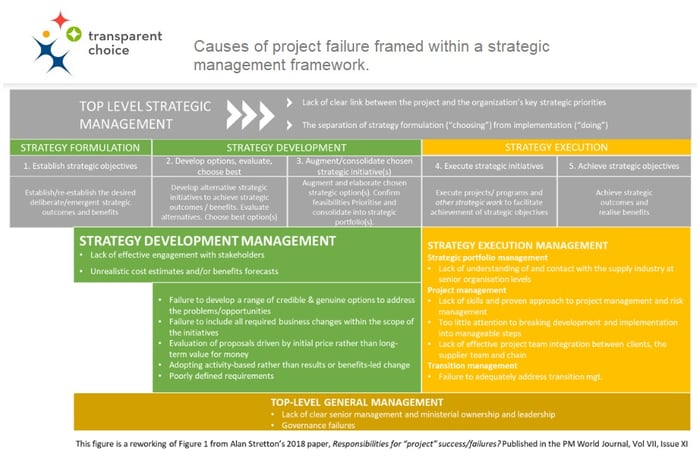
Stretton approaches the issue from a different direction. He pulled together published causes of project failure and mapped them against the stages of organizational strategy and project delivery. The result helps show where problems arise, and who might be able to address them.
Some causes sit in the strategic planning process: defining strategy, developing ideas, choosing projects and deciding what the organization can realistically support. Others sit in project definition, estimating and planning. Fixing these problems early can prevent a lot of pain later.
Of course, there are the “normal” execution-related project failure modes, but the ones that interest me in this blog are the ones that occur before the project has even begun (green in the image below).
There’s a lot of detail in this model - it’s a bit of an eye-test, in fact - but the take-away messages are:
- Strategic goals need to be usable in project and portfolio decisions. If goals and drivers are too vague to guide project prioritization, work can be approved without a clear view of how it contributes to strategy. Our Strategic Goals article explores how to make those priorities explicit.
- Strategic context also needs to reach delivery teams. If teams understand the outcomes a project is intended to support, they are better placed to make in-flight choices around benefits, scope and features that remain consistent with that intent.
- Project ideation can become disconnected from strategy. Incoming demand matters, but organizations also need a way to generate and develop ideas around the outcomes leadership is trying to achieve. A PMO can help connect that operational demand with the wider portfolio rather than treating every request independently.
- Weak estimating and project definition can create problems before delivery begins. Stretton argues for involving experienced project managers earlier in evaluation, estimating and project definition so assumptions and potential problems can be challenged before commitment.
Okay, time for the eye-test. The green parts show the causes linked to strategy and project initiation.
Whose problem is this to fix?
Stretton argues that experienced project managers should get involved earlier, particularly in evaluation, estimating and project definition. That's a good start. But some problems need decisions that an individual PM simply cannot make.
Leadership owns the strategy and the investment choices. The PMO can facilitate the process, bring delivery expertise into those choices and make the consequences visible before work is committed.
For a broader practitioner view of why execution problems can begin upstream, watch Strategy to Execution: Closing the Gap. Frederic Casagrande and Stuart Easton connect three parts of the problem: defining what really needs to be solved, defining the right solution and portfolio choices, and preparing the organization for the resulting change.
Don’t get me wrong - tools are not a magic bullet. But they can provide structure, consistency and visibility around the decisions the PMO is helping leadership make.
Where should the PMO start?
- Quantify the problem: Review where the problems are actually entering the system. Are weak outcomes being created by strategy, demand, project evaluation, portfolio selection, capacity assumptions, project definition or delivery? That gives leadership evidence about which part of the decision process needs attention rather than assuming the problem sits with project execution.
- Win exec sponsorship: Now the problem is visible, it’s time to paint a picture of how to “fix it”. Our four ways to improve executive sponsorship can help you involve the leaders whose decisions and support you need.
- Win PM support: It’s time to ‘fess up to the PMs. Help them understand that they have a responsibility to execute well, but that the organizational leadership has a responsibility to define strategic direction, to ensure projects support that direction and that projects are adequately resourced…. But the quid pro quo is that they, the delivery teams, then focus their work on delivering business benefits rather than checking off functionality.
Not sure which PMO services to improve first? Our PMO Service Catalogue article shows how to choose them based on the problems your leadership wants solved.
Is this just theory? No. At Harbor Foods, an accumulated project backlog became a business-led prioritization process, with business leaders setting the criteria and weights used to evaluate the work.
PMI's 2017 research found that organizations with an EPMO aligned to strategy reported 38% more projects meeting their original goals and business intent, and 33% fewer projects deemed failures, compared with organizations whose EPMOs had lower alignment.[4] This was an association, not proof that EPMO alignment caused the difference, but it reinforces the case for looking beyond delivery alone. Our Strategic Portfolio Management guide explores the wider cycle from strategy and portfolio selection through execution, benefits and review.
So coming back to the title of this blog, are PMs to blame for project failure? Well, yes, partly. But leadership and the PMO have to do their part too. You can't ask a delivery team to rescue every bad decision made before delivery.
The PMs can’t do it on their own.
💚 If you enjoyed this article, please consider following us. It’s a small gesture that means a lot to us and encourages us to keep sharing what we learn. See the ways to follow us below ↓
References
- Alan Stretton (2018), Relating causes of project failure to an organizational strategic business framework, PM World Journal. ↩ ↩
- Stephen Jenner (2015), Why do projects ‘fail’ and more to the point what can we do about it?, PM World Journal. ↩
- Project Management Institute (2026), Pulse of the Profession® 2026: Driving Success in Complex Projects. ↩
- Project Management Institute (2017), Pulse of the Profession: Success Rates Rise, pp. 6 and 9. ↩ ↩
- Monitor Deloitte (2026), 2026 Global Chief Strategy Officer Survey: Leading Strategy at the Speed of Change, survey of 148 global strategy leaders. ↩