
Project Portfolio Governance - The Future
About this webinar
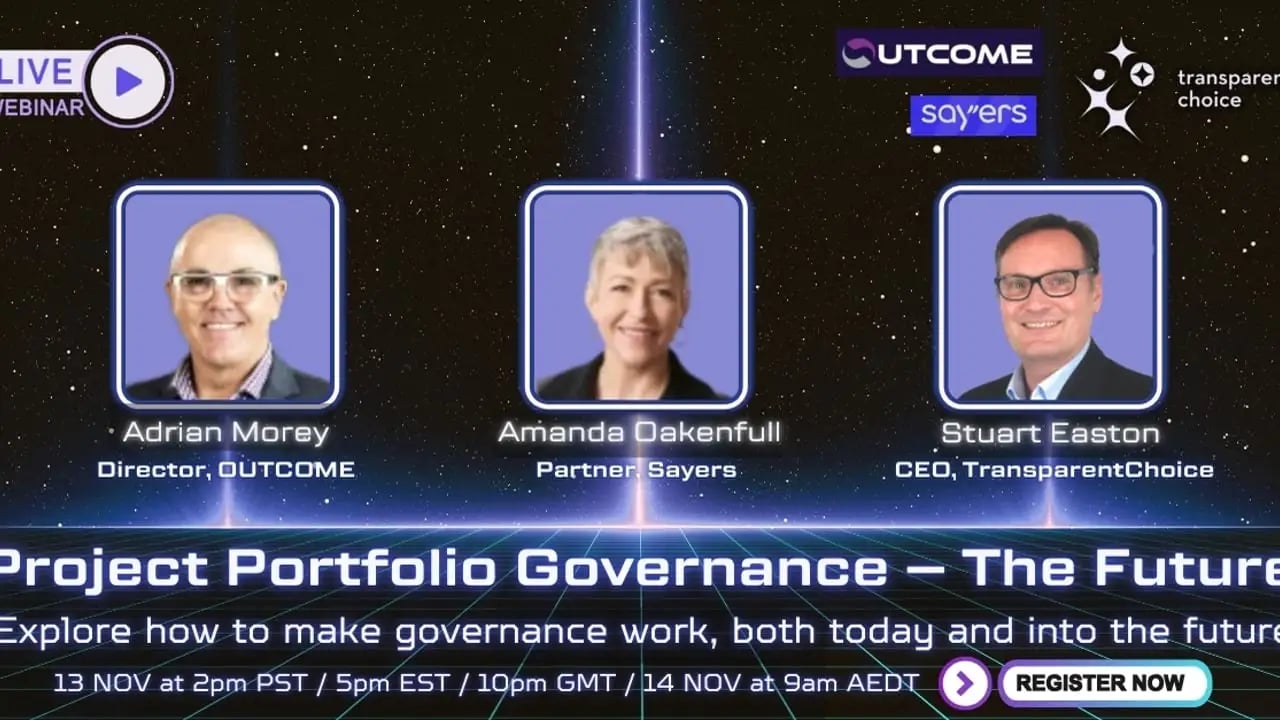
Governance often gets reduced to paperwork, reporting and committee meetings. But its purpose is to help the right people make the right decisions, at the right time, with the authority and information they need. In this session, governance experts Adrian Morey and Amanda Oakenfull join Stuart Easton to explore what that means for projects, programmes and portfolios.
Drawing on their experience in governance design, programme recovery and major transformation, Adrian and Amanda examine the relationship between accountability and empowerment. They discuss why clear decision rights matter, how fear can drive leaders towards excessive control, and why a governance meeting that only repeats status reports is not necessarily helping the organisation make better decisions.
At portfolio level, the discussion goes beyond approving new initiatives. It explores how investment governance can reconsider existing commitments, use evidence that decision-makers understand, and delegate decisions appropriately so that executive committees can focus on the choices that genuinely require their authority.
What you’ll learn
- Why governance is fundamentally about decision-making, not simply controls, reporting or committee structure.
- How to connect accountability with the authority to decide, and delegate decisions to the lowest practical level.
- Why governance groups should support accountable decision-makers rather than obscure who owns the decision.
- How leadership behaviours, fear and excessive control can undermine otherwise well-designed governance arrangements.
- How portfolio-level governance can address both new investment decisions and the continuing review of existing commitments.
- Why governance structures should be tailored to the organisation, with enough authority at programme and sub-portfolio level to avoid overloading executive committees.
- How to question whether the information, meetings and processes in a governance system are actually adding value.
The central question is not whether an organisation has enough governance. It is whether its governance helps people make and act on the decisions that matter.
Explore further
For the distinction between project accountability and ownership of the resulting business outcomes, read Who Owns the Benefits?. For a closer look at when portfolio governance should reconsider an existing commitment because another credible claim needs the same resources, explore Capital Allocation: Revisit Existing Investment.
Speakers

Adrian Morey is a globally recognised expert in project, program, and portfolio (P3) governance with over 30 years of experience across infrastructure, technology, and transformation. He co-authored the global best practice Project, Programme and Portfolio Governance (P3G) Guide, on which the P3GP® certification is based — the world’s only recognised qualification for P3 governance. A sought-after international speaker, Adrian is known for advancing governance and sponsorship practices that ensure projects deliver lasting value.

Amanda Oakenfull GAICD is a senior executive and transformation leader with deep experience in strategy, governance, and program delivery. She has led complex business and technology transformations, guided post-merger integrations, and recovered critical programs across industries including defence, health, ICT, and infrastructure. A frequent speaker and advisor, Amanda is known for enabling organizations to achieve sustainable outcomes through strategic leadership and portfolio governance.

Stuart helps PMO and portfolio leaders build strategy-aligned portfolios and prove ROI. A guest lecturer on project prioritization at the University of Oxford, he speaks widely on killing pet projects, focusing investment on value, and using decision science (AHP) to make clear, defensible choices.
