
From Alignment to Impact: How High-Impact PMOs Close the Strategy–Execution Gap
About this webinar
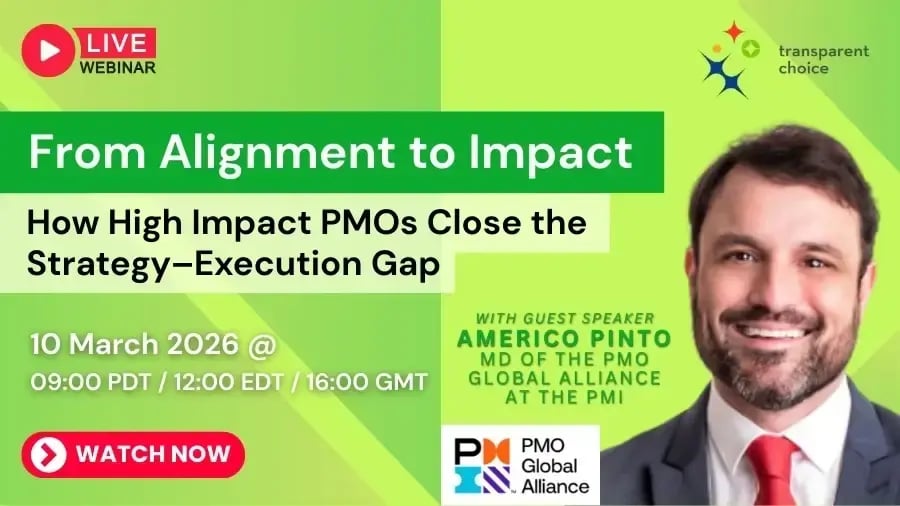
Strategic alignment becomes real when leadership has to decide what matters enough to receive scarce funding and capacity. In this session, Americo Pinto, Managing Director of the PMO Global Alliance at PMI, joins Stuart Easton to explore what a PMO can do when strategy, funding and delivery reality are not lining up.
The starting point is PMI’s Bridging the Gap report. As Stuart and Americo describe it, executives put strategic alignment at the top of the capabilities they value from PMOs, while PMO leaders give project-management process and strategic alignment almost equal weight. Americo argues that strategic alignment is still often more aspiration than established practice.
His diagnosis is that this is not a technical problem. PMOs already know the methods. The harder part is people: executives readily agree that portfolios should be prioritised and benefits measured, but weak measurement can avoid accountability and weak prioritisation can leave the dominant voice in control. The PMO can help by creating a transparent process that connects strategic goals, prioritisation and the constraints the organisation actually faces.
What you’ll hear
- Turn strategic alignment into real choices. If resources are finite, saying that everything supports the strategy is not enough. Leadership eventually has to prioritise.
- Keep the decision with the business. The PMO can structure a transparent prioritisation process, support leadership judgement and build buy-in without taking ownership of the choice away from business leaders.
- Bring capacity into the choice before the portfolio is fixed. Strategic capacity management asks whether the organisation can deliver the portfolio at all, not who works on which task next week. Stuart describes C-suite planning at one of the world’s top five banks allocating billions of dollars without overlaying resources, and identifies that disconnect as part of the strategy-execution gap. Projects can be selected on criteria without constraints, and an approved portfolio can become undeliverable when commitments exceed real capacity.
- Define value through the people the PMO serves. Dashboards and other PMO outputs only create the potential for better decisions; value depends on how the people being served perceive and use what the PMO provides. Americo recalls an executive who valued the PMO because he no longer had to walk back unreliable numbers in front of his peers. Who those customers are depends on the PMO’s mission: senior leadership can be critical, but an IT PMO may primarily serve the CIO.
Start with how leaders decide today
When discussing TransparentChoice, Americo describes an adoption problem he has seen practitioners encounter: arriving with a supposedly correct set of decision criteria can create resistance, even when the underlying method is sound.
His alternative is to begin by making visible how leaders already make decisions, then improve that decision model with them over time. That keeps leadership judgement inside the process rather than presenting the PMO’s model as a finished answer.
Ask the portfolio question
The discussion then moves from individual project selection to the wider portfolio choice: which combination of work delivers the most value within the organisation’s resource constraints? Choosing the highest-value projects one by one does not necessarily produce the strongest workable portfolio when they compete for the same scarce capacity.
Research in context
Strategic alignment is not mainly an agreement problem. Americo argues that PMOs can talk about being strategic without working that way. PMI’s Bridging the Gap report, based on its 2025 Global PMO Survey of 1,905 senior leaders and PMO leaders, found broad agreement on which capabilities matter. The disconnect is in where PMO resources actually go.
Capacity is also an investment-allocation question. Stuart and Americo argue that capacity should shape the portfolio before work is approved, not only determine who does what afterwards. In a 2010 survey of 115 CFOs of diversified Western European firms, 79% rated the organisation's ability to execute projects, including manpower and knowledge, as very or highly important to capital-allocation decisions.
How this connects to TransparentChoice
The gap in this webinar sits between agreeing strategic priorities and deciding what the organisation can actually support. TransparentChoice connects the two. Leaders assess initiatives against explicit priorities, with judgements captured independently or together, so competing views, and the consequences of forcing a commitment into the portfolio, are visible before resources are committed.
The model then applies funding, capacity by role, skill or team, timing, dependencies and other constraints, and evaluates combinations of initiatives to find feasible portfolio alternatives. Leaders can compare what is included or excluded, what each option demands of funding and capacity, and how the answer changes when priorities or constraints change. TransparentChoice supports the analysis; leadership decides which portfolio to commit to.
Learn more
Join the next live webinar

What happens when new demand meets capacity that is already committed?
In Bridging the Strategy–Execution Gap, Dirk Withake and Stuart Easton show how a PMO can make current commitments visible and ask leadership what stops or gives way when a new priority arrives.
How does a PMO make strategic portfolio management operational?
Continue with Deborah Yates and Stuart Easton on building strategic portfolio management into the PMO, including strategy cascade, governance, strategic value and decision-oriented executive reporting.
What does business-led prioritisation look like in practice?
The Harbor Foods PMO case shows how an accumulated backlog became a business-led prioritisation process, with business leaders setting annual criteria weights and scoring work rather than leaving the choice to IT.
Speakers

Americo Pinto is a globally recognized thought leader in the Project Management Office (PMO) domain and Managing Director of the PMO Global Alliance at PMI. With over 25 years of experience as an executive, consultant, author, and speaker across four continents, he has shaped PMO practices worldwide. Founder of the PMO Global Alliance, now part of PMI, Americo has been honored with the PMI Distinguished Contribution Award and holds multiple certifications, including PMP, PMO-CP, PMO-CC, and IPMA-A.

Stuart Easton is Founder & CEO of TransparentChoice. He works with leaders and portfolio teams on decisions about which investments and initiatives to fund, continue, change, defer or stop when priorities compete for limited funding and capacity. His work combines structured decision-making with practical portfolio choices.