
AHP as the foundation for a great portfolio: an 8-week roadmap

 I used to tell my kids the story of the three little pigs - the one with the houses made of straw, sticks and bricks, and the big bad wolf with the attitude problem. The little pigs who used straw and sticks probably did a great job in planning their houses, perhaps with a Gantt chart and milestones mapped out, but (spoiler alert) they were destined to become homeless from the moment they picked the wrong materials.
And it's the same thing with project prioritization.
A backlog built of the wrong projects will get flattened as soon as the CEO does a bit of huffing and puffing.
It could be that you've included low value projects which are obsolete from the start. Or you've got no hope of completing work on time because you've said "yes" to everything. Either way you’re wolf food, because you're using the wrong building blocks, no matter how well you plan or escalate once delivery is up and running.
Conversely, let’s think about the little pig who built his portfolio using prioritization. He looked for projects that supported his priorities, then checked which combination his budget and people could realistically support. That doesn’t guarantee an easy build, but it gives him a better set of bricks to work with.
Sound too good to be true? AHP - the Analytic Hierarchy Process - can help you judge what matters and how projects contribute. Use it to create your very own supply of bricks, then check funding, capacity and other constraints before you start building.
And this is so much easier than replacing your PPM or rebuilding your entire planning process. Here’s one illustrative eight-week route for introducing AHP-led prioritization across a defined scope, not a fixed deadline. Leadership availability, scope and data readiness will affect the pace. And if you have one decision to make now, you can start smaller and build the repeatable process from there.
How to Build a Prioritized Portfolio in 5 Steps
1. Make a plan
Get the right people in the room to define what success means. Reflect on how planning works (or does not work) in your organization. We recommend a simple 3 P’s framework as a place to start:
- Process: How does the prioritization exercise align to the allocation of resources? What scope / timeframe does this imply? Who needs to be involved?
- Politics: Who are the key stakeholders? Is there good alignment between teams? What changes are needed to ways of working? A good sponsor is critical to make change happen.
- Projects: What is the size and scope of the backlog under review? Decide if you are prioritizing projects, programs, features… or something else, and avoid mixing within the same model.
This can happen in 1 week, or longer for a more complex portfolio, but resist the temptation to skip it as it will make everything else work far better.
2. Build & Weight Criteria with Leadership
Building an AHP model is not rocket science (though NASA systems engineering guidance includes AHP among its decision-analysis methods). Follow these steps:
- Review your current portfolio for Pros & Cons: Learn about what the key business drivers are for your business stakeholders. Ask project sponsors what they are trying to achieve and look for patterns across the business. Perhaps it's about operational efficiency or winning market share, or probably a bit of both.
- Use existing Strategic Goals: Strategic Goals are excellent as a base for Criteria: they show what you are trying to achieve, while criteria help you judge how projects contribute. That also gives you a stronger way to make the case to the CEO, by showing how prioritization connects to their strategy.
- Separate value from constraints: For this rollout, use AHP to assess how projects contribute to agreed goals, then bring costs into the portfolio choice. Value divided by cost can be a useful diagnostic for finding projects that deserve a closer look, but it isn’t a rule for selecting a feasible portfolio. Cost can sometimes also be an AHP criterion; if you do that, take care not to double-count it when you apply budget limits.
- Let us help you get started: We have written a guide to project prioritization criteria to help you build a starting point. Don’t start from scratch.
- Agree on Criteria: Get an agreement on the criteria you are going to use to prioritize your projects. If people see that important criteria are missing, they won’t feel comfortable with the whole process. Put another way, without a credible shared model, people are much less likely to trust the results.
- Use pairwise comparisons to weight your model: When you have your criteria agreed it is time to prioritize them. AHP gives you a powerful way of doing this prioritization – pairwise comparison. This is also great way to continue driving alignment within the leadership group, as it's a chance for competing voices to learn from one another.
If you’re pushing it, this can be done inside 3 weeks. Longer is fine if you need change to be more gradual to give people time to reflect. It’s critical to get quality time with your leadership team to ensure you fully realize the value of journey, or as one client’s CEO put it: “We’re having conversations we should have had years ago”.
3. Get Project Level Data
Clearly you're going to need to get data - here's the shopping list to build that wolf-proof process:
-
Where do my projects come from?: If you have a PPM system with a set of projects in then plug it in. If you want to drive ideation from within your organization then set up a simple project request page. Or simply get a group together to brainstorm projects as a team. Don't forget when it comes to identifying winning projects, it's your mid-level managers who know what's best, so make sure you're tapping into their insight.
One special tip here, don't prioritize every project request. Eliminate proposals that are not ready to be prioritized or shouldn't be prioritized at all. For example, you may block projects that are too risky, not aligned with strategy, don’t comply with legal requirements, or are not clearly defined. Similarly, you may need a project because of new legal regulations. You don’t need to treat it as optional work if there is no choice about doing it, but the funding and capacity it uses still affect what else can fit.
- What are your resource constraints? For this rollout, keep the AHP value assessment distinct from the costs and resource limits you will use when choosing the portfolio. Cost can also be a preference criterion in some models, but avoid double-counting it. Capturing the resource data is critical, so don’t forget this step. Estimates can be simple T-Shirt Sized, or detailed bottom up views. They can also be individual estimates or team generated ones. You can even add bottleneck analysis, by identifying the type of resource needed for each project, so you can check whether a team would be overloaded before committing. For a complex portfolio, constrained optimisation can help compare workable combinations.
- What other flags or lenses do you need for analysis? Overlaying a reporting hierarchy or requesting team is often important, especially if you have a ‘spaghetti-mess’ problem. Identifying mandatory projects is also often important.
This can all happen in parallel to your criteria build, so aim to have it in place by week 4. For a fuller checklist of the information to gather and who needs to provide it, see our 10 portfolio data sources.
4. Get Scoring
It’s important not to rush this step as it’s where a lot of the magic happens, when people compare votes and learn from one another. That said a well-structured model shares the workload, so folks can score in parallel across different projects and criteria.
- Generate personalized questionnaires: Independent answers can reveal disagreements that group discussion might hide. Where it matters, ask more than one knowledgeable person to assess the same question before comparing responses. Find the right people for the right questions - have the engineers cover technical features, and the marketeers assess customer engagement. If you’ve got an ongoing review process, make it easy to reuse the questionnaires next time.
- Chase compliance: Track completion; for a new process people may need to some 'encouragement' to get their work done, as they build the muscle memory needed to commit to a new way of working. Once they get started they'll realize it's easy, and a great way to have their say.
- Build Alignment: Once you have judgements identify where there is real disagreement. Putting the issue on the table gives people a chance to listen to different viewpoints, challenge the evidence and explore why assessments differ. That doesn’t mean everyone will agree or that a shared score turns judgement into fact, but it gives leadership something concrete to discuss before deciding. These conversations can be among the most valuable parts of the process. Getting people involved can be worth the price of entry on its own.
Allow 2 weeks for this process, or longer if you're colleagues are going to be slow, but try to keep focus as this is good for driving change.
5. Choose the best portfolio
Once you have the project assessments and resource estimates together, this step becomes easier to discuss. Value-for-money rankings can highlight projects worth a closer look, but they don’t select a deliverable portfolio. The ‘Efficient Frontier’ view shows how modelled portfolio value changes at different funding levels, so leadership can explore the trade-offs before deciding what to fund.
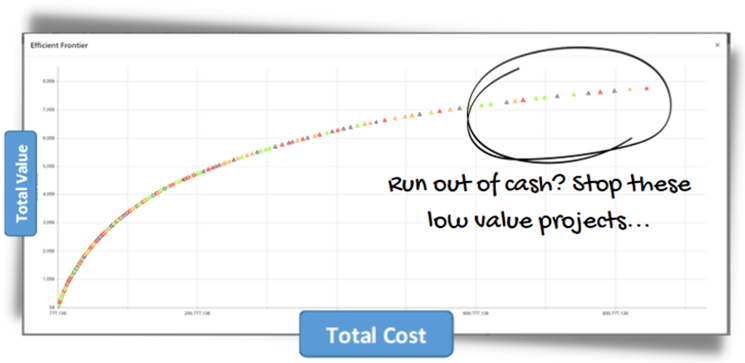
For a portfolio with funding, resource, timing or other constraints, optimisation can help compare combinations of projects that satisfy the limits you have modelled. Leadership still decides which feasible alternative to support. Don’t forget start dates either. Having a portfolio of projects all start on January 1st isn’t helpful.
Far better to map out a month-by-month plan, test it against available people and skills, and see where commitments may need to move. Tools can help compare start dates and capacity pressure, but the proposed sequence still needs checking with the people doing the work.
With the right tools, generating alternatives can be quick. However, we recommend allowing 2 weeks for people to reflect, offer feedback and challenge assumptions before leadership commits. Offering the leadership team different scenarios is also often a good idea.
So that’s one possible 8-week route to a more wolf-resistant plan.
For those of you starting on this journey you will always hear (at least) one colleague challenge you – “couldn’t we just do this in a spreadsheet / meeting room / PPM tool”? We don’t have time to do this right now. Here the reply should be simple. It might be quicker to build a house from straw (or sticks) but how much time will you waste re-building that house again and again as your construction fails to withstand the rigors of a big bad wolf? Surely, it’s far better to deliver quality at pace than to stick with a solution that doesn’t work.
AHP gives you some of the bricks and mortar for effective project prioritization, but the wolf won’t disappear forever. Once you’ve made the first portfolio choice, revisit priorities, funding, capacity and project assumptions as conditions change. Be prepared to change what starts, waits or stops when the old plan no longer fits.
If leadership has a consequential portfolio choice to make, explore the Decision Sprint: focused, supported use of TransparentChoice to compare feasible portfolios, test trade-offs and understand what stays and what gives way.