
Project Prioritization Matrix: Avoid These 4 Common Mistakes

In this blog I often talk about the project prioritization process and the best method of implementing it. In this article I would like to share some ideas on how to use the prioritization matrix to prioritize projects in a way that gives you a chance to succeed.
What is Prioritization Matrix?
A prioritization matrix is a simple tool where you create a set of criteria (which should map to your business goals) and use them to score your projects. Why? Well, you’re trying to work out which projects are most important so that you can prioritize them.
It’s pretty simple in concept, but can be really hard to do well.
It’s not the maths that’s difficult (and that’s where most articles on prioritization matrices focus), it’s all the human stuff...
Benefits of Prioritization Matrix
In principle, a prioritization matrix is easy to use and to use to make decisions. Most business managers can understand the concept of a weighted score in a spreadsheet.
Once you have your spreadsheet, it’s easy to tweak criteria weights and to see the effect on your ranking immediately.
Your priority matrix also spits out a clean, unambiguous number for “priority”. This is something that everyone can understand and relate to.
Prioritization Matrix For Projects
Let’s spend a minute looking at how the project prioritization matrix is usually deployed.
First, you define a set of criteria that you will use to score projects. These criteria should reflect your business goals. You should then weight these criteria - usually people will give each one a percentage-based weighting.
Next, you score your projects. You need to score each project against each criterion, but you need to come up with a suitable scale.
In decision-science speak, we talk about normalizing scores, so that every criterion is measured on a comparable basis. Simply using the same 1–5 scale for every criterion isn't enough: you need clear descriptions of what each level means, including what counts as no contribution. For hard numbers such as NPV, you may need a benchmark or cap to turn raw figures into comparable scores. I won’t go into the maths here, but don’t skip this step - it can cause real problems.
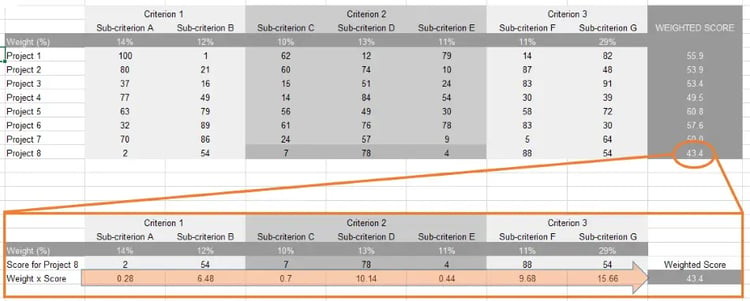
Now you have your weighted criteria and your scores for each project, you can work out the weighted score for each project by doing a fairly simple calculation:
(Weight of Criterion 1 x Score of Criterion 1) + (Weight of Criterion 2 x Score of Criterion 2) + (Weight of Criterion 3 x Score of Criterion 3) + …..
Keep going until you have added up the weighted scores for all the criteria… and that’s it. You have a priority score for your project… and you can move on to do the same calculation for the next project.
Of course, you’ll probably want to do this in a spreadsheet. This example will show you what the maths looks like.
Problems with Project Prioritization Matrix
The core problem is caused by its main benefits - the prioritization matrix is a tool designed to be quick and easy to use... which is okay if decisions are not very important. If you’re prioritizing short tasks, things that don’t have much impact over the long term, then this is fine.
But projects are not tasks.
Projects are bigger and the consequences of picking the wrong ones can be spectacular.
Pick the wrong mix of projects and you can spend the budget while leaving more valuable work undone. That’s a pretty significant consequence, even when individual projects deliver.
So let’s look at four ways a project prioritization matrix can mislead you, and what to do about them.
1. No alignment on criteria
Very often, a team that “owns resources” will put together a priority matrix to help figure out what they should tackle first.
The problem is that this team is not the “customer”. Those projects exist to support your “customer - stakeholders” and they should be the ones to select the criteria.
Of course, you can own the “process” of selecting criteria - run a brainstorming workshop, for example - but your stakeholders should own the selection of criteria.
For a practical example, the Harbor Foods PMO case describes business leaders, rather than IT, setting annual criteria weights and answering project-assessment questions.
2. No process to establish weights
Your criteria are not all equally important.
What’s more, if you ask 5 stakeholders what weight to put on the criteria, you’ll probably get 10 answers!
Without agreement on this, your project prioritization matrix is meaningless.
Sure, it will give you some numbers, but those numbers will not be trusted (or even relevant) to your stakeholders. So yes, you’ll be able to make prioritization decisions, but you won’t be making decisions that actually help your stakeholders.
One way to establish weights is the Analytic Hierarchy Process (AHP). Instead of starting with guessed percentages, stakeholders compare the relative importance of criteria in pairs.
A 2017 University of New South Wales comparison of multi-criteria decision methods found AHP and Data Envelopment Analysis (DEA) the two most suitable of eight methods compared in detail for the project portfolio management problem it examined.
The comparisons make differences in judgement easier to see and discuss. The group can then agree on weights it is prepared to use, rather than hiding disagreements behind a single tidy-looking number.
3. Broken collaboration on scoring
When you’re scoring a project against a criterion like “Impact on customer satisfaction,” you have to make a subjective judgement. Some people might see the “impact” of the project as being “Major” and others might consider it “Insignificant”.
If you don’t have a mechanism for resolving this, for bringing together different stakeholders to make subjective judgments, then your scores will end up being totally meaningless… at least, they will be meaningless to your stakeholders.
Some of your scores will be “hard numbers”. For example, the “net present value” or “number of systems impacted” are hard numbers, but somehow you have to get those data from the “subject matter expert” who holds them. This typically involves a lot of chasing and then cutting-and-pasting into spreadsheets.
This not only takes time, but is open to errors as you copy data from one place to another. It’s also common for data to be out of date.
This is where a shared assessment process can really help.
TransparentChoice can route assessment questions, including hard data such as net present value, to the people who hold the answers. It can collect independent assessments from different contributors, keep their responses separate and show differences for discussion. That gives stakeholders a better basis for reconciling a subjective judgement such as “Impact on customer satisfaction”.
Overall, if you don’t collaborate effectively when scoring projects, your prioritized scores will not be “trusted”.
4. Score-based decisions
When you’re prioritizing small, tactical items (tasks, maintenance items, etc.), you can usually use the “score” from your matrix to prioritize work. Taking the task with the highest score is typically a good rule.
Projects are different.
Projects exist to help you achieve more strategic business goals. They compete for resources and for budget. Sometimes, there are dependencies between projects and the whole decision is usually quite political. This means you need to balance resources across different departments, different business goals, etc…. and all while tracking your various resource constraints and budget.
A spreadsheet can be enough for a small, understandable set of projects. The harder question is whether you can reliably compare alternative combinations once funding, shared capacity and dependencies matter. Complexity grows with the decision, not at a fixed project count.
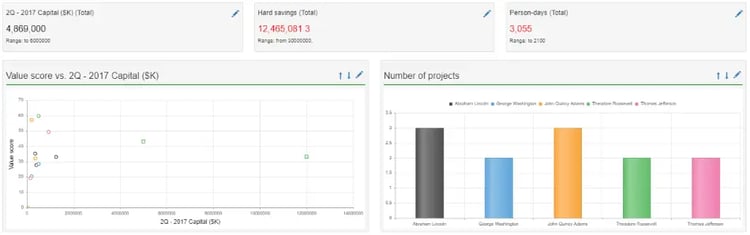
TransparentChoice can bring value assessments together with funding, resource-capacity and dependency constraints, then compare feasible combinations of projects. You can see what is included, what gives way and how the answer changes if priorities or assumptions change. You still decide which commitments to make. See how the software supports portfolio choices.
Summary
The Prioritization Matrix is a useful scoring tool, but ranking individual projects is not the same as deciding which combination can actually be supported. That is where the wider project prioritization and selection process matters.
The concepts behind it are sound - we want to maximize alignment with our goals, and use weighted scoring to do that - but the practice typically falls short in areas such as:
- Getting business stakeholders to own the criteria
- Weighting those criteria (with stakeholder buy-in)
- Reconciling different judgements about project scores
- Testing funding, capacity and dependencies before committing to a portfolio
TransparentChoice can help take the matrix ideas further: structure stakeholder judgement, compare portfolios against real constraints and revisit the choice when circumstances change. That makes the trade-offs behind the portfolio choice easier for leadership to see and explain.
Learn more
For the full process, from criteria and scoring through feasible portfolio selection and sequencing, see the Project Prioritization guide.