
Why AHP works for Prioritization

 If your current prioritization process feels more like a Magic Spreadsheet or a Magic Eightball, the Analytic Hierarchy Process (AHP) gives you something much more useful: a structured way for leaders to compare projects against several competing priorities. It makes the judgement explicit by defining criteria, comparing priorities, assessing alternatives consistently and testing where those judgements do not fit together coherently.
How AHP turns strategy into explicit priorities
AHP decomposes broad strategic goals into criteria and sub-criteria that can be compared and used to assess alternatives. That creates a visible bridge between strategic intent and project evaluation without pretending strategy can be reduced to a single objective measure.
The difficult part is often not identifying desirable goals. It is deciding how much one matters relative to another when they compete. Growth may pull against cost control. Resilience may compete with short-term return. Sustainability may matter alongside service quality or risk.
Pairwise comparison makes relative priorities explicit
Instead of asking leaders to invent abstract weights directly, pairwise comparison asks them to compare two priorities at a time: which matters more, and by how much? This makes relative priorities easier to express and gives leadership a structured way to turn broad strategic language into explicit trade-offs.
It enables you to create user-friendly questions which look like this:
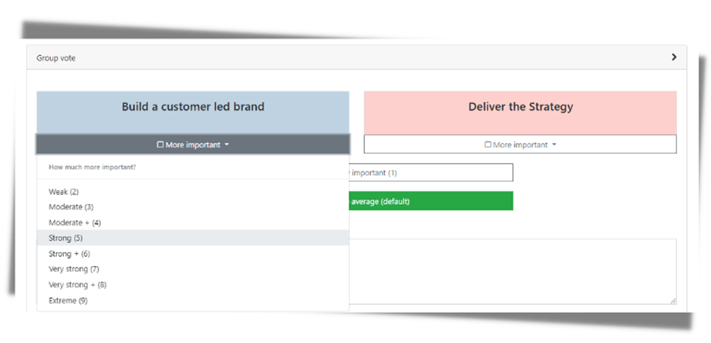
The calculations behind AHP convert those comparisons into weights and include a consistency measure that flags when a set of judgements does not fit together coherently. That does not prove a judgement is wrong; it tells the decision-maker where another look may be useful. Software can handle the maths while keeping the underlying comparisons visible.
The key to Pairwise is that it forces you to make choices. Your strategy probably doesn’t differentiate between the elements that keep the CEO up at night, and the elements that got shoe-horned in because every director needed a couple of bullet points to call their own. That means it will fail as the base for a prioritization model because it’s not making the hard choices, and if everything is important… then nothing is important.
Structuring criteria creates a measurable bridge between strategy and projects
The “H” in AHP stands for Hierarchy. For example, breaking your model into Productivity vs. Environment is a start, but neither of these goals is specific enough to be measurable, so add layers (‘sub-criteria’) beneath. Perhaps “Productivity” is best defined as types of saving (headcount vs materials for example) or by channel (call center vs sales). This means you get the granularity needed for measurement, connected to the high-level trade-offs that define a good strategy. Similarly, “Environment” could be expressed as impact on Emissions, Water Usage and Recycling (for example) as more specific benefits against which different environmental projects will be measured.
As above, you then apply pairwise to weight these competing branches in the model, so you continue to make practical trade-offs between competing objectives.
For each sub-criteria you build scales to make sub-criteria quantifiable. Typically, these scales start with an ‘ideal’ outcome (where the sub-criterion is fully satisfied), then step down through less good choices. There’s no fixed rule but having five options works well. It’s very similar to a Likert scale which you’d have seen in psychometric questionnaires (“Do you... Strongly Agree / Agree / Neutral etc.”)
How AHP improves the decision process
Structured collaboration improves the decision
Prioritization gets harder when important judgements sit in one person’s head or are made in a meeting where the first or loudest opinion shapes everything that follows.
People bring different knowledge, assumptions and perspectives to a portfolio decision. AHP gives you a way to capture those judgements independently before the group discussion begins. That helps make differences visible before hierarchy, anchoring or group dynamics have a chance to smooth them away. Read more about Noise in Decision-Making.
Independent input first, discussion second
Rather than asking everyone to negotiate a score in the room, participants can complete their pairwise judgements independently. The results then show where people already agree and where their priorities differ.
AHP also measures consistency. If your comparisons imply that A is more important than B, and B is more important than C, the method can flag when the rest of your judgements do not fit that pattern coherently. That gives participants a chance to revisit the judgement rather than burying the inconsistency inside an overall score. Read more about inconsistency here.
Then bring the group together. Instead of spending equal time discussing everything, leadership can focus on the areas where judgements genuinely diverge, assumptions need clarification or priorities are inconsistent. Having a nice chat about everything you already agree on is low value add, unless the meeting has really good biscuits.
Participation builds buy-in to difficult choices
A good prioritization process will not make everyone agree with every outcome. But people are far more likely to understand a decision when they can see the criteria, understand the trade-offs and know their perspective was part of the process.
That matters when some projects will not be funded. A transparent decision process gives leadership a much stronger basis for explaining “yes”, “no” and “not now” than a ranking produced behind closed doors.
Why AHP is well suited to complex prioritization
A University of New South Wales study reviewed more than 100 multi-criteria decision-making methods and selected eight for detailed comparison. AHP and Data Envelopment Analysis (DEA) emerged as the two most suitable approaches for the project portfolio management problem they examined.
That fits the practical reason we use AHP: it can handle several competing criteria, make relative priorities explicit and give leadership a structured way to compare projects without reducing every form of value to a financial number.
Want to learn more? Watch this Webinar:
Why we chose AHP
TransparentChoice is built around AHP because it gives us the combination we need for complex prioritization: multiple dimensions of value, explicit trade-offs, participation from different stakeholders, consistency checking and a transparent model leadership can inspect.
Financial measures such as ROI and NPV remain important. They answer financial questions well. But portfolio decisions often involve more than financial return: strategic contribution, risk, resilience, customer outcomes, regulatory requirements and other priorities may all matter at the same time.
AHP lets those considerations sit inside one decision structure without pretending they all need to be converted into money. If you want a deeper look at that distinction, see Value-Based Prioritization: Why ROI Alone Is Not Enough.
Weighted scoring can also compare several criteria, but AHP adds the discipline of pairwise comparison and consistency checking. Product methods such as MoSCoW and RICE are useful for different prioritization jobs, particularly within product teams and backlogs. Our problem is broader: helping leadership compare competing investments across several strategic priorities.
For the kind of complex, cross-functional portfolio decisions we work on, we have not found a stronger combination. AHP gives us both discipline in the judgement and a process stakeholders can understand and participate in. That is why it became the decision-science foundation for TransparentChoice.
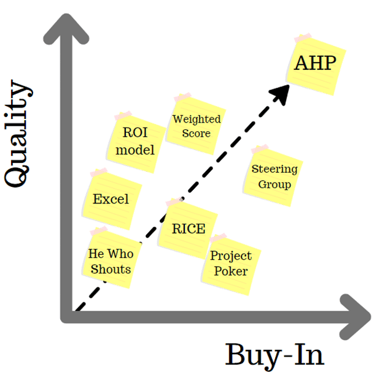
The chart below summarizes our view of how common prioritization approaches compare on those dimensions.
AHP turns judgement into portfolio analytics
Once priorities and project assessments are quantified consistently, leadership can see patterns that are difficult to spot in a spreadsheet full of individual scores.
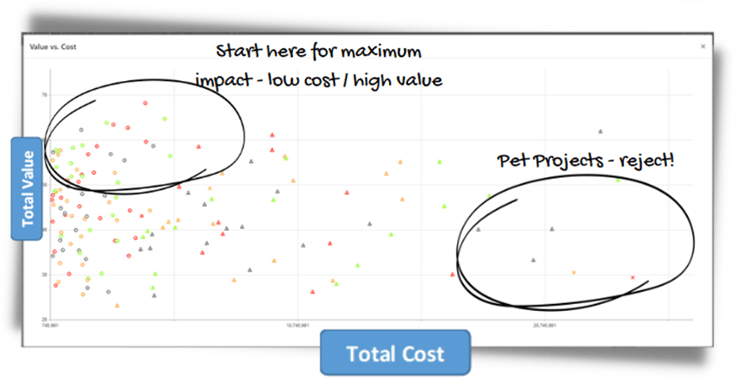
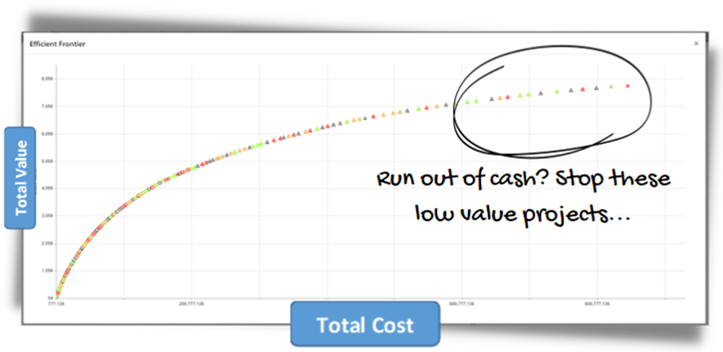
You can compare value with cost, see which strategic goals different investments support, examine the distribution of value across divisions and explore where the portfolio is concentrated or exposed.
The important shift is from a list of scores to something leadership can interrogate. Quantification makes the assumptions and patterns easier to see, discuss and challenge. We have a whole other article on prioritization data visualization.
AHP helps manage risk
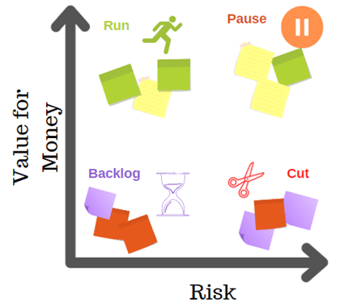
Dealing with risk is a key challenge in most planning processes. Ignore risk at your peril, but let it dominate and you become too cautious. Every organization is different, the key is that you determine the right approach as part of planning. Here are the main options:
- Make risk a gating factor to fast track ‘must do’ projects.
- Build a risk model using AHP, which scores projects according to what happens if the project is not done, enabling pragmatic judgements around 'grey areas'.
- If detailed quantitative risk modelling is available, you can integrate that evidence into the AHP model or compare it alongside overall project value.
- Score project riskiness as a discount to the value of your project, thus reducing the score where (for example) organizational readiness is low or risk of disruption is high.
Making risk explicit means leadership can see how it affects the comparison, challenge the assumptions behind it and decide how much weight it should carry alongside other priorities.
AHP makes reprioritization faster
One of the biggest advantages of building the decision model properly is that you can reuse it. Once leadership has made the hard choices about what matters, you do not need to rebuild the prioritization logic from scratch every time a new proposal arrives or circumstances change.
- Criteria and definitions can be reused. Once leadership has agreed what value means, the same structure can support repeated investment decisions while those priorities remain relevant.
- Discussion becomes more focused. Areas of agreement do not need to be endlessly re-litigated; leadership can concentrate on the judgements or assumptions that have actually changed.
- New work can be assessed against an established model. Teams do not need executive micro-management every time another proposal appears.
- Priorities can be revisited. When strategy changes, leadership can reweight priorities and see how the relative value of competing initiatives changes.
- The updated judgement can feed portfolio optimisation. Funding, capacity and other constraints can then be applied again to see whether a different feasible portfolio should be considered.
That reusable decision logic is what creates speed. When something changes, leadership can update the relevant priorities or assumptions, rerun the analysis and see what changes without rebuilding the entire decision from scratch.
If you are establishing the process for the first time, our eight-week AHP prioritization roadmap walks through the stakeholder process from defining the decision model through project assessment and portfolio review.
Connect leadership judgement with portfolio optimisation
AHP helps structure and quantify judgements about the relative importance of goals and the contribution of different initiatives. Those assessments can then be used alongside funding, capacity, mandatory requirements and dependencies to compare feasible portfolio combinations. Some of the binding constraints may sit beyond headline budget and headcount.
Portfolio optimisation adds a separate computational step. It helps leadership explore which combinations can be supported under the available constraints, what each would protect or defer, and how the choices change when priorities or assumptions change. Leadership remains responsible for deciding which portfolio to support.
What this looks like in practice
Different organizations use the same decision structure for very different portfolio problems.
Make sponsor influence visible. At the American Planning Association, board-defined criteria and weights gave executives a common basis for assessing competing work and helped expose projects being protected by sponsorship rather than their contribution to agreed priorities.
Create a common language across a complex portfolio. After a merger, Suzano used shared AHP criteria to compare more than 130 innovation projects that had previously been evaluated through different divisional approaches. The customer case reports prioritization becoming 10× faster than its previous spreadsheet process.
Reprioritize when the world changes. At the RNLI, engineering experts and leaders used shared criteria to assess existing and proposed work. When COVID changed priorities, the criteria were reweighted and the portfolio was rebalanced.
Replace lobbying with a repeatable process. Simon Fraser University replaced spreadsheet and whiteboard prioritization with shared value and complexity criteria plus stakeholder scoring, creating a process participants could understand even when their preferred project was not selected.
From AHP to a real portfolio decision
AHP gives leadership a structured way to define value, make trade-offs and compare competing initiatives. TransparentChoice connects those judgements with funding, capacity and other constraints, then helps leadership compare feasible portfolio choices and see what each would protect, defer or leave exposed.
See how TransparentChoice turns structured judgement into portfolio decisions →
💚 If you enjoyed this article, please consider following us. It’s a small gesture that means a lot to us and encourages us to keep sharing what we learn. See the ways to follow us below ↓