
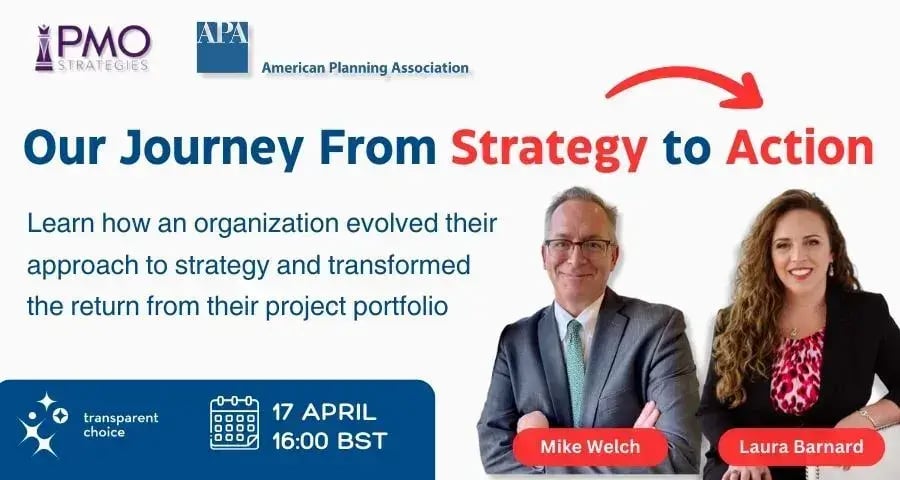
Our Journey From Strategy to Action
About this webinar
The American Planning Association (APA), the national membership organisation for urban planners in the United States, had 144 items on its two-year strategic plan, no single view of all the work underway and more commitments than it could realistically support. Mike Welch recalls a culture in which people came to expect that some promised work would never be finished. What changed when APA began making harder choices about what to pursue?
In this conversation, Mike Welch of APA joins Laura Barnard and Stuart Easton to explain how the organisation narrowed its priorities, challenged established programmes and built greater confidence in following through on its commitments.
What you'll hear
- From 144 items to four or five initial priorities. APA brought scattered work into view, involved leadership in defining and weighting strategic criteria, and concentrated resources on a much smaller number of initiatives rather than trying to advance everything at once.
- A difficult decision about international outreach. Mike describes a programme with committed advocates but, in his assessment, limited value for members. Its relatively low score against leadership's criteria made the trade-off visible and, in his account, helped APA stop further spending. Laura explains how AHP and pairwise comparison can make the judgements behind prioritisation more explicit.
- How executive buy-in was earned. Mike explains why he started by interviewing executives about their problems, using their language and demonstrating early value rather than asking them to surrender decision authority. Support from APA's CEO and board mattered, as did working through resistance when familiar programmes lost priority.
- Building delivery capability, not just choosing better work. With training and coaching from PMO Strategies, APA introduced practical project-management methods, risk planning and support for project sponsors. Mike describes building capability gradually, learning which practices worked and later introducing a separate delivery-management tool.
- What changed for the people doing the work. Mike contrasts the old expectation that some commitments would inevitably fall away with a new sense of confidence, satisfaction and pride. In his account, people became more confident that when APA committed to something, they could see it through and deliver value for members.
The conversation also explores recurring strategy and portfolio reviews, how pandemic conditions made some early changes easier, and the continuing difficulty of measuring long-term impact for members.
Research in context
In a 2015 Harvard Business Review study drawing on a survey of 7,600 managers in 262 companies, only 11% said all their organisation's strategic priorities had the resources needed for success. Eight in ten said their companies were too slow to stop unsuccessful initiatives or exit declining businesses.
These are problems managers reported across many organisations. Mike's account shows APA confronting both: concentrating resources on fewer priorities and challenging continued spending on established work, including international outreach.
How this connects to TransparentChoice
Making the trade-off visible. When APA assessed its international outreach programme against priorities set by leadership, the resulting scores made its relative weakness visible enough to confront the funding question. TransparentChoice supports this kind of discussion by structuring leadership judgement through AHP and enabling initiatives to be assessed against those priorities.
From individual scores to feasible portfolios. When the question extends from comparing individual initiatives to deciding which combination of work can actually be supported, TransparentChoice can also evaluate feasible portfolios against funding, capacity and other constraints. Leaders can compare alternatives, test changed assumptions and see what would give way. Leadership makes the final commitment decision. See how TransparentChoice software works.
Learn more
Join the next live webinar

How can a PMO turn business problems into a practical improvement system?
Laura Barnard explains her six-stage IMPACT Engine, from understanding stakeholder problems and finding root causes to delivering visible improvements through short planning and review cycles. Watch Laura's IMPACT Engine discussion
How do you earn executive support when it isn't there yet?
Alexander David and Stuart Easton explore how to build credibility by diagnosing leadership problems, demonstrating early value and developing a Case for Change that can evolve as support grows. Watch Winning Executive Buy-in for Your PMO
Why is it so difficult to stop established work?
Projects can retain protection through sunk costs, sponsor interests and fear of admitting failure. Explore how shared priorities and visible trade-offs can help leadership make a defensible stop decision. Read Lessons from Weeding Project Portfolios
Speakers

Mike Welch has over 20 years’ experience at APA, leading initiatives in leadership development, organizational strategy, and global collaboration. He specializes in aligning people, processes, and strategy to deliver impact for membership organizations.

Laura Barnard, PMP, CAL, Prosci, IES is the Founder and CEO of PMO Strategies and author of The IMPACT Engine: Accelerating Strategy Delivery for PMO and Transformation Leaders. Recognized as the 2021 World PMO Influencer of the Year, she has nearly three decades of experience helping organizations close the strategy-to-execution gap. Laura is also host of the PMO Strategies Podcast and Co-Founder of Project Management for Change, where she champions raising the profile of project management worldwide.

Stuart Easton is Founder & CEO of TransparentChoice. He works with leaders and portfolio teams on decisions about which investments and initiatives to fund, continue, change, defer or stop when priorities compete for limited funding and capacity. His work combines structured decision-making with practical portfolio choices.