
Optimize Project Flow: Make projects go faster by slowing down!

 My son has recently taken up running. I keep telling him to pace himself, but he doesn’t. He blasts out and, after a couple of hundred meters, has to walk for a bit. Then he’s off again.
He gets to the end. He’s exhausted and his dear old dad is already there, waiting for him.
Did dad sprint? No, I certainly did not!
I ran steadily and slowly, but I beat him.
How did an overweight, middle-aged guy beat his teenage son? Well, I know something that he doesn’t. I know a little about the theory of constraints. And what I know can transform your project delivery flow.
Where Project Flow Breaks Down
Most of what I know about the theory of constraints I learned from Mike Hannan. Mike is a recognised expert in applying theory of constraints to project delivery.
We recently had Mike run a short webinar outlining the key concepts. You can watch the full session at the bottom of this blog, or the short video below for a concentrated version.
The key point is simple. The flow of projects, water, or even oxygen when you are running is limited by the bottlenecks in the system. When you try to exceed the capacity of that bottleneck, overall flow slows down rather than speeding up.
These are the same constraints and flow challenges we see when working with portfolios in practice. Learn more about how TransparentChoice approaches portfolio decisions.
In the clip, Mike shows a clear example using water flowing out of a bottle.
Why Maximising Utilisation Slows Delivery
So you are a PMO. You have 200 project resources, but their utilization rate is only 50 percent.
It feels obvious how to increase project flow. Add more projects and drive up utilization.
That works for a while. Then something unexpected happens. Flow starts to slow down. This screenshot from the webinar shows the effect.
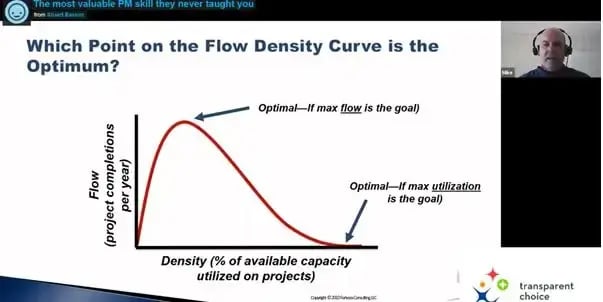
The graph shows something most organisations miss. The point where you maximise flow is not the same as the point where you maximise utilisation. If you are operating on the right-hand side of the curve, reducing the load slightly will actually increase the number of projects completed.
Coming back to the running metaphor, slowing down allows you to keep going. You reach the finish line sooner because you do not burn out halfway there.
What Happens When You Reduce the Load
When an organisation operates on the right-hand side of the curve, well beyond the peak, the same level of project flow could potentially be achieved with significantly less effort.
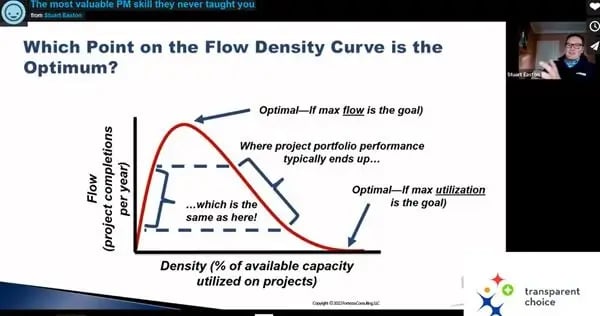
This is another screenshot from the webinar, and it raises a simple question. Where would you rather operate?
- On the right-hand side, with teams under constant pressure
- On the left-hand side, with more breathing room and the same level of delivery
- At the peak, where effort and output are in balance and flow is maximised
For most organisations, the answer is obvious once the trade-off is made explicit.
Why Prioritisation Determines Value
Not all projects are created equal, and the business does not care how many projects you complete. What matters is the value you deliver.
Every organisation has a practical limit to how much work it can push through the system. You can improve that limit over time, but there is always a ceiling.
This is where prioritisation matters. It is how you ensure that limited capacity is spent on the work that creates the most impact. When capacity is constrained, the choice of which projects move forward determines how much value flows through the portfolio.
There are effective and ineffective ways to approach project prioritisation. I will not go into that here, but if you want to explore what good looks like in practice, you can see our Ultimate Guide to Project Prioritization.
Putting It All Together
In summary, do not make the same mistake my son makes when he runs. Pushing flat out all the time feels productive, but it slows progress overall.
Capacity is limited. The challenge is to deliver the maximum business value from the capacity you already have. That comes down to three practical steps.
- Prioritise the projects that matter most
- Set a project load that maximises throughput for your organisation
- Then work deliberately to increase your maximum flow over time
Webinar: The Most Valuable Portfolio Management Skill They Never Taught You
Michael Hannan of Fortezza Consulting shares a practical technique that helps PMOs move from activity to impact. He explains the cycle many PMO environments get stuck in and shows how leadership decisions can shift that cycle in a more productive direction.
The presentation introduces a more mission-driven set of performance measures, challenges common assumptions around consistency and compliance, and explains a simple technique organisations can use to get closer to their true potential.
Mike is a highly experienced consultant and author with a long track record of helping organisations improve portfolio outcomes. If you want a deeper dive into the ideas behind project flow and constraints, the webinar is well worth watching.
From Insight to Action
The patterns described in this article are not theoretical. We see the same bottlenecks, overload, and prioritisation challenges in portfolios we work with. Teams are busy, utilisation looks high, and yet progress can feel slower than it should.
The first step is not necessarily a tool, a framework, or a big transformation. It is understanding the decision you are facing and what is constraining it.
A Decision Review is a 30-minute, no-fee, confidential conversation about what is changing, what is constrained, and what would be worth testing. No preparation, sensitive detail or confirmed sponsorship is required, and the conversation can stand alone whether or not a Decision Sprint follows.
💚 If you enjoyed this article, please consider following us. It’s a small gesture that means a lot to us and encourages us to keep sharing what we learn. See the ways to follow us below ↓