
Pet Projects: How Executive ‘Great Ideas’ Destroy Portfolio Value


Many inspirational growth stories start with a paradigm shifting project: Netflix turning entertainment into a subscription model, Under Armour and connected data, Apple and iPhone... but for every free-thinking Unicorn story there are hundreds of portfolios littered with ugly Pet Projects, which start as one exec's "great idea" but turn out to be hungry hippos that eat all the resources and trample on your career.
Pet projects aren’t just quirky executive distractions — they are a major driver of portfolio overload, wasted spend, and strategic drift. They quietly erode value long before anyone notices.
In our portfolio work, we regularly encounter initiatives that retain support despite competing claims on the same scarce resources. The question is whether their continued protection is justified by the value they are expected to deliver.
If this sounds familiar — critical maintenance keeps slipping, teams are permanently “at capacity,” and yet there’s always room for one more executive side-project — you’re already living with pet projects.
Pet projects can be especially difficult to challenge because sponsorship may protect them from the same scrutiny applied to other work. When they continue consuming scarce capacity without a persuasive value case, other worthwhile commitments can be delayed or displaced.
The hard part isn’t spotting a pet project — it’s challenging it in a way that protects relationships and still protects the portfolio.
Who better to speak truth to power than Amanda Oakenfull? As a specialist in portfolio turnaround she's seen the damage a rogue pet project can cause, and provides a direct simple view on how to deal with them:
Amanda’s experience highlights how common — and costly — pet projects can be. Here’s how to recognise them and stop them early.
In most organizations today, portfolios are already overloaded and resources are stretched thin. When an executive-driven pet project jumps the queue, something valuable is pushed out — often something critical. This is why tackling pet projects is essential to improving flow and delivering strategy.
What are Pet Projects?
Firstly let's be clear: Pet Projects are not cute. They are a pest within your portfolio that will destroy value and take your career with it.
They consume scarce resources but deliver little value. They distract the organization from what actually matters and quietly reduce the overall value your portfolio delivers.
At its worst, it can mean ignoring the basic requirements needed to keep your organization viable — the portfolio equivalent of fiddling while Rome burns.
Where do Pet Projects come from?
- Chasing the latest shiny new thing: Beware the executive who has been to a conference. Or the CEO who thinks that all the other CEOs have a new toy...
- Misplaced innovation: There is a pressure on leaders to be innovative thinkers, but many are simply not very good at it. Sadly, nobody has told them that.
- Business cases are easy to manipulate: It's really easy to produce a business case that looks good with a little creativity in excel and PowerPoint, especially if there's no culture of accountability.
- Weak prioritization process: If you don't have a proper process for project prioritization, then you can easily miss a pet, especially if you have a culture where "no" is a career limiting choice.
- Fixation on delivery: If your PMO is overly focused on delivery and the detail of execution then it's very easy to miss the basic reality that they're working on a pointless project. Don't be that PMO who is delivering something useless, really well.
How to control Pet Projects
There’s no mystery here — stopping pet projects means changing how ideas enter the system, how they’re evaluated, and how trade-offs are made.
- Broaden ideation: If ideas for projects only come from the top-down you're gong to end up with some pretty ugly pets. Why? Execs are, to put it bluntly, not the best people to come up with new ideas. The most successful initiatives come from the people close to the action, so why not source your backlog more inclusively?
- Value-based prioritization: This is critical: define and weight what matters to the organization before comparing projects. Agreed criteria help expose low-value proposals and give leadership a basis for comparing them with other claims on resources, rather than making the discussion personal. The key is to create a process where executive-backed ideas are evaluated alongside other worthwhile work.
- Select projects as an organization not an individual: Projects belong to an organization, not to the person who happens to be the current custodian of a budget; therefore make sure that the organization is picking projects. This means having groups scoring projects, rather than an individuals mandating them.
- Manage budget via multiple portfolios: A favorite bear trap in project selection is to ignore projects dedicated to maintenance, risk mitigation, and efficiency in favor of bigger shinier 'transformation' initiatives. To resolve, simply split the portfolio into 'buckets' that ringfence resource to ensure that a proportion of spend is always aligned to the less sexy investments.
- Track value delivery: you need a culture of tracking value through the lifecycle of a project so you can respond if your good project morphs into a pet. People get attached to 'their' project, so they need to know that it's OK to put their hand up and say, "hey - this isn't a good idea anymore, let's stop". If the work is already under way, understanding why stopping projects is difficult can help leadership make that decision without treating it as a personal failure.
- Learn from mistakes: How many underwhelming projects have you seen delivered that get quietly swept under the carpet? They're embarrassing, but they're also a golden opportunity to learn from your mistakes.
Challenging one sponsor’s project is only part of the problem. When different departments each have their own top priorities but depend on the same people, leadership needs to agree on what comes first across the organisation. In this webinar with Bill Dow and Stuart Easton, they discuss how to build executive support for that shared priority order and what changes for delivery teams when it is clear.
Prioritization Matrix: Pet Project Killer
This simple graphic is all you need to get rid of pet projects. We've seen it time and again: show a leader data that says their project is a drag on their strategy, and they'll kill it. After all what they're trying to achieve is more important than how they do it.
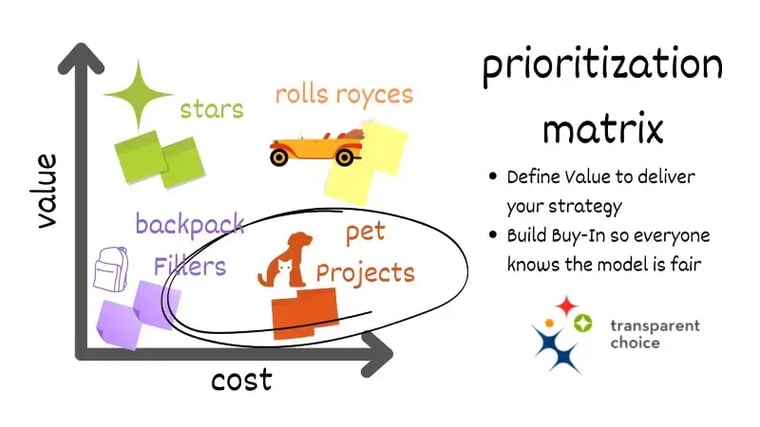
The key is how you build it. If you have a good prioritization process then you're set, because you have a definition of value which works. Moreover, not only do you have great data, you also build buy-in through the process of collecting it.
This means that the bright idea from the boss is exposed as, objectively speaking, poor use of organization resources, and so needs to be rejected.
How to challenge a pet project without getting fired
The goal isn’t to tell a senior leader they’re wrong. The goal is to show, using the criteria they agreed to, that there’s a better use of scarce resources. These conversations become far easier when framed around value, not opinion.
Here are three phrases that work:
- “When we score this against the criteria we agreed, it falls low on both impact and strategic fit…”
- “If we fund this, here’s what gets delayed or dropped from the portfolio — is that trade-off acceptable?”
- “If this is now a higher priority, should we revisit the full portfolio instead of making a one-off exception?”
You’re not blocking their idea. You’re protecting their strategy.
Once you can speak to value clearly, the next step is building a prioritization framework that consistently prevents pet projects from slipping through.
What to do next
- If you want to see how TransparentChoice helps leadership compare competing commitments against priorities, funding and capacity constraints, explore the software →
- If an executive-backed initiative is competing with other worthwhile commitments for scarce resources, a Decision Review is a 30-minute confidential conversation to explore the choice you are facing and whether TransparentChoice could help.