
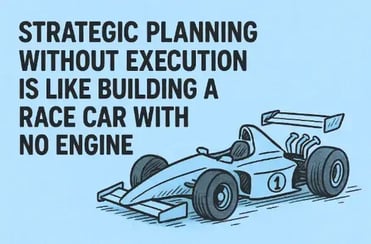
Strategic Planning Without Execution Is Like a Race Car With No Engine

Every year, PMOs watch the same ritual unfold. Strategic planning season arrives. The whiteboards fill up, the Post-its multiply, coffee flows.
After weeks of debate, the strategy emerges - polished, ambitious, and ready to roar. There’s a leadership briefing (maybe over pizza), and a flurry of kick-off meetings. And then slowly everyone reverts to their old priorities. The racing car stalls.
The problem usually isn’t the strategy — it’s what happens when strategy, funding, and delivery decisions drift apart after planning is over.
Sound familiar?
Here’s the hard truth: “Less than one-third of respondents … say their companies’ transformations have been successful at both improving organizational performance and sustaining those improvements over time.” (McKinsey)
And when that happens, the PMO is left trying to execute a plan that was never truly executable.
That’s the cost of misalignment, and it's exactly where you, the PMO, can make the difference.
Why Strategies Fail Without Execution
- Leadership loses interest after the initial sign-off
- Too many projects chasing too few resources
- Budgets approved without capacity planning
- “Business as usual” drowns out strategic initiatives
- PMO is judged on process, not outcomes
These aren’t isolated problems — they’re all symptoms of the same underlying issue.
The strategy looks good on paper — but it slowly collapses under real-world constraints.
The Alignment Challenge: CSO, CFO, PMO
Put simply, strategic execution is a collaboration challenge — one that can only be solved by aligning the key owners of strategy, funding, and delivery.
- The CSO - The Planner: Defines strategy and OKRs, but often ignores constraints.
- The CFO - The Funder: Allocates budgets, but rarely accounts for people capacity.
- The PMO - The Enabler: Does their best to deliver the portfolio, but inherits an overloaded plan.
Each decision makes sense in isolation — but together they create an unexecutable portfolio.
That may be a problem with the structure of the portfolio, rather than with how individual projects are being delivered. In this conversation with Ben Chamberlain and Stuart Easton, they distinguish portfolio structural risk from execution risk and discuss the warning signs leaders can look for before poor results become obvious.
Without collaboration, each role optimizes for their own silo. The result? Too many projects, not enough focus.
How Collaboration Unlocks Executive Engagement
For strategy to stick, the CSO, CFO, and PMO must align around one process. Their roles are different, but complementary:
- CSO → Clarity: What matters most
- CFO → Discipline: What we can afford
- PMO → Reality: What we can deliver
When these voices converge, executives get one joined-up narrative, agreeing on:
- What we’re doing
- What it costs
- What it delivers
- How it fits together
That shared narrative is what enables better decisions — without forcing everyone into another heavyweight planning cycle.
This unified story makes it far easier for leaders to commit — and to role-model the collaboration the rest of the organization needs to see. It also reduces administrative burden with a joined-up demand management funnel for new work.
Five Principles for Turning Strategy into Execution
Every organization is different, but turning strategy into execution consistently depends on a few shared principles:
- Create a shared Demand Management process: Finance, Strategy and PMO. Work out the minimum level of admin needed for it to succeed.
- Build a golden thread around benefits: Connecting funding, resourcing, delivery and reporting. Use it to focus updates on outcomes that leadership care about.
- Recognize the cost of dysfunction to build the business case: Work out what poor alignment has cost. Use this to set goals and overcome objections to change.
- Go beyond complex spreadsheets: Use tools that make collaboration and trade-offs visible, rather than forcing teams to manage decisions in static files.
- Improve & iterate: Rather than searching for a "perfect-on-paper" process. Success will come through developing buy-in over time, not endless tweaks to a big slide deck.
What This Looks Like in Practice
We see this pattern across many organizations, and we help PMOs, strategy teams, and finance leaders address it in practice. For example:
- Working with the PMO: US trade association learned to say “no” to pet projects at annual planning, saving millions, and driving focus.
- Working with the CSO: UK non-profit turned a five-year strategy into a phased, capacity-driven roadmap that gave their executive a choice of realistic scenarios.
- Working with the CFO: Global life sciences’ annual prioritization moved from spreadsheets to live collaboration, enabling 100+ colleagues to build plans in parallel.
The outcome? Fewer projects, clearer priorities, and stronger execution — without spreadsheet headaches for the teams involved.
Your Next Step as a PMO
If this feels familiar, you may already have a strategy and a plan. The question is whether planning, funding and delivery are still connected well enough to make it executable.
You need clarity on which commitments still make sense together, what is constraining the portfolio, and what might need to change.
Start with a Decision Review. It is a 30-minute, no-fee, confidential conversation about the choice you are facing, not a software demo. You do not need portfolio data or confirmed executive sponsorship to start.
👉 Talk through your portfolio decision with us
We’ll work through the situation, the constraints, and what would have to change for a different choice to make sense. It can be useful whether or not a Decision Sprint follows.
Get clarity before adding more fuel to a stalled strategy.