
Strategy-Execution Gap: Is your CEO driving a Clown-car?

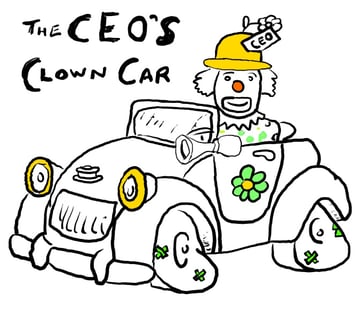 If you read this post on LinkedIn and its associated comments, you’d be forgiven for thinking that the CEO drives a clown-car to work and that the rest of the exec team spend all day throwing custard pies at each other!
In summary, the post presents a striking claim: “80% of executive projects fail. 80% of middle-manager projects succeed.”
That certainly gets your attention. But is that really what the research says?
The comments in response to the post were really interesting; a recurring theme was “Executive = Vanity Project”...
Ouch!
But I wasn’t convinced that this was fair, so I went and read the Harvard Business Review article by Quy Huy.
What did the research actually say?
Huy’s article was really about the role middle managers can play during significant organisational change.
He argues that mid-level managers can contribute because they:
- generate entrepreneurial ideas for useful initiatives,
- work through the informal organisational networks that help things get done,
- stay sensitive to employee sentiment and adapt how change is communicated, and
- help balance change with continuity.
It is easy to see how those ideas become an “executives lose, middle managers win” story. But that is not Huy’s argument, and it certainly does not mean that the executives are clowns.
How strategic direction connects with operational insight
The role of the executive team, at the end of the day, is to provide strategic direction and to ensure the organization is set up to achieve its goals.
In his book, Align, Oxford University researcher Dr. Jonathan Trevor describes how the leadership of an organization is responsible for creating a clear picture of the “purpose” of the company and for coming up with a strategy to achieve that purpose.
For example, if your “purpose” is to be the most valuable car-maker, you could do-a-Toyota and chase volume or do-a-Tesla and pursue value through technology. Those are very different strategies towards the same broad purpose.
Executive teams set strategic direction, but they are not always close enough to the day-to-day operational detail to see every resource constraint, dependency, barrier or opportunity involved in delivering it.
That is where operational insight from mid-level managers becomes important.
But this is also where the clown-car comes in.
The Clown-car cannot steer!
When I spoke with Jonathan Trevor, we talked about a problem I had seen repeatedly: an executive team can have a clear strategy while the connection to what actually gets done is weak.
On the clown-car, the steering wheel is not connected to wheels on the road. It doesn’t matter how you twirl the steering wheel, nothing happens... and that’s not funny!
The problem is not necessarily that people closer to delivery disagree with the strategy. They may simply not have a clear picture of how it should change the choices in front of them.
In that situation, they do the projects that make sense on the ground.
Those projects can have a positive ROI, solve a real operational problem and still pull scarce resources towards work that matters less to the strategy than another credible option.
I put this video together to illustrate the idea that positive ROI projects do not necessarily “move you forward”. Each match represents the positive ROI of a project, but each one points in a different direction strategically.
And so the exec team gets frustrated. There is lots of activity, but not enough movement towards the priorities they thought were clear.
They may respond by proposing projects of their own. People closer to operations, meanwhile, hold context about feasibility, constraints, dependencies and opportunities that the executive team may not see. Neither side has the whole picture. The connection has to happen before work is selected and resources are committed.
Creating the link between strategy and execution
How do we fix this? How do we create a direct connection between the steering wheel and the road? In concept it’s simple – again I refer you to Align by Jonathan Trevor – but in practice it can be difficult and slow.
But there are practical steps you can take quickly to strengthen that connection.
First, make sure you have clear alignment within your leadership team.
Alignment doesn’t just mean that they all sign off on the same Vision and Mission statement. It also means that they agree on the key goals and drivers of success (and how to define them) and that there is a clear map of which of these goals and drivers are most important.
And that distinction matters: a strategic priority is not a project. Projects are proposed ways of advancing those priorities, and several credible proposals can compete for the same resources.
AHP (the Analytic Hierarchy Process – sounds scary, but isn’t) can help with this. It gives leadership a structured way to clarify what the goals mean, compare their relative importance and see where judgements differ or are inconsistent. The output is a clear “map” of which goals and drivers matter most.
Now that strategic map can do some work:
- Communicate strategy - use the “goal and driver map” to give people a clearer picture of what leadership wants them to prioritise.
- Project ideation challenges - use the same map to focus the creativity of those talented and plugged-in mid-level managers on the strategic priorities that matter most.
- Measurement of alignment – You can now use the AHP process again to assess the expected contribution of projects to your organisation’s goals. This helps leadership understand how the proposed work is intended to advance its strategic goals, while recognising that actual benefits depend on delivery and subsequent business results.
- Selection and governance - Understanding the relative value of projects is not yet a portfolio decision. Leadership still needs to decide which combination of work can actually be supported within available funding, capacity and other constraints. TransparentChoice software compares feasible portfolios against those constraints so leaders can see the choices and consequences before deciding what to support.
For a real example of leadership judgement and operational expertise working together, see how the RNLI combined senior leadership priorities with specialist input to compare credible portfolio choices when scarce resources could not support everything.
This process creates a clearer connection between strategic direction and the work being considered for the portfolio. Of course, true alignment of the whole organization, in the Jonathan Trevor sense, also involves people, organizational structures, geographic structure, product mix and other factors that take longer to change.
Connecting your strategy process (steering wheel) directly to project and portfolio decisions is a practical way to strengthen that connection while wider organisational changes take longer.
For the next step, watch Bridging the Strategy–Execution Gap, where Dirk Withake and Stuart Easton take this into the real portfolio: make priorities explicit, show what current commitments already consume, and ask what stops or gives way when a new demand arrives.
Why strategic goals and portfolio decisions belong in one system
So far, I’ve talked about how strategic planning should “guide” the action on the ground, but I constantly see examples where the two are not directly linked. I’ve used the Clown-car's steering wheel as the analogy, but now let’s look at real cars...
Car companies don’t design a steering wheel, then design driving wheels and then think, “Gee, how do we connect these two?”
When you design a car, you design one system for steering. It includes the steering wheel, the connection mechanism, the axles, suspension and wheels. Car companies spend time testing different tyres, suspension bushes and spring rates. They work on steering “feel”, the speed that the steering wheel turns the driving wheels... and so on.
I have four points I want you to take away from this analogy:
- It’s one integrated system that allows you to get your car to its destination.
- There’s no point having a steering wheel if it’s not connected to the road.
- There’s no point having a car if you can’t steer it.
- The steering mechanism is what connects the two, completing the system.
Strategy and execution need to work as one connected system.
- There’s no point creating a beautiful, elegant strategy if you don’t then execute the right projects to implement it.
- There is no point doing projects if they don’t take you where you want to go.
- Portfolio decisions are where strategic priorities become choices about what work to support.
It’s one system. AHP can help make goals, relative priorities and project contributions explicit. Our project prioritization guide covers the wider process of deciding which initiatives should start, stop, wait or accelerate when priorities and resources compete. But a ranked list is not yet a portfolio decision. Leadership also needs to compare which combinations of work can be supported within funding, capacity and other constraints.
So, if you want your steering wheel to change direction, connect your strategic planning process with operational insight and with decisions about what to fund, continue, change, defer or stop.
The same logic applies to work that is already underway. When an existing commitment and a new credible claim need the same scarce resources, leadership may need to reopen the existing investment decision.
💚 If you enjoyed this article, please consider following us. It’s a small gesture that means a lot to us and encourages us to keep sharing what we learn. See the ways to follow us below ↓