
Avoid Project Portfolio Disasters
About this webinar
Starting more projects can look like progress. In an overloaded portfolio, it can have the opposite effect: scarce people are spread across too much work, projects wait for one another and completion slows down.
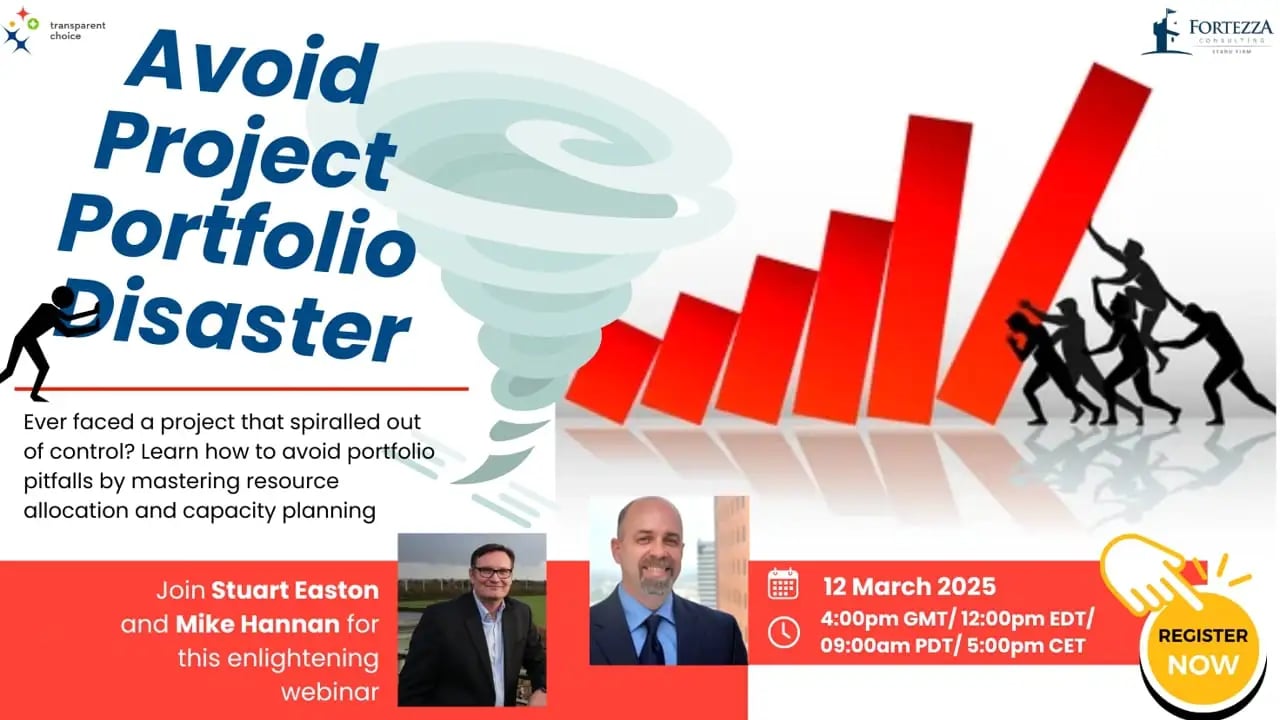
Michael Hannan joins Stuart Easton to explain why trying to keep everyone busy can work against getting more finished. Mike’s argument: unlike drivers stuck in traffic, organisations control how much work they put on the road, so they can cut concurrent work and get it flowing again.
Mike once questioned whether prioritisation was even necessary if projects could simply flow much faster. Stuart pushes on the flaw in that logic: cut without priorities and you can end up finishing the wrong projects faster. The conversation works through how flow, prioritisation and sequencing fit together, and why starting earlier does not mean finishing earlier.
What you’ll hear
- Why fast execution needs people ready to take the baton, not loaded to the limit.
- Mike’s cut-in-half heuristic: pause half the portfolio and move people onto the rest.
- How asking an executive which current project should give up its people turned an urgent request into one that could wait.
- What happened when an executive in Brazil cut projects with a pen and sales could no longer hit its goals.
- A simple baseline: count what the organisation actually got done last year.
- How a staggered start lets even the lowest-priority project finish sooner.
The discussion ultimately moves from project flow to a leadership choice: when the organisation cannot do everything at once, which work should consume the available capacity first?
Research in context
Stuart’s curve shows delivered value rising as work is added, then falling once capacity becomes overloaded. A 2023 Strategic Management Journal study found a similar pattern in a different project setting: across 42 new-product-development projects and 580 employees at one multinational manufacturer, projects stayed closer to schedule as people took on more concurrent projects up to a point, then slipped at higher loads.
That sharpens the webinar’s practical point: the aim is not to minimise concurrent work, but to recognise when adding more stops helping and starts working against timeliness.
How this connects to TransparentChoice
At portfolio level, the flow problem becomes a decision: which work should receive scarce capacity, and when should it start?
TransparentChoice can combine leadership priorities and initiative assessments with funding, resource capacity by role, skill, team or other resource pool, timing, dependencies and other modelled constraints to compare feasible portfolio choices. Selected work can then be sequenced against time-phased capacity, with utilisation and shortfalls remaining visible so leaders can test what should start, wait, change or give way.
To reflect the full load on shared capacity, BAU, maintenance, small change and other material work can be included as work items or as reserved or reduced capacity. Where a sequence still shows periods above stated capacity, they remain visible so leaders can adjust and retest.
Learn more
Join the next live webinar

How do you turn an overloaded portfolio into a feasible plan?
Once you accept that everything cannot start at once, this article on capacity planning and sequencing shows how to test whether approved work fits real capacity and decide when supported work should start.
What does this look like when priorities change in practice?
The RNLI case study shows how one organisation surfaced hidden work, compared credible portfolio choices and rebalanced commitments when priorities changed.
Speakers

Mike Hannan is a co-author of the PMBOK® Guide – Eighth Edition and lead author of The CIO’s Guide to Breakthrough Project Portfolio Performance. He brings more than 25 years of project management experience across portfolio, programme, process and technology roles, including work with government agencies and Fortune 500 companies.

Stuart Easton is Founder & CEO of TransparentChoice. He works with leaders and portfolio teams on decisions about which investments and initiatives to fund, continue, change, defer or stop when priorities compete for limited funding and capacity. His work combines structured decision-making with practical portfolio choices.