
Intelligent Portfolio Management
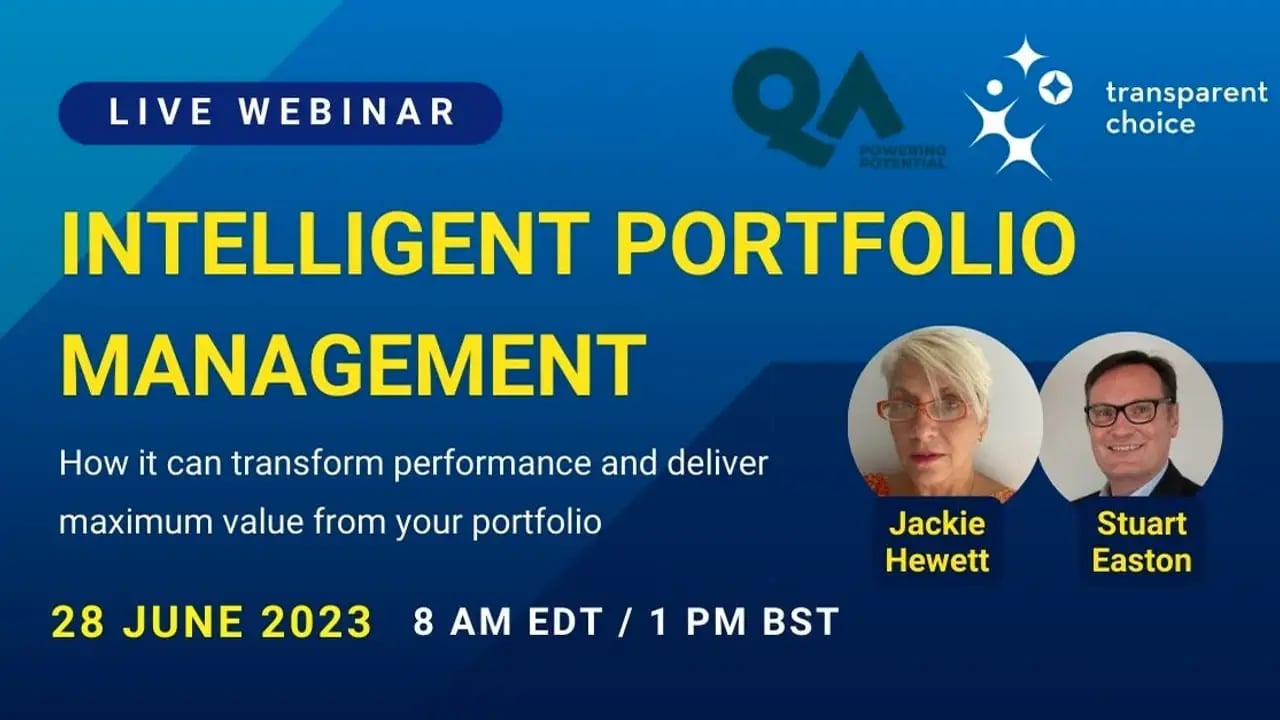
About this webinar
Better project execution is only part of portfolio performance. If leaders are backing the wrong work, loading too much into shared capacity or leaving portfolio choices untouched as conditions change, better delivery practice cannot solve the whole problem.
In this webinar, Jackie Hewett and Stuart Easton connect those issues through Stuart’s “bigger eggs, more eggs, fewer broken eggs” framing: choose work that creates more value, help valuable work flow through finite capacity, and reduce the delays and failures associated with portfolio overload. Jackie brings the practitioner reality, including a client tracking more than 500 large cross-departmental transformation initiatives, the problem of deciding what even belongs in the portfolio, and the “I’ve started, so I’ll finish” instinct that can keep existing work alive.
What you’ll hear
- Move the conversation upstream from execution. A portfolio can contain well-managed projects and still underperform if leadership is backing the wrong mix of work or too much work at once.
- Make value a leadership decision, not a finance-only calculation. The MRI example shows why value can include service and operational outcomes that financial return alone cannot capture. AHP is introduced as a structured way to make competing judgments explicit.
- Earn real buy-in before showing the results. Stuart distinguishes genuine ownership of the value model from people simply not disagreeing in a meeting. Without that ownership, a low-value, high-cost project gets defended because “the model’s wrong”; with it, nobody wants to be the executive defending that project, and even expensive high-value work can be tested by asking whether three cheaper projects would serve the organization better than one expensive one.
- Treat governance as decision-making. Templates and checklists may support delivery, but Stuart argues that governance is fundamentally about decisions and the information needed to make them. The PMO structures and enables the process; leadership makes the portfolio choices.
- Review the portfolio as strategy execution, not a once-a-year budget event. Jackie and Stuart discuss more frequent review so changing costs, estimates and priorities can feed back into decisions instead of allowing the portfolio to become “fire and forget”.
- Protect flow and trace failure back to portfolio load. Starting more work does not necessarily mean finishing more when projects compete for shared capacity. Stuart traces the problem back from struggling projects to team members juggling too much work, and from there to a prioritization process that allowed too much into the system.
Research in context
Agreement on priorities is associated with better organizational performance. A 2011 meta-analysis in the Journal of Business Research covering 23 independent samples found a modest positive link between management agreement on strategy and organizational performance, clearest when the agreement was about priorities.
Managers report difficulty resourcing priorities and stopping work. In a 2015 Harvard Business Review survey of 7,600 managers in 262 companies, only 11% said all strategic priorities had the resources they needed, and eight in ten said their companies were too slow to kill unsuccessful initiatives or exit declining businesses. These are manager-reported perceptions, not measured resource flows or termination rates.
How this connects to TransparentChoice
This recording was made in June 2023. Product statements in the recording reflect the product at that time; this section describes current TransparentChoice capability.
The webinar brings together three questions that are often handled separately: what the organization values, how much work it can realistically support, and whether the portfolio still makes sense as conditions change. TransparentChoice connects those questions in one portfolio model.
- Make value explicit. Leaders can set and weight priorities together, using pairwise comparison (AHP) where useful, and assess initiatives against them. That gives a consistent basis for comparing worthwhile work.
- Choose what fits, including work already under way. Existing commitments and new proposals can be compared in the same model against available funding and capacity, using what is still needed rather than what has already been spent. Leaders compare combinations that fit rather than relying on a ranking, and can see what is included, excluded or displaced.
- Test when selected work can start. Demand and available capacity can be modelled over time, so leaders can test different start timings, see where capacity remains under pressure and decide what to change.
- Retest as conditions change. Priorities, funding, capacity or initiative assumptions can be changed and the portfolio recomputed to see what stays, what gives way and whether the previous choice still holds.
TransparentChoice supports the analysis; leadership decides what to commit to. See how the software works.
Learn more
Join the next live webinar

How do you challenge a pet project without making it personal?
The webinar shows why leaders defend low-value projects when they do not own the value model. Pet Projects Destroy Portfolio Value shows practical ways to challenge protected work through shared value and opportunity cost rather than personal confrontation.
Does our approved portfolio actually fit capacity, and what should start when?
Capacity planning tests what the organization can realistically support, while sequencing decides when approved work should start. Why Execution Breaks Down Before Projects Start separates the two.
What does a revisitable portfolio look like in practice?
RNLI surfaced previously hidden work, compared credible portfolio choices and rebalanced the portfolio when priorities changed. See the RNLI case study.
Speakers

Jackie Hewett is a PPM capability leader and accredited trainer with 15+ years designing and delivering qualifications and bespoke programs across PRINCE2, PRINCE2 Agile, MSP, AgilePM, Change Management, and APM. A former operations director and lead trainer at an accredited training organisation, she blends hands-on project experience in IT and HR with a learner-centred approach. Her focus is helping teams turn best-practice frameworks into practical delivery.

Stuart Easton is Founder & CEO of TransparentChoice. He works with leaders and portfolio teams on decisions about which investments and initiatives to fund, continue, change, defer or stop when priorities compete for limited funding and capacity. His work combines structured decision-making with practical portfolio choices.