
The PMO’s Achilles Heel: Portfolio Governance
About this webinar
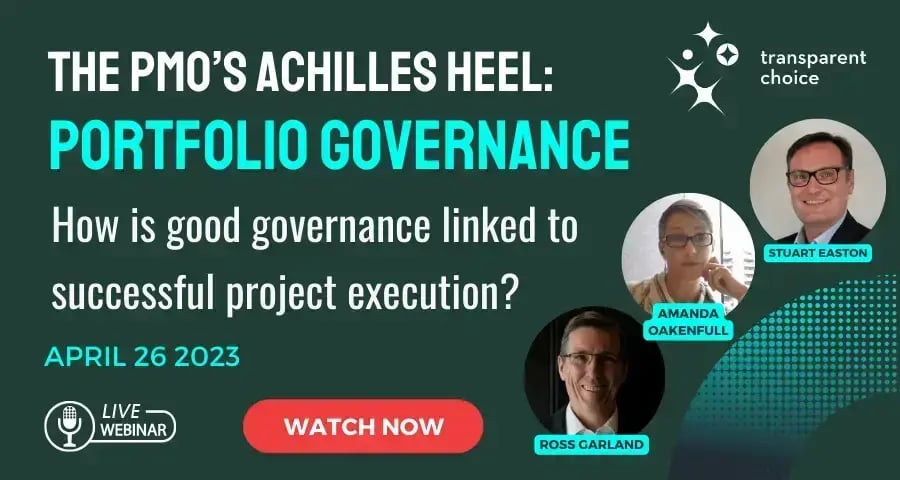
Governance is not project management with more committees. Amanda Oakenfull and Ross Garland examine how decision structures, accountability, information and organisational behaviour determine whether governance actually works.
Amanda’s recovery lesson is simple: start with leadership and governance, then reporting, then tools. Better tools cannot rescue weak decisions.
What you’ll hear
- Build governance around decisions. Ross focuses on the forums where decisions happen, the people accountable for them and the information they need.
- Make accountability usable. People need authority, clear escalation boundaries and enough safety to surface bad news. Material changes belong with the sponsor or the appropriate programme or portfolio forum.
- Watch for levels collapsing. Ross’s warning signs: project-board decisions sent up for the boss or CFO to ratify, and portfolio committees pulled into execution detail.
- Make stopping possible. Sunk cost and career risk make continuation hard to challenge, and Stuart adds that tying an executive’s goals or bonus to delivering a named project removes any reason to help stop it.
- Avoid governance overload. More reporting and meetings can slow recovery instead of helping it.
Research in context
A 2012 Academy of Management Journal meta-analysis of 166 independent samples found that responsibility for the original decision was associated with persisting in a failing course of action, including when responsibility had been assigned rather than freely chosen.
That adds a second mechanism to Stuart’s incentive point: beyond goals or bonuses, ownership of the original commitment can itself make stopping harder. Researchers have suggested separating continuation decisions from the original decision-maker.
How this connects to TransparentChoice
When a commitment’s case changes, extra funding or capacity has to come from somewhere else.
TransparentChoice can update the changed assumptions or constraints, model remaining requirements and recompute feasible portfolio alternatives. Leadership can then see what stays, what changes and what gives way before deciding whether to continue, change, defer or stop.
Learn more
Join the next live webinar

How do you decide whether work should continue?
Steve Jenner and Stuart Easton explore staged funding, challenging assumptions presented as facts and making continuation decisions consequential. Watch: Portfolio Management - Influencing the Weather?
How do you make portfolio review recurring?
Recurring checkpoints give leadership deliberate opportunities to reconsider evidence, funding, capacity and continuation rather than treating approval as permanent. Read how portfolio decision checkpoints work.
What does revisiting a portfolio look like in practice?
The RNLI case shows existing and proposed work competing for scarce specialist capacity, with the portfolio rebalanced when priorities changed. See the RNLI case study.
Speakers

Amanda Oakenfull GAICD is a senior executive and transformation leader with deep experience in strategy, governance, and program delivery. She has led complex business and technology transformations, guided post-merger integrations, and recovered critical programs across industries including defence, health, ICT, and infrastructure. A frequent speaker and advisor, Amanda is known for enabling organizations to achieve sustainable outcomes through strategic leadership and portfolio governance.

Ross Garland is a global authority on project, program, and portfolio governance with over 25 years of international experience. Lead author of Project, Programme and Portfolio Governance (P3G), he has advised governments and organizations worldwide on governance frameworks, assurance, and decision-making confidence. He is recognized as one of the world’s leading practitioners in project governance and a regular speaker at major conferences.

Stuart Easton is Founder & CEO of TransparentChoice. He works with leaders and portfolio teams on decisions about which investments and initiatives to fund, continue, change, defer or stop when priorities compete for limited funding and capacity. His work combines structured decision-making with practical portfolio choices.