
Project Portfolio Governance - The Future
About this webinar
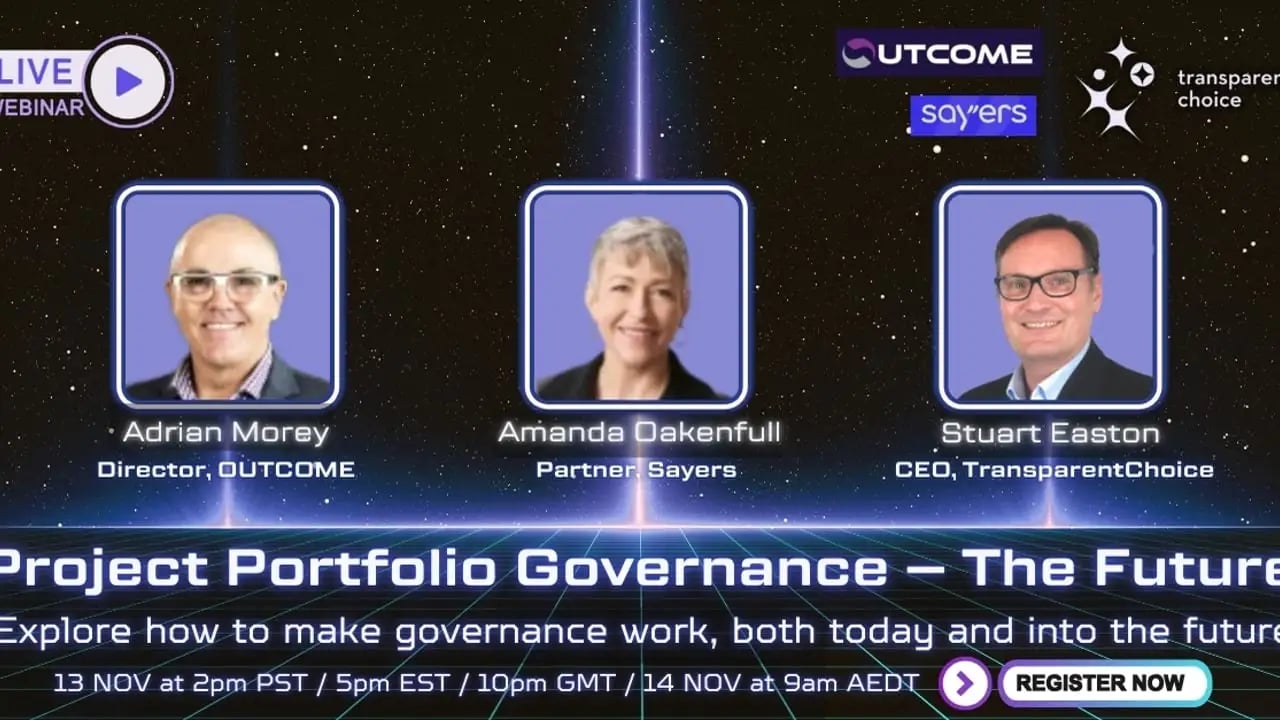
Governance is not the meetings, reports and controls around a decision. Adrian Morey and Amanda Oakenfull argue that it is the decision system itself: who decides, what authority they have, what evidence they need and which decisions should move up or down the organisation.
What you’ll take away
- Make decision ownership explicit. A governance group can bring evidence, challenge and different perspectives, but Adrian argues it should not make the decision. That belongs to a named accountable person, who needs to understand the evidence and be able to explain the choice. At project level, that means choosing someone accountable for the business outcomes the investment is intended to enable.
- Put decisions at the lowest practical level. Accountability needs enough authority behind it. Adrian describes using programme and sub-portfolio groups as a clearinghouse so senior investment committees are not burdened with decisions that can be made lower down.
- Revisit what is already funded. Portfolio governance is not only about deciding what enters the portfolio. It also has to reconsider existing commitments, including what should leave.
- Do not confuse structure with good governance. Amanda warns that an organisation can have the right structure on paper while leadership behaviour works against it. Under pressure, fear can pull decisions upward and replace empowerment with tighter control.
- Improve governance by finding the decision problem. Overruns and delays may be symptoms of missing accountability, an absent sponsor or decisions sitting with the wrong people. If you are trying to change the system from inside, the speakers suggest finding someone with a real stake in improving it and proving a better approach in one part of the organisation first.
Good governance is not more governance. If a meeting or control is not helping the right people make the right decisions at the right level, Adrian’s advice is to change it or remove it.
Research in context
Adrian’s case for pushing decisions down has independent support. A 2018 McKinsey Global Survey of 1,259 executives and managers found:
- Put decisions at the right level. Respondents who said this happened, often through delegation, were far more likely to be at organisations McKinsey classed as strong decision-makers.
- Cross-cutting decisions need coordination. When several parts of the organisation were involved, stakeholder coordination and well-run decision meetings mattered most; clearly defined roles, accountability or decision rights alone were not enough.
- Delegated decisions need real empowerment. Ownership, coaching and room to fail safely were associated with stronger delegated decision-making.
The implication for governance is clear: deciding who has authority is necessary, but the support around that decision matters too.
How this connects to TransparentChoice
TransparentChoice becomes relevant when governance reaches an allocation decision: several credible commitments are competing for the same funding or capacity.
- Bring in the right judgement. Relevant experts can assess the dimensions they understand, independently where useful, while leadership priorities are made explicit.
- Compare new and existing commitments together. Existing work and new proposals can be considered using their remaining funding and capacity requirements.
- See the trade-off. TransparentChoice applies funding, capacity and other constraints, compares feasible portfolio alternatives and makes visible what is displaced when one commitment is protected.
Learn more
Join the next live webinar

Where does a PMO start if it can’t make the decision itself?
Dan Dures and Gregor Androjna show how a PMO can start small, bring leadership workable choices and improve the prioritisation process without trying to redesign the whole system at once. Watch: Your PMO’s MVP for Change.
How do you make existing commitments come back for review?
Stage gates create recurring portfolio checkpoints where funding, capacity, evidence and continuation can be reconsidered after the initial approval. Read about recurring portfolio decision checkpoints.
When has governance become bureaucracy?
Use a practical diagnostic to distinguish governance that improves decisions from approval layers, templates and checklist behaviour that add friction. Read the governance-friction diagnostic.
Speakers

Adrian Morey is a globally recognised expert in project, program, and portfolio (P3) governance with over 30 years of experience across infrastructure, technology, and transformation. He co-authored the global best practice Project, Programme and Portfolio Governance (P3G) Guide, on which the P3GP® certification is based — the world’s only recognised qualification for P3 governance. A sought-after international speaker, Adrian is known for advancing governance and sponsorship practices that ensure projects deliver lasting value.

Amanda Oakenfull GAICD is a senior executive and transformation leader with deep experience in strategy, governance, and program delivery. She has led complex business and technology transformations, guided post-merger integrations, and recovered critical programs across industries including defence, health, ICT, and infrastructure. A frequent speaker and advisor, Amanda is known for enabling organizations to achieve sustainable outcomes through strategic leadership and portfolio governance.

Stuart Easton is Founder & CEO of TransparentChoice. He works with leaders and portfolio teams on decisions about which investments and initiatives to fund, continue, change, defer or stop when priorities compete for limited funding and capacity. His work combines structured decision-making with practical portfolio choices.