
From PMO to VMO - Without the BS
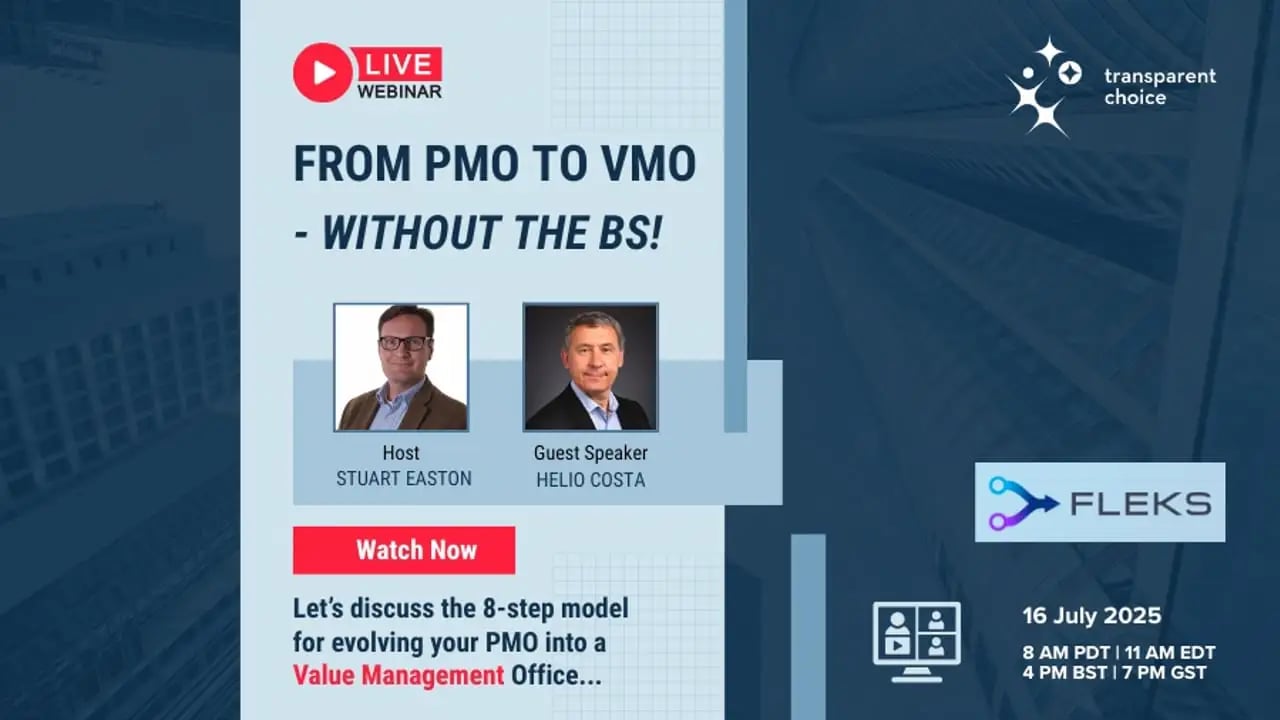
About this recording
A project can deliver what it promised and still leave the business with a serious problem. Dr Helio Costa describes a Portuguese company that launched a new customer-card service only to discover that its software did not connect with the company's commercial and finance systems. He reports roughly €120 million in problems. The company subsequently established an integration unit to check whether new initiatives would work within the wider business.
That failure illustrates the gap behind Helio's FLEKS Model. Organisations create value through both transformation and ongoing operations, often drawing on the same people and resources. His proposed Value Management Office (VMO) helps connect both sides with strategic goals. It is not simply a project-focused PMO with a new name, although existing PMOs can already make valuable contributions.
What you'll learn
- How to configure a VMO around real needs. Helio's eight-step VMO Star starts with strategic goals, stakeholder jobs, pains and gains, then helps define, prioritise and revisit the services an organisation needs. His DJ analogy makes the point: listen to what the business wants rather than play your own preferred playlist.
- Why value is wider than financial ROI. Helio challenges Stuart's ROI framing, considering outcomes for customers, society, partners and other stakeholders, as well as the risks involved in creating value.
- Where to begin. Helio recommends defining organisation-level value indicators and managing the transition as organisational change, which may involve culture, processes or structure. Stuart offers a smaller first move: speak with people across the business, understand their problems and solve something achievable.
Helio walks through the FLEKS Model and VMO Star while Stuart tests the approach against other PMO value methods, including the PMO Global Alliance Value Ring and Laura Barnard's IMPACT Engine. The comparison helps explain what distinguishes Helio's proposal: its reach into operations and the freedom to define services beyond a fixed catalogue of project functions.
Research in context
Helio's customer-card example raises a practical question: who makes sure a new product or service will actually work inside the business before it goes live?
After the troubled opening of Heathrow Terminal 5, the Terminal 2 programme took a deliberate approach to operational readiness. In their 2018 case study, Zerjav, Edkins and Davies describe a dedicated operational-readiness organisation, 192 staged trials, a planned transfer of responsibility from construction to operations, and a gradual opening.
The important difference is that operational readiness became part of delivering the project, rather than something left until handover. For anyone building a VMO or improving the connection between transformation and operations, the case raises three useful questions: Who will run the new capability? What has been tested with the people who will use and operate it? And when will the business be ready to take responsibility?
How this connects to TransparentChoice
Stuart points out that much of the capacity needed to deliver change comes from the people and resources already running the business. A new initiative therefore competes not only with other projects but also with ongoing operational demands.
TransparentChoice can account for explicitly represented operational demand through work items, reserved capacity or separate portfolios sharing resources with change initiatives. Leadership can then use its priorities alongside funding, capacity and other modelled constraints to compare feasible portfolio choices, see what gives way and retest when assumptions change.
This supports the allocation decision about which changes the organisation can realistically commit to, while operational integration remains part of delivering those changes.
Learn more
Why doesn't delivering a project automatically deliver value?
Projects enable change, but the intended benefits depend on what happens as that change becomes part of everyday operations. This short illustrated article develops the Strategy → Change → BAU cycle discussed in the webinar, with a simple explanation you can share with colleagues. Read: What's the Point of Doing Projects?
How does Americo Pinto approach PMO value?
Helio refers to Americo Pinto and contrasts his VMO with the PMO Global Alliance Value Ring. In this related conversation, Americo explains why a PMO should diagnose stakeholder needs before choosing services, and challenges the idea of portfolio ROI as a universal measure of PMO value. Watch: Unlocking the Secrets of High-Impact PMOs
How can change commitments fit the capacity the business actually has?
Transformation work draws on people who also have operational responsibilities. This article explains how leaders can check whether their portfolio fits available capacity, control when work starts and revisit commitments as conditions change. Read: Why Execution Breaks Down Before Projects Even Start
Speakers in this recording

Helio Costa is a project, program, and portfolio management expert with over 20 years of experience. He specializes in developing hybrid practices that integrate predictive and agile approaches. As a consultant and professor, he has trained more than 20,000 professionals across 11 countries, helping leaders unlock their potential and deliver greater organizational value.

Stuart Easton is Founder & CEO of TransparentChoice. He works with leaders and portfolio teams on decisions about which investments and initiatives to fund, continue, change, defer or stop when priorities compete for limited funding and capacity. His work combines structured decision-making with practical portfolio choices.