
Building a High-Impact PMO
About this webinar
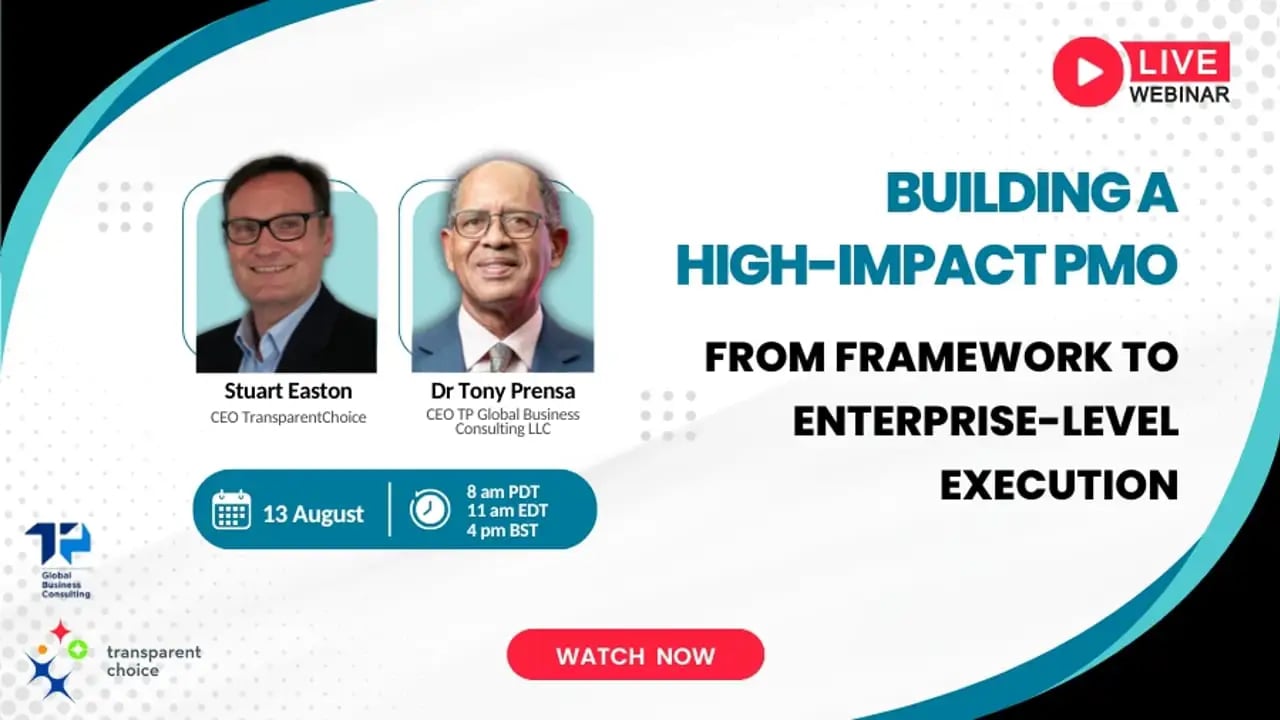
Dr Tony Prensa joins host Stuart Easton to explore what makes a high-impact PMO useful to the business rather than simply busy administering projects. Tony’s starting point is that a PMO loses its place when it fails to demonstrate value, and that value is defined by the leaders, stakeholders and customers the PMO serves.
Become a student of the business
Tony asks PMO leaders to understand how the organisation creates value, what makes it successful and what its leaders are trying to achieve. Stuart pushes the point further: PMO leaders cannot wait for a complete strategy to be handed to them, so they need to find it through leadership conversations, strategy documents and direct investigation of the organisation’s goals and business drivers. Tony then makes co-creation central to the response, involving stakeholders in shaping the PMO’s mandate and the way it works.
From mandate to operating model
- Define a clear vision and mandate connected to the organisation’s purpose and value.
- Build the right governance and structure, assess the current state and create an evolution roadmap.
- Separate the business KPIs leaders care about from PMO KPIs, and connect PMO measures to the value it contributes rather than project completion alone.
- Turn strategic alignment into execution through portfolio prioritisation, capacity alignment, benefits realisation, risk management and communication.
- Deliver visible value incrementally, then review and refine the model as the organisation changes.
Who owns the benefits?
Stuart argues for a broad PMO responsibility, ranging from capturing strategy and selecting projects through managing risk, tracking benefits and making sure the decision and delivery infrastructure works. His road analogy casts the sponsor as responsible for reaching the destination and the PMO as building the road, while the sponsor remains accountable because they have the authority to make change happen.
Tony complicates that division by describing the PMO as also helping to drive, in continuous conversation and feedback with the business.
Research in context
Tony and Stuart differ in emphasis on how far the PMO should go: Stuart casts the PMO as builder of the road and the sponsor as driver, while Tony also describes the PMO as helping to drive. McKinsey’s transformation research adds an outside view of which PMO leader practices were linked to reported success.
2016 Global Survey: the PMO or transformation-office leader practices most closely linked to reported transformation success were identifying barriers to change and sharing transformation knowledge and best practices. McKinsey also described effective leaders as problem solvers and thought partners to senior managers.
Separate 2014 survey: McKinsey found no clear link between simply having a PMO or central transformation team and reported transformation success.
How this connects to TransparentChoice
The operating model Tony describes includes portfolio prioritisation and capacity alignment, the point where strategic priorities have to become actual portfolio choices. TransparentChoice provides a decision layer for that step: making leadership priorities explicit, combining them with funding, capacity and other constraints, and comparing feasible portfolios rather than stopping at a ranked list of projects.
When priorities, assumptions or constraints change, the analysis can be rerun to show what changes in the portfolio and whether the previous choice still holds. The software supports that decision process; leadership remains responsible for what the organisation ultimately commits to.
Learn more
Join the next live webinar

Earn executive credibility from business problems
Laura Barnard takes this further in the IMPACT Engine webinar, connecting business pain and root causes with a 90-day operating rhythm.
Clarify who owns the benefits
The article on benefit ownership goes deeper on how accountability splits between the business and the PMO.
See business-led prioritisation in practice
The Harbor Foods PMO case shows how an accumulated backlog became a business-led prioritisation process with executive involvement.
Speakers

Tony Prensa helps organizations turn strategy into execution. With 35+ years in project leadership and AI-enabled transformation, he builds high-performing PMOs that align portfolios to business goals, accelerate delivery, and prove value. He is the author of The Digital Project Playbook and a long-time educator and mentor.

Stuart Easton is Founder & CEO of TransparentChoice. He works with leaders and portfolio teams on decisions about which investments and initiatives to fund, continue, change, defer or stop when priorities compete for limited funding and capacity. His work combines structured decision-making with practical portfolio choices.