
Reviewing the PMO World 2023 Trends, Triumphs & Trajectories
About this webinar
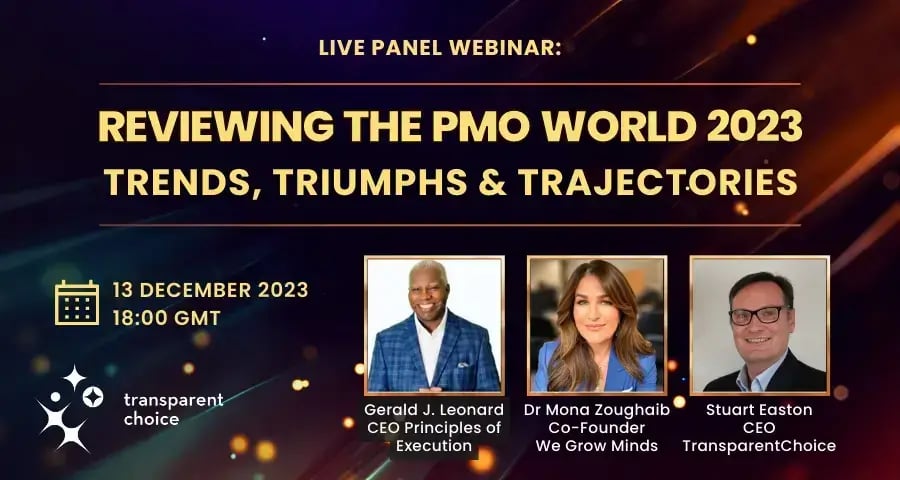
As AI and new ways of working gained ground in 2023, where did the PMO's value lie? In this year-end discussion, Dr Mona Zoughaib, Gerald J. Leonard and host Stuart Easton look beyond emerging tools to the decisions and relationships that make a PMO useful to the business.
Keep the view across the organisation. Stuart strongly challenges an audience-reported trend towards removing the PMO and letting business managers run their own projects. Without a shared portfolio view, he argues, prioritisation, scheduling and sequencing can retreat into silos. Mona describes the PMO as a bridge across departments. Gerald draws on the Theory of Constraints to explain how contracting bottlenecks and scarce technical specialists can hold up work across the organisation. The panel even considers a different name for the PMO, with Gerald suggesting a Strategic Implementation Office.
Talk about business impact, not just projects. Mona argues for business fluency rather than relying on project-management qualifications alone. Stuart calls for PMOs to discuss ROI and business impact at the highest level. He recalls that roughly a third of questions at a benefits session in Paris came back to prioritisation: choosing the right work in the first place. Gerald describes a law firm where business relationship managers helped project charters show departmental strategic alignment and expected outcomes before reaching a review board.
New tools meet familiar human resistance. Gerald observes that technology can be upgraded much faster than the habits and reactions of the people expected to use it. Rather than treating resistance as simply a systems problem, he suggests asking people what becomes possible and how they can participate in change. Stuart admits the answer surprised him. Later, his audience poll finds participants more interested in solving problems and achieving goals than in ticking off tasks. AI could take on some routine work, Stuart argues, but PMO professionals will need stronger business and people skills to make the most of that opportunity.
Research in context
Different decisions need different kinds of support. In a 2019 McKinsey analysis of a 2018 global survey, which received 1,259 responses, researchers examined practices associated with stronger organisational decision-making. For decisions spanning several parts of an organisation, effective stakeholder coordination and well-run decision processes stood out. For narrower decisions delegated to individuals or teams, ownership, coaching and room to fail safely were more closely associated with stronger results.
That distinction adds context to the panel's challenge to replacing the PMO with separate business-led project management. Giving business teams greater responsibility need not mean losing the organisation-wide view needed to reconcile competing priorities and demands on shared resources. The survey examined organisational decisions generally, rather than testing particular PMO structures.
How this connects to TransparentChoice
From a shared view to a feasible portfolio choice. The panel's concern about scarce specialists and decisions retreating into departmental silos leads to a practical question: when worthwhile work competes for the same funding and people, which combination can the organisation actually support? Today, TransparentChoice helps leaders structure their priorities, model existing and proposed commitments against funding, shared skills or team capacity and dependencies, then compare feasible portfolios. They can retest priorities or constraints to see what stays, what gives way and how start timing might change. The software makes these trade-offs visible; leadership makes the choice. Explore how TransparentChoice software works.
Learn more
Join the next live webinar

How has the PMO-value debate evolved since 2023?
Laura Barnard, Rebecca Reynolds, Dr Al Zeitoun and Mickey Nakamura explore what PMOs contribute during budget cuts, restructuring and AI disruption, including different views of how technology may change the role. Watch: The New Role of the PMO in a Disrupted World
How can PMOs communicate business impact to executives?
Move beyond project terminology to the outcomes, decisions, options and consequences leadership needs to understand. This concise article shows how to turn project information into executive insight. Read: Why Executives Don't Speak Project Language (And Why That's Okay)
How can departments work from one shared priority order?
Bill Dow and Stuart Easton examine why every function can believe its own work comes first, and how a visible priority list, executive support and delivery evidence can help teams make consistent choices about scarce resources. Watch: Killing the Wrong Projects
Speakers

Mona Zoughaib, PhD, PMP is a leading project management expert, professor, and consultant with over 20 years of experience across banking, aviation, and education. She is a certified PwC Academy trainer, PMI Authorized Training Partner instructor, and a former PMI Lebanon Chapter board member.

Gerald J. Leonard, PfMP, PMP is a strategic advisor, author, and TEDx speaker specializing in AI-driven portfolio management, ESG strategy, and executive productivity. He combines business expertise with the creativity of a professional bassist to help leaders deliver lasting impact.

Stuart Easton is Founder & CEO of TransparentChoice. He works with leaders and portfolio teams on decisions about which investments and initiatives to fund, continue, change, defer or stop when priorities compete for limited funding and capacity. His work combines structured decision-making with practical portfolio choices.