
Killing the Wrong Projects: The Hidden Costs of Broken Prioritization
About this webinar
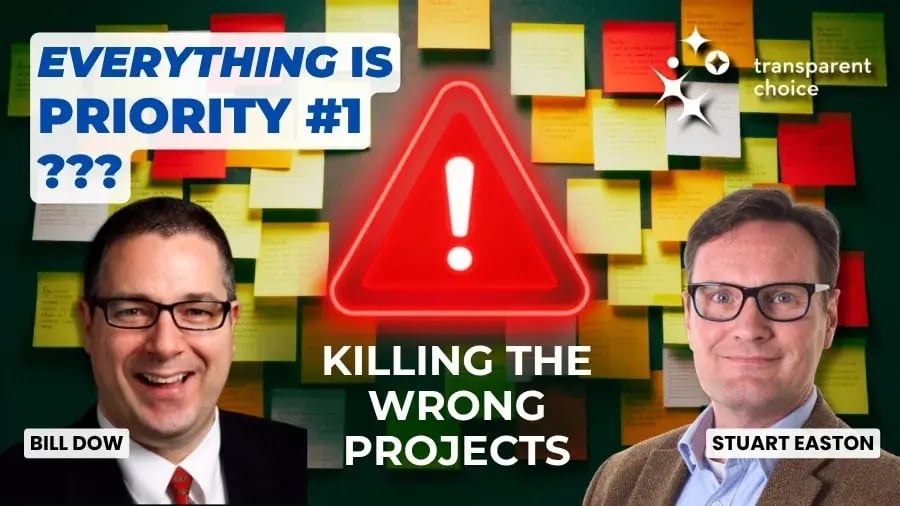
When Marketing, Sales, HR and other functions each name their own top priorities but draw on the same people, sensible local choices collide. Stuart opens with an early customer example where 80% of one utility’s portfolio was marked priority one, yet a third of the portfolio turned out to be obsolete. Bill connects that pattern to multitasking, sponsor-backed pet projects and teams being asked to support more work than shared resources can realistically carry.
Bill’s answer is simple to state and harder to implement: create one visible priority order across functions, get executives to support it, and use real delivery and capacity evidence when competing demands cannot all be supported.
What you’ll hear
- Make one priority order matter across functions. Bill describes publishing a common order that teams could use when resource demands conflicted. It gave people a basis for pushing back on lower-priority work and helped executives focus on removing roadblocks from the work that mattered most. “It was all about completing, not starting.”
- Build the case from your own organization. Bill starts with conversations across functions, recurring complaints and delivery data, takes that case to the PMO’s own executive first, then helps that executive win over their peers. The aim is to show leaders a problem they already recognize in their own organization.
- Make capacity part of the decision. Bill separates operational work from project work, uses timesheet data to understand where people’s time is going and looks forward at project demand. He is blunt that the data has to be mandated from the top: “You can’t grassroots timesheets.” A priority order becomes more useful when leadership can see whether the planned work can actually fit.
- Choose a method the organization will actually use. Stuart argues for AHP to expose and structure different leadership judgments. Bill agrees with the value of the method but warns about “funny math” in weighted scoring and the harder challenge of getting executives to act as one leadership team rather than functional representatives.
- Start small and improve. Bill favors a crawl-walk-run approach: pilot the process, learn what works and expand it rather than waiting for a perfect enterprise design.
The thread running through the conversation is that prioritization only becomes useful when it changes real behavior: what gets attention, what waits, where executives intervene and how much work the organization is genuinely prepared to support.
Research in context
The same stop-or-continue question appears in wider executive research. In a 2015 survey of 514 senior executives by the Economist Intelligence Unit for PMI, respondents believed that, on average, one in five current projects in their strategic portfolios should be terminated.
How this connects to TransparentChoice
Bill’s practical model connects priorities with the capacity actually available to deliver them. TransparentChoice supports that same decision job:
- Make leadership priorities explicit. Structure and compare leadership judgment, using AHP and pairwise comparison where appropriate.
- Test what can actually fit. Apply funding and capacity by role, skill or team, compare feasible combinations, and see which work is included, left waiting or displaced.
- Make timing explicit. Sequence selected work against capacity across time periods and reserve capacity for operational work, so the project plan does not assume people are fully available for change.
Learn more
Join the next live webinar

Why does starting more work make delivery slower?
Optimize Project Flow explains the bottleneck and work-in-progress mechanism: when too much work competes for constrained capacity, adding more can reduce throughput rather than increase it.
How do you actually stop work that no longer deserves support?
Lessons from Weeding Project Portfolios looks at the organizational barriers that remain after the analysis is clear, including sunk costs, sponsorship and the fear that stopping a project means admitting failure.
What makes prioritization stick?
The Four Pillars of Prioritization takes the implementation question further: leadership commitment, knowledgeable contributors, decision-ready data and governance all have to support the process rather than expecting methodology or software to carry it alone.
What does cleaning up “everything is priority one” look like in practice?
In the Energinet case study, 60 of 80 IT projects were flagged top priority. Weighted strategic criteria and regular reassessment exposed obsolete work, which was stopped, with reported savings of over €6 million.
Speakers

Currently Director of Enterprise PMO at UW Medicine & also owner of Dow Publishing LLC, Bill is a recognized expert, author & speaker on portfolio and program management, with a focus on building practical, value-driven governance structures that enable better decision-making & execution.

Stuart Easton is Founder & CEO of TransparentChoice. He works with leaders and portfolio teams on decisions about which investments and initiatives to fund, continue, change, defer or stop when priorities compete for limited funding and capacity. His work combines structured decision-making with practical portfolio choices.