
Prioritizing Prioritization
About this webinar
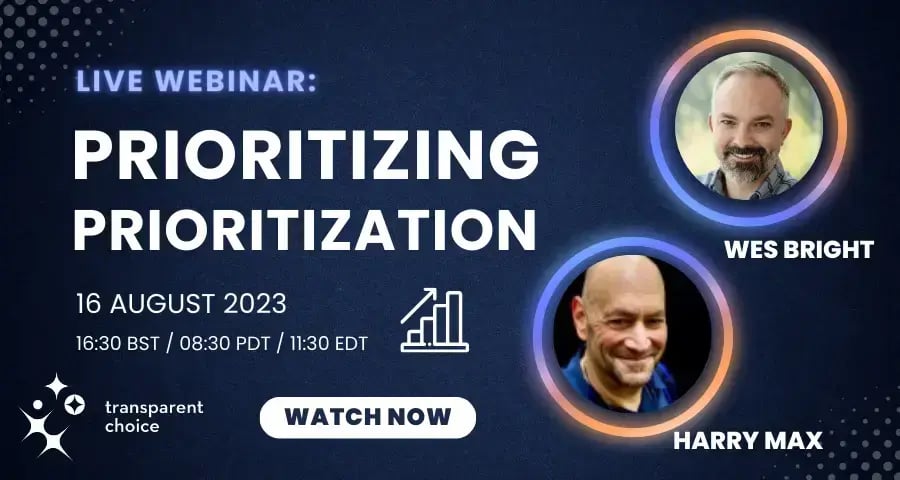
Prioritization is often reduced to a score, a ranked list or a meeting where people decide what comes first. Harry Max, Wes Bright and Stuart Easton take a broader view: prioritization is a repeatable process for turning strategy into choices about where people, time and resources go.
A ranking can help structure the conversation, but it does not make the decision. Leaders still have to choose what to support, what to delay and what will not happen when resources are limited.
What you’ll hear
- Start with strategy. Strategic goals provide the filter for lower-level decisions. Disagreement about projects can reveal a deeper disagreement about what matters most.
- Prioritize before locking OKRs. Stuart argues that prioritization belongs inside strategic planning. If objectives and bonuses are fixed first, leaders can end up defending the projects needed to hit their own targets instead of considering the portfolio as a whole.
- Treat prioritization as a process, not a meeting. Harry introduces the DEGAP model: Decide, Engage, Gather, Arrange and Prioritize. The work starts before anything is ranked, and the decision may need to be revisited when circumstances change.
- Use the method that fits the decision. Harry describes a SaaS company using RICE largely because its product lead had used it before. Stuart notes that RICE can work well with one decision-maker, while decisions involving many stakeholders need a way to make competing priorities explicit. Harry’s broader point is that RICE, impact-versus-effort, simulations and hybrid methods such as AHP each fit different situations.
- Compare like with like. Small tasks and major investments do not necessarily belong in the same decision process. The amount of analysis should match the scale and consequences of the choice.
- Make the reasoning visible. Wes argues that a score gives leadership useful evidence, not a verdict. Leaders still apply judgment, and clear reasoning matters even when someone’s preferred project is not chosen.
- Make room for new opportunities deliberately. When something new arrives, ask not only where it ranks but what existing work will wait, change or give way if it is supported.
The session is useful for strategy, product, transformation, portfolio and PMO leaders who need prioritization to work across organizational levels rather than remain a backlog-scoring exercise.
Research in context
Stuart suggests that disagreement about projects can reveal a deeper disagreement about which goals matter most. A 2011 meta-analysis in the Journal of Business Research looked at 23 samples and adds evidence on why that matters: agreement on which strategic priorities mattered most was modestly linked with better organizational performance, while agreement on how to carry out the strategy was not. That points the alignment effort upstream: settle what matters most before trying to agree on every detail of the plan.
How this connects to TransparentChoice
Harry and Wes make an important distinction: a ranking informs the decision; it does not make it. For a portfolio, that leaves another question: which combination can we actually support? TransparentChoice can structure leadership judgment using AHP and pairwise comparison, then apply funding, capacity, timing, dependencies and other constraints to compare feasible portfolios.
If leaders want to back something the model did not select, they can force it into the portfolio and see what it displaces. They can also change priorities, assessments or constraints and recompute the alternatives during the discussion. The software makes the consequences visible, but leadership still decides what to fund, defer or stop.
Learn more
Join the next live webinar

Make prioritization work beyond the meeting
The Four Pillars of Prioritization looks at the leadership, people, data and governance conditions that need to work together for prioritization to become a repeatable capability.
When a new priority means something else has to give
In Bridging the Strategy–Execution Gap, Dirk Withake and Stuart Easton examine the leadership conversation that follows when a new demand arrives but capacity is already committed.
See the portfolio decision in software
Mastering Project Prioritization follows LuAnn Piccard as she sees TransparentChoice for the first time, moving from leadership priorities and initiative assessment into funding and capacity constraints, feasible portfolio choices and retesting.
Speakers

Harry is an executive coach, consultant, and product leader who helps organizations and teams turn vision into results. He is the author of Managing Priorities and co-host of the Traction Heroes podcast. With experience spanning Apple, Adobe, Google, PayPal, and over a dozen global brands, Harry brings pragmatic solutions to complex challenges.

Wes helps leaders and teams cut through complexity to achieve clarity, focus, and lasting success. He has served as Head of Product for multiple startups and was an early product manager at Rackspace Cloud. With experience across 50+ brands, Wes is known for turning complex ideas into actionable strategies that deliver results.

Stuart Easton is Founder & CEO of TransparentChoice. He works with leaders and portfolio teams on decisions about which investments and initiatives to fund, continue, change, defer or stop when priorities compete for limited funding and capacity. His work combines structured decision-making with practical portfolio choices.