
The Power of And: Strategy AND Execution
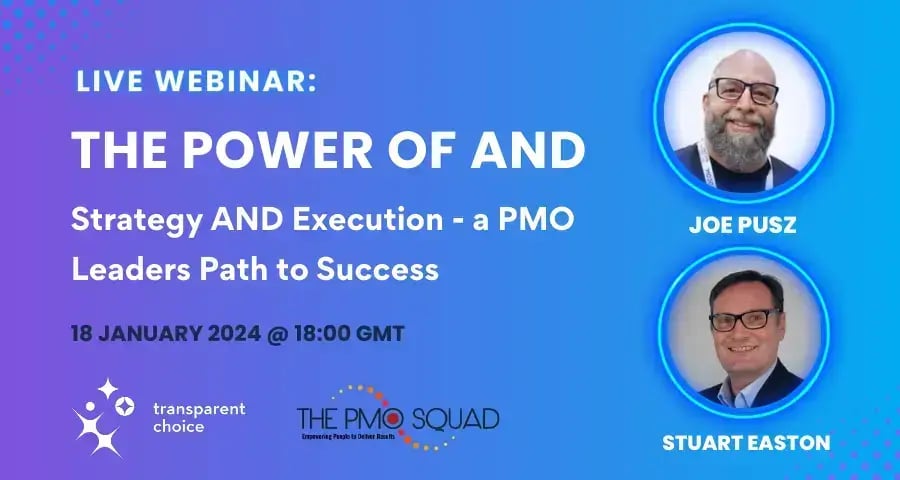
About this webinar
Joe Pusz opens with a point he attributes to Morris Chang: execution without strategy is aimless, while strategy without execution is useless. His argument is that project delivery needs both, yet the project-management profession has historically put more emphasis on developing and certifying practitioners than on helping the organization bring strategy and delivery together.
Drawing on 11 years of PMO Squad client work and his experience judging the PMO Global Awards, Joe explores what that organizational capability looks like in practice.
What you'll hear
- The problem may sit outside the PMO. From PMO Squad's client work, Joe says many of the PMOs they are asked to improve are already good. The cause of poor delivery often sits upstream of project delivery, in the organization around the PMO.
- Capability over maturity. Maturity is repeating established processes consistently. Capability is whether the wider organization actually follows them.
- Projects are part of operations. Joe argues that it should not be framed as operations or projects, but operations that include projects. His examples include accidental project managers, pet projects drawing people away from strategic work, resistance when operational staff are pulled onto projects, and the need for top-down organizational support rather than leaving the PMO as an outlier.
- Both/and has limits. Joe and Stuart discuss false either/or choices, but they also acknowledge genuine constraints. One scarce person cannot work fully on two projects at the same time. Even then, a both/and mindset can expose a third option, a partial step or work that prepares the second phase rather than accepting the first binary framing immediately.
- When resource allocation becomes strategy. Joe describes a familiar pattern: the PMO builds an approved process for project managers to request people, but the resource manager never acknowledges the requests. Stuart takes it further: when leadership has not given clear priorities, a resource manager can end up making de facto strategic allocation decisions by deciding who gets scarce people, rather than leadership deciding what gives way.
- Governance should help delivery. Joe argues for asking the people who use PMO processes what helps and what gets in the way, then streamlining the rest. Stuart adds that process should be as light as it can be while still supporting teams, a theme explored further in lighter governance and self-managed teams.
- PMOs need executive relevance. Near the end, Joe challenges the idea that the PMO should position itself only around execution. His argument is that executives are more likely to engage when the PMO can connect project delivery to the business return and strategic value the organization is trying to create.
Research in context
In a 2015 survey of 7,600 managers in 262 companies published in Harvard Business Review, only 55% of the middle managers surveyed could name even one of their company's five highest priorities.
Joe and Stuart's resource-manager example shows why that matters when someone has to allocate scarce people.
How this connects to TransparentChoice
Joe's resource-manager example exposes a specific decision problem. Several worthwhile commitments may need the same scarce capacity, while the person handling individual resource requests should not have to invent the organization's priorities locally.
TransparentChoice can make that choice explicit by:
- structuring leadership priorities, so the relative importance of competing objectives is visible;
- comparing commitments against funding and capacity, including capacity by role, skill, team or other resource pool across time periods; and
- representing material work outside the formal project list, such as BAU, maintenance, small change or other demands consuming the same capacity.
The comparison reflects the demand and constraints that have been represented. Leadership decides what to fund, continue, change, defer or stop, and governance keeps the resulting allocation in place.
Learn more
Join the next live webinar

Capacity Planning for PMOs Made Real
Edita Kemzūraitė, Joe Pusz and Stuart Easton go deeper into forward capacity planning versus resource assignment, what new demand means when existing commitments already consume capacity, and how prioritization, budgeting and replanning fit together. Watch the webinar →
Accelerating PMO Performance: A Proven Framework for Strategy IMPACT
Laura Barnard and Stuart Easton take the executive-engagement question further: how a PMO can start with business pain and outcomes rather than PMO process, diagnose the underlying problem and build credibility around what leadership cares about. Watch the webinar →
Speakers

Joe Pusz, known as PMO Joe, is the founder of PMO Squad Staffing and a leading voice in project management. He co-founded International PMO Day, The PMO Leader, and the Veterans Project Management Mentoring Alliance (VPMMA), and hosts the Project Management Office Hours podcast. Recognized as PMO Influencer of the Americas (2022) and consistently ranked among the top global PMO influencers, Joe brings extensive experience in organizational project delivery, leadership, and mentoring.

Stuart Easton is Founder & CEO of TransparentChoice. He works with leaders and portfolio teams on decisions about which investments and initiatives to fund, continue, change, defer or stop when priorities compete for limited funding and capacity. His work combines structured decision-making with practical portfolio choices.