
To go faster, do less: why your projects are late (and how to fix it)

Why Project Delivery Fails: The Real Reason Behind Delays
If you're struggling to execute your strategy due to poor project delivery, read on....
I know you’re busy, so here’s the bottom line: if your projects are late, over budget and
unpredictable, it’s not because you need “more project management”...
I know that sounds counter intuitive, but when we do a root cause analysis, we find that
projects are usually set up to fail because you’re trying to do too many things all at once.
The Root Cause of Project Delays
If you cut work-in-progress (WIP) and focus on finishing a few projects, delivery speed and
predictability massively improve. You can then move on to the next projects and, ultimately,
land more projects, delivering more business value from the same resources.
To make this happen, you need to build your “portfolio management” muscle. Your PMO can lead this this change if you empower them, and software from TransparentChoice can make a huge difference.
How big a difference I hear you ask? How does 100% more business impact from the same resources sound? Crazy, right? But read on and you'll see that it's absolutely possible.
That's the 30 second version... now let’s look in more detail.
The Top Reason Why Projects Fail (and How to Avoid It)
When I speak with business leaders around the world I hear, time and again, that their strategy is stalled because of poor project delivery;
-
Slipped timelines, mounting costs, benefits that never quite materialize.
-
Constant firefighting, last-minute escalations, no clear view of what’s really stuck.
-
Every team is “at capacity”, yet nothing seems to finish.
When delivery falters, the instinct is to add more project methodology, templates, checkpoints.
“We need better project management” is a natural conclusion, but this is a myth. We know
this because clever people have done the research. One such study looked at 333 projects and
found that, once you have a basic level of project management capability, adding more has no
effect on benefits realization.
In other words, you cannot “project manage” your way out of the hole.
In fact, piling on process can slow down project delivery and reduce the focus on benefits, undermining the very point of running projects.
So, if it’s not project management, why do projects fail? When you do the root cause analysis, one of the most common causes is that you’re simply trying to deliver too many things all at once.
Here’s how it usually goes:
• Too many concurrent projects → resources spread too thin.
• Multitasking and context-switching → lost time, more errors, more rework.
• Work queues balloon → each project waits longer for scarce specialist time.
• Result: everything takes longer and feels less predictable.
How Reducing WIP Accelerates Project Delivery
Cutting WIP, therefore, should increase project velocity enabling you to deliver more projects
successfully. This isn’t opinion, it's observed reality backed up by theory and operations
research.
-
In product development projects, feature cycle time fell by ~42% (Siemens Health
Services) -
Across 12 tech firms, capping concurrent projects cut development times by 30–50%
-
An electronics company trimmed the number active projects to fit their capacity (cut by
around a third) and delayed new project starts resulting in ~30% more project
completions and ~35% shorter cycle time -
A four-year study of 8,000+ work items showed that reducing WIP showed a statistically
significant negative correlation with lead time: teams with less WIP finished faster.
The pattern is consistent but feels counter-intuitive: do fewer projects in parallel, finish more
projects, finish them faster.
Portfolio management boosts project flow
The discipline of figuring out which projects you should do and when you should start them has
a name – it's called Portfolio Management. Roughly speaking:
Portfolio Management = Project Prioritization + Capacity Planning.
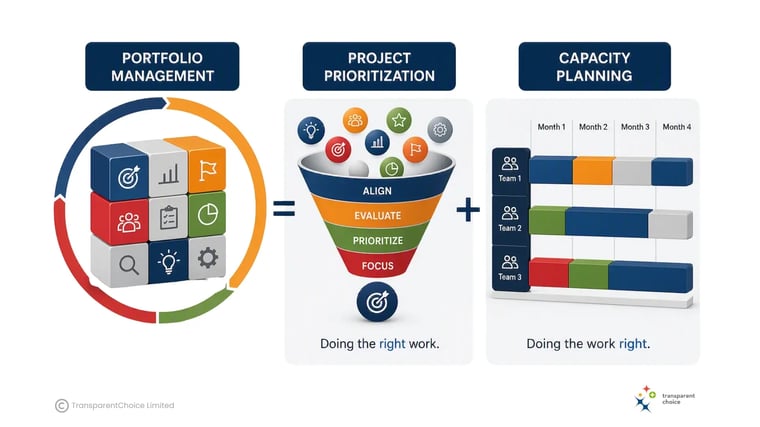
Here’s an analogy that many people find helpful...
When the highway is busy, you don’t speed it up by adding more cars. When cars exceed the capacity of the road, you get a traffic jam and a very low flow rate. Instead, you meter the on-ramps and create fast-lanes for high-occupancy vehicles... flow improves and more people get to where they are going more quickly!
Step-by-Step Guide to Effective Portfolio Management
Portfolio management is that metering and prioritization process – adding projects only when you have the capacity to deliver, while fast-tracking those that deliver the most business value.
Here’s how:
-
Use “contribution to strategy and desired business value” to prioritize projects ruthlessly.
-
Estimate the amount of resource each project will consume
-
Select a portfolio that maximizes contribution to strategy while staying within your resource constraints
-
Create a plan that staggers your project start-dates so that the workload is matched to your real capacity. Adjust your plan monthly to incorporate changes and new data
-
Use a single intake funnel so work can’t bypass the system
-
Kill or pause low-value work to protect high-value flow
-
Make sure you take your team (esp leadership team) is with you – if they don’t buy in, they will try to override the system and destroy your hard-won gains!
Portfolio management sits above projects. Crucially, it’s not paperwork; it’s how you create speed and predictability by design.
This really works. One organization I spoke to recently used these techniques and increased project flow by 84%. Not everyone gets quite that level of increased flow, sure, but we also have case studies where they more-than doubled the flow of value.
And remember, the independent research is totally clear – cutting WIP (aka portfolio management) consistently increases flow.
Before we move on, I should admit something – building a portfolio roadmap to “right-size WIP” throughout the year (or whatever your planning horizon is) is rather tricky. Tricky enough that doing it manually takes time and discipline, which means it’s difficult to keep it up-to-date and to respond to change.
Which is where TransparentChoice software comes in. We’ve built special AI algorithms that can run thousands of “what if” scenarios in seconds, letting you create roadmaps on demand. This means that you can respond quickly to change (new projects, key resources leaving, etc.), while maintaining maximum velocity.
Schedule a demo of TransparentChoice's portfolio management tool
Portfolio management also boosts benefits
Not only does portfolio management increase your project flow, but it also increases the percentage of those projects that actually deliver the intended benefits.
According to the PMI, a good portfolio management process delivers a 38% improvement in project ROI across the portfolio. Another study showed that 29% more projects hit their benefits target when you do portfolio management well.
Explore further with our free e-book on Benefits Management
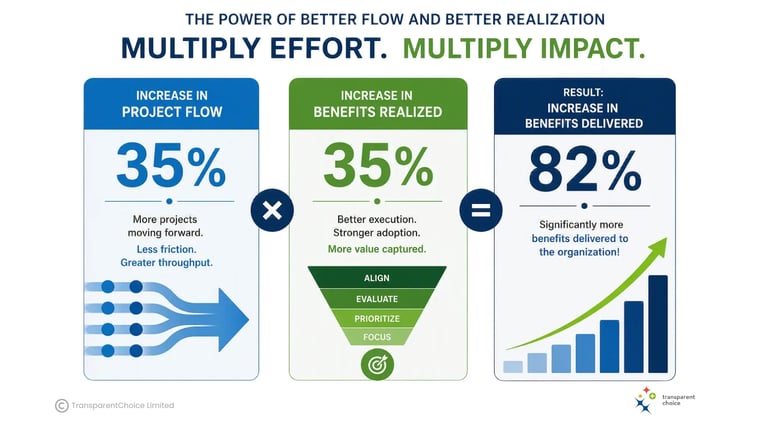
Big numbers, sure, but combine it with the improvement in flow and the numbers get really big.
Let’s pick 35% as our increase in flow (a mid-range value from the studies mentioned above). Let’s also assume a 35% increase in benefits realization (again, pretty much mid-point of the data above).
That gives an overall increase in benefits delivered to the organization of:
35% Increase in project flow x 35% increase in benefits realized = 82% increase in benefits delivered!
"The how" matters for effective project prioritization
Let me ask you a silly question. Do you think your strategy matters?
You do? Oh. So why are you relying on project prioritization methods that don’t accurately align your portfolio with your strategy?
According to the PMI, 20% of a typical portfolio is so badly aligned with strategy that we can safely call it waste. Since you’re probably using one of the typical methods of prioritization today, and those methods deliver 20% waste... well, you can do the maths.
So just prioritizing isn’t enough. You have to prioritize so that it can be used to maximize the contribution to your strategy. And that means you should be using something called AHP (Analytic Hierarchy Process) to prioritize.
Learn more in our Ultimate Guide to Analytic Hierarchy Process (AHP)
Why do I say AHP is “the way?”
One large scale meta-study looked at over 100 methods for prioritizing projects in complex organizations (like yours). They found that only two methods were “suitable” (their word); AHP and something called Data Envelopment Analysis – what is it with decision science guys and their silly names?
Here’s what you need to know now; DEA is really difficult to implement, AHP is relatively simple so AHP wins.
All the other methods – all those sticky notes on whiteboards, pitching contests, MoSCoW, etc. - they may help you cut some projects, but they aren’t great at actually maximizing your portfolio's contribution to your strategy.
For that you need AHP. And this is where I slip in a short advert, because TransparentChoice software makes AHP easy, scalable and transparent. You don’t need to understand the decision science – we take care of that. You won’t see AHP in your typical PPM tool, nor in the toolkit of most consultants. That’s why we built it into our software.
End of advert.
Schedule a demo of TransparentChoice's project prioritization tool
So, imagine that implementing AHP helps you eliminate, what, 10 percentage points of that waste.
Now our equation for increased value becomes:
10% Reduced waste x 35% Increase in project flow x 35% increase in benefits realized = 100% increase in benefits delivered!
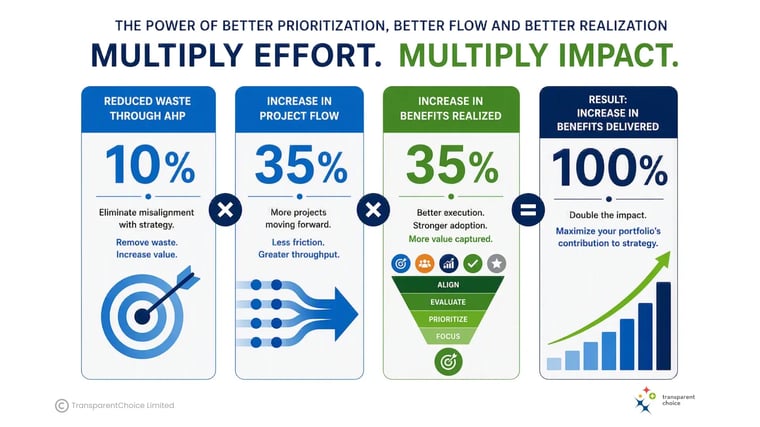
Well, 100% more strategic value is a suspiciously round number. Sure, I picked values to get us to something memorable, but those values were well within what the research shows is not only possible, but highly achievable.
Your Monday morning action plan: start transforming your portfolio management
If you’re a typical organization, doubling the impact of your portfolio should be possible, but how do you get there. Here are my suggestions;
-
Download this infographic summarizing this blog. It's a great tool to help engage stakeholders around the organization. Channel your inner Sinatra and "Start spreading the news..."
-
Empower your PMO to create a proposal to get you from where you are, to where you could be, to where you want to be. Our free Portfolio Briefing session is a great place to start
-
Set up a Case for Change meeting so we can help fine-tune some of the assumptions to make these numbers more realistic for your environment. There’s no obligation and no sales person will hound you...
-
Engage your leadership team in a conversation about whether or not they would like to accelerate strategy execution. Start to help them understand the root cause of so much frustration. Involve them early in the process – their buy-in is make-or-break!
We started this article on a note of frustration and failing projects, but now we know the world does not have to be like that.
Whether you use our software or not, I hope we can help you on your journey. Our blog, YouTube channel and regular webinars are all there, all free, always. They are packed full of useful guidance on how you can stop the frustration and maximize strategic contribution.
Good luck!
Sources: iMusawir, H., Serra, C. E. M., Zwikael, O., & Ali, I. (2017). Project governance, benefit management, and project success: Towards a framework for supporting organizational strategy implementation. International Journal of Project Management, 35(8), 1658–1672· | Vacanti, D., & Valett, B. (2015). Actionable Metrics at Siemens Health Services. Agile Alliance Experience Report | Adler, P. S., Mandelbaum, A., Nguyen, V., & Schwerer, E. (1996). Getting the Most out of Your Product Development Process. Harvard Business Review; see also related Management Science work referenced therein. | Adler, P. S., Mandelbaum, A., Nguyen, V., & Schwerer, E. (1996). Getting the Most out of Your Product Development Process. Harvard Business Review. | Sjøberg, D. I. K., et al. (2018). An Empirical Study of WIP in Kanban Teams. ACM/IEEE ESEM. | Global Benefits Realization Report, PPMI | PMI & Economist Intelligence Unit
Frequently Asked Questions
Q: What is work-in-progress (WIP) in project management?
A: Work-in-progress (WIP) refers to the number of projects or tasks that are being worked on simultaneously. High WIP often leads to resource overload, delays, and reduced project quality. Reducing WIP helps teams focus, finish projects faster, and improve delivery predictability.
Q: How does portfolio management improve project delivery?
A: Portfolio management helps organizations prioritize and select the right projects based on strategic value and available capacity. By aligning projects with business goals and managing resource allocation, portfolio management increases project flow, reduces waste, and boosts the percentage of projects that deliver intended benefits.
Q: Why do so many projects fail to deliver on time or on budget?
A: Projects often fail because organizations try to do too many things at once, spreading resources too thin. This leads to multitasking, context-switching, and bottlenecks. Focusing on fewer projects and managing WIP can significantly improve outcomes.
Q: What is AHP and how does it help with project prioritization?
A: AHP (Analytic Hierarchy Process) is a structured decision-making method that helps organizations prioritize projects based on multiple criteria, such as strategic alignment and business value. It ensures that resources are allocated to the projects that matter most.
Q: Can software help with portfolio management and WIP reduction?
A: Yes, specialized portfolio management software, such as TransparentChoice, can automate prioritization, scenario planning, and capacity management. This makes it easier to respond to change, optimize project flow, and maximize business impact.
Q: How quickly can organizations see results from reducing WIP and improving portfolio management?
A: Many organizations see measurable improvements in project flow and benefits realization within a few months of implementing WIP reduction and portfolio management best practices. Some have reported up to 82% more business impact from the same resources.