
Stakeholder Alignment for PMOs: Challenges and Practical Responses

 Reading the PMO Squad’s excellent 2024 survey I was reminded of a simple truth that we, as a sector, seem to be increasingly aligned upon – project execution focus can only take you so far, and that playing a role in strategic planning is a critical next step to becoming a purpose-driven PMO. In shifting the PMO’s focus towards strategic delivery, stakeholder alignment becomes a critical competency.
I wholeheartedly buy into this ambition but think it’s important to recognize that people are far harder to organize than projects. We love an idiom in the English language, and here at TransparentChoice we like to talk about this challenge as “herding cats”- the art of getting an individualistic ‘group’ to move in the same direction.
Stakeholder groups: where to challenge and support
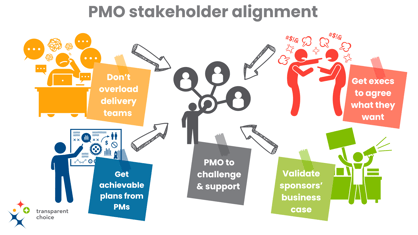
Stakeholders are, of course, a series of individuals who will respond positively to different mechanisms for engagement (I respond well to cake, for example). However, thinking more strategically it makes sense to identify the key groups of stakeholders who matter, and to work out how you, as the PMO, need to both support and challenge them with your governance process. For example:
Executives
- Challenge: Clear strategic goals are critical, as is alignment within the C-Suite
- Support: Drive ROI from allocated resources, without always asking for more funds
Project sponsors
- Challenge: Beware of over-stated business cases used to get resources for 'their' project
- Support: Clarify expected benefits, who owns them and how progress will be checked
Finance and budget owners
- Challenge: Make funding limits and business-case assumptions explicit, rather than letting every sponsor plan as though the money is already there
- Support: Show how competing commitments affect budgets, timing and the trade-offs leadership needs to settle
Functional and resource owners
- Challenge: Check whether promised people and scarce skills are really available once business-as-usual work and other commitments are counted
- Support: Make demands on shared teams visible so starts and priorities can be agreed without quietly overbooking delivery
Project managers
- Challenge: Beware of optimism bias in building an achievable project plan
- Support: Enable focus through clear prioritization of what matters most
Delivery teams
- Challenge: Limit how much work is in progress at once, because finishing before starting can improve project flow
- Support: Set rational prioritization to stop overload from ‘Too Many Projects’
What should be startlingly clear at this point is that one size does not fit all, so aligning to each group (as well as key individuals) is an important step in successful strategic delivery. However, before rushing off to get the doughnuts, first consider the underlying challenges that you might come up against, as successful stakeholder alignment is likely to require both improved communication and governance solutions.
Getting stakeholder buy-in requires more than just "doughnuts". It takes a credible account of where support is missing, what is driving the misalignment and what would need to change for the PMO to help.
So are you a gamechanger or only a doughnut supplier?
Six stakeholder alignment challenges
Where people are involved, things get complicated, but let’s think about common drivers of misalignment and how to resolve them:
- No clear strategy to align against: Without clear direction it’s impossible to align stakeholders, regardless of how many templates you create. But don’t despair. Almost every organization has a strategy, it’s probably just poorly communicated. At this point alignment means finding that strategy and putting it into a relatable structure that can be cascaded to different stakeholders.
- Misalignment within leadership: “Team in Name Only” executives spell trouble for the PMO. In this context, stakeholder alignment may require the PMO to don the ‘brave pants’ and ask the group to commit to a shared high-level policy for prioritization. Pretending divisions are not there just stores up problems for later.
- Bad data: Data is the glue that sticks organizations together by providing rational reference points that are trusted as ‘fair’. It comes in many forms (pun intended) – from surveys to data models - and a key PMO skill is developing the right collection mechanisms, while remaining aware of the risk of “analysis-paralysis” that comes from data proliferation.
- Culture of poor governance: It’s critical that alignment includes shared commitment to honest planning. Think of a business case. The ‘real’ effort is 10 days, but the resource manager puts in 20 to avoid a beating if things go wrong. The sponsor then doubles projected benefits to achieve payback, which finance turn into unachievable goals, that nobody buys into. Contrast that to a system with agreed buffer built in to insulate delivery teams from “Murphy’s Law” while creating motivation to outperform estimates, linked to a bottom-up planning model that you can rely on as the basis for budgeting.
- Stakeholders' bias: To align stakeholders, the PMO must often play the role of “honest broker” who navigates an array of distorting biases in their organization. There are many to pick from but to name-check the top 3… (1) Strategic misrepresentation – gaming for political ends, (2) Optimism bias – overstating benefits / under estimating costs, and (3) Uniqueness bias – seeing ‘your’ own pet project as more special than it really is.
We could go on… but let’s focus on the solution: building stakeholder relationships that engender trust, evaluating projects rigorously, and putting in place benefits tracking that enables improvement over time. - Everyone is really busy: Any new process is likely to be greeted with a degree of resistance based on this being another job to be done. To acknowledge this, consider two tactics. Firstly, find the “WIIFM” – “What’s in it for me” that comes from better planning for different stakeholders. Mandating tasks does little to win hearts and minds. Secondly, make new planning steps ‘net effort neutral’ by cutting something else, such as a redundant reporting commitment. It’s a practical help and shows empathy for the mental strain of a crammed diary.
A purpose driven PMO will need to make a call on which of these factors are the most critical challenges and identify solutions. In doing so, beware of your own uniqueness bias – there are solutions and experts out there who will save you “re-inventing the wheel” (I did say we like an idiom…)
From misalignment to a useful decision
Before choosing a solution, work out what kind of misalignment you are dealing with. Three situations that look like a lack of buy-in can need quite different responses:
- Executives disagree about what matters. Ask which goals or criteria they value differently. Make those differences visible, then ask leadership to settle the priorities that will guide the choice. Custom criteria models and making value explicit, below, give that discussion a structure. The PMO can facilitate this discussion, but cannot decide for the executive team.
- Sponsors disagree about the assessments. Are they using the same assumptions about benefits, cost and risk? Independent stakeholder input and integrated business cases, below, help separate genuine differences in judgement from different underlying assumptions before anyone tries to negotiate a shared view.
- The commitments do not fit available funding or capacity. This can look like delivery teams who have not bought into the plan. Find out which budgets, resources, dependencies or dates are actually constraining the work. Check funding assumptions with Finance or budget owners and usable capacity with functional or resource owners, including business-as-usual demands. Use portfolio scenarios to compare feasible combinations and capacity-aware roadmaps to test timing and expose any remaining overload. Then show leadership what would need to wait, change or give way, rather than asking teams to align around a plan that cannot be delivered.
Alignment does not mean everyone gets their preferred outcome. People should be able to understand the priorities, evidence and trade-offs behind the choice, and know who owns the decision. That is more useful than everyone politely nodding in the same meeting.
Eight solutions to support stakeholder alignment
Since stakeholder alignment is a ‘people thing’ there’s a temptation to limit solutions to relationship building, which pivot around the PMO as a person not a function. To create a more holistic, sustainable solution, also think about tooling & process (after all we’re told PMOs love these…) that enable better stakeholder alignment at the planning stage of a portfolio:
- Kanban boards bring together all your projects into one decision pipeline, so each proposal has a clear communicable status, making progress transparent and outcomes unambiguous.
- Custom criteria models. Leaders will not align around generic criteria. ‘Their’ model must reflect the business they run and reinforce their strategy. Likewise, flex the model between sub-portfolios to reflect different objectives as you cascade. Learn how to build criteria with our free best practice bundle.
- Independent stakeholder input. One viewpoint can hide important differences in how stakeholders see the same project or criterion. Gather relevant judgements independently, then compare them and discuss the reasons for disagreement before reaching a shared view.
- Make 'value' explicit, not a buzzword. AHP helps stakeholders weigh criteria and assess how projects contribute to them. Those assessments support a shared discussion of priorities; selecting a portfolio also requires comparing which combinations fit funding, capacity and other constraints.
- Shareable dashboards. Making the right data visible to the right people is critical. Stale reporting and lack of personalization undermine engagement, as do mega-packs which hide tricky truths amongst a ton of “everything is fine” updates.
- Portfolio scenarios. Where stakeholders disagree, comparing alternative portfolios helps make the trade-offs concrete. Test different leadership priorities, funding limits and capacity assumptions, then examine which feasible combinations of projects each scenario supports.
- Capacity-aware roadmaps. Stakeholders need to know when work could start, whether they're managing workload, customer expectations or another time-sensitive commitment. Test the sequencing of selected work against time-phased capacity, dependencies and date constraints; make any remaining overload visible so it can be addressed rather than hidden in a schedule.
- Integrated business cases. For work competing for resources, connect strategic objectives, expected benefits, funding and capacity assumptions, and named ownership in a decision-ready business case. Otherwise stakeholders can end up agreeing to different versions of the same proposal.
While it’s possible to tackle these challenges with PPM, Excel and a good supply of baked goods, TransparentChoice can help with the decision-making parts: structuring stakeholder judgement, comparing resource-constrained portfolio choices and retesting scenarios when priorities or assumptions change. We’ve also assembled a global network of partners with experience of making the magic happen.
Don’t let misaligned stakeholders derail your success!
If your PMO needs help identifying what is blocking stakeholder alignment, explore the free Case for Change workshop with Stuart Easton. This one-hour workshop looks at challenges affecting strategic alignment and project prioritization, traces their root causes and develops a tailored PMO improvement roadmap.