
People First: Setting Projects Up For Success
About this webinar
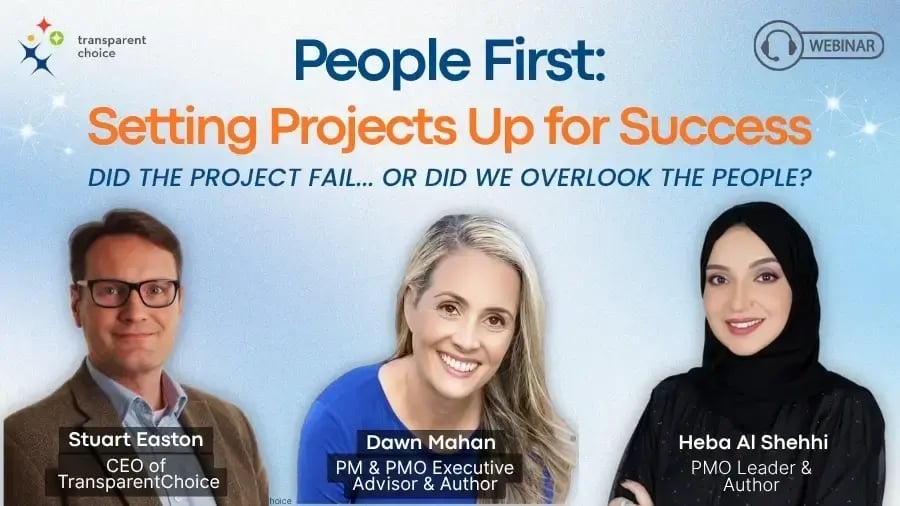
Project success is not just a question of tools, templates or process. In this discussion, Dawn Mahan, Heba Al Shehhi and Stuart Easton explore what leaders can do to create the conditions in which people can make good decisions, work across organisational boundaries and deliver the outcomes a project is meant to create.
Heba brings her nature-inspired leadership model, built around water, fire, wind and earth, and the idea that leaders need the right balance of all four. Dawn brings her Projectland animal characters, such as the sponsor as the lion, as a memorable way to recognise the people around a project and what each of them needs.
The conversation then widens from the team to the portfolio around it: what happens to people when too much work is started at once.
- Mission, not deliverable: how Stuart reframed a $13m billing-system replacement around revenue and customer satisfaction, and why that changed the team's everyday decisions
- Kind is not soft: Heba on fairness, authenticity and saying no without losing trust
- The scary sponsor: how Dawn shielded her team from a feared C-suite sponsor by becoming his point of contact, and why Heba advises letting a stubborn superior win the argument, then proving your case in action
- Helping executives decide: why an executive who appears to be flip-flopping may be juggling a hundred other conversations that day, and why the useful briefing is the problem, the options and their impact rather than more data
- Overload: what Dawn sees when people are spread across three or more projects plus a day job, and why chasing 100% utilisation misses the point when productivity and benefits are the goal
Research in context
Dawn and Heba repeatedly come back to the conditions leaders create: whether people feel able to raise problems, challenge, ask for help and contribute what they know.
A 2022 UK Ministry of Defence study of 12 major projects combined interviews with senior project leaders and a survey of 244 programme-team members. Leadership behaviours came out as the biggest factor in psychological safety, followed by clarity of direction. Teams with higher psychological safety also reported better team performance and wellbeing.
That backs both halves of this conversation: how leaders behave, and whether the team knows what it is really trying to achieve, are linked to whether people feel safe to raise problems and challenge while there is still time to act.
How this connects to TransparentChoice
The webinar's overload discussion eventually becomes an allocation question: if the same limited people cannot support everything at once, which commitments should consume that capacity, and when?
TransparentChoice can model demand and available capacity by role, skill, team or other resource pool across time periods, including day-job and BAU demand when it is represented in the model. Leaders can compare portfolio choices against their priorities and constraints, optimise when selected work starts, and see where modelled capacity remains highly utilised or overloaded, so they can test what should continue, wait or start later.
This is capacity planning at portfolio level, not named-person scheduling, and leadership still makes the trade-offs.
See how TransparentChoice models capacity, priorities and timing.
Learn more
Join the next live webinar

Trace overload back to the portfolio
If your people are juggling too much, the cause often sits upstream. In conversation with Jackie Hewett, Stuart Easton traces struggling projects back through overloaded people to the prioritisation process that let too much work in.
Turn an overloaded portfolio into a feasible plan
An approved portfolio can become undeliverable before anything starts. Why execution breaks down before projects start separates capacity planning from sequencing.
Speak to executives in the language of decisions
Executives need business outcomes, value and risk rather than project-management detail. Why executives don't speak project language explains why that's okay and recasts sponsorship as a partnership.
Speakers

Dawn Mahan, PMP, is an international speaker, author, award-winning consultant, and inventor of the ProjectFlo® Process Learning System. A former Fortune 50 PMO leader, she now helps organizations build strategic PMOs and accelerate project success, and she serves on the American Lung Association Philadelphia Leadership Board.

Heba Al Shehhi is an award-winning PMO leader and author of the bestseller Elements of Leadership. Recognized as PMO Leader of the Year (2023), she also serves as Lead of the PMOGA MENA Hub with PMI–PMO Global Alliance. With over 20 years of experience, Heba specializes in PMO strategy and operations, digital transformation, enterprise architecture, and business agility.

Stuart Easton is Founder & CEO of TransparentChoice. He works with leaders and portfolio teams on decisions about which investments and initiatives to fund, continue, change, defer or stop when priorities compete for limited funding and capacity. His work combines structured decision-making with practical portfolio choices.