
10 Signs You Have a Project Prioritization Problem (and What to Do About It)

TL;DR – 10 Signs You Have a Prioritization Problem
Struggling to deliver projects on time, feeling overwhelmed by competing demands, or constantly shifting focus? You may have a prioritization problem. This post highlights the top 10 warning signs—like unclear goals, frequent project delays, decision fatigue, and team burnout—that signal your current approach isn’t working. Learn how to spot these red flags early and discover actionable steps to regain control, improve project outcomes, and align your team around what matters most.
Is your PMO struggling? You are not alone
If your PMO feels like it’s got its delivery processes in place, and yet is struggling to assert itself as a value driver, then there’s a high likelihood that it is working hard to deliver the wrong projects. Or, in other words, it has a prioritization problem.
Symptoms vary, but these are the 10 pain points show up most often with the PMOs we work with. We know because we’ve surveyed hundreds of PMOs, and used their feedback to build this list.
In this blog we’ll explore why these are symptoms you cannot afford to live with and point to how they can be solved with the right combination of Governance, Data and Leadership Commitment.
To go deeper, explore the Ultimate Guide to Project Prioritization.
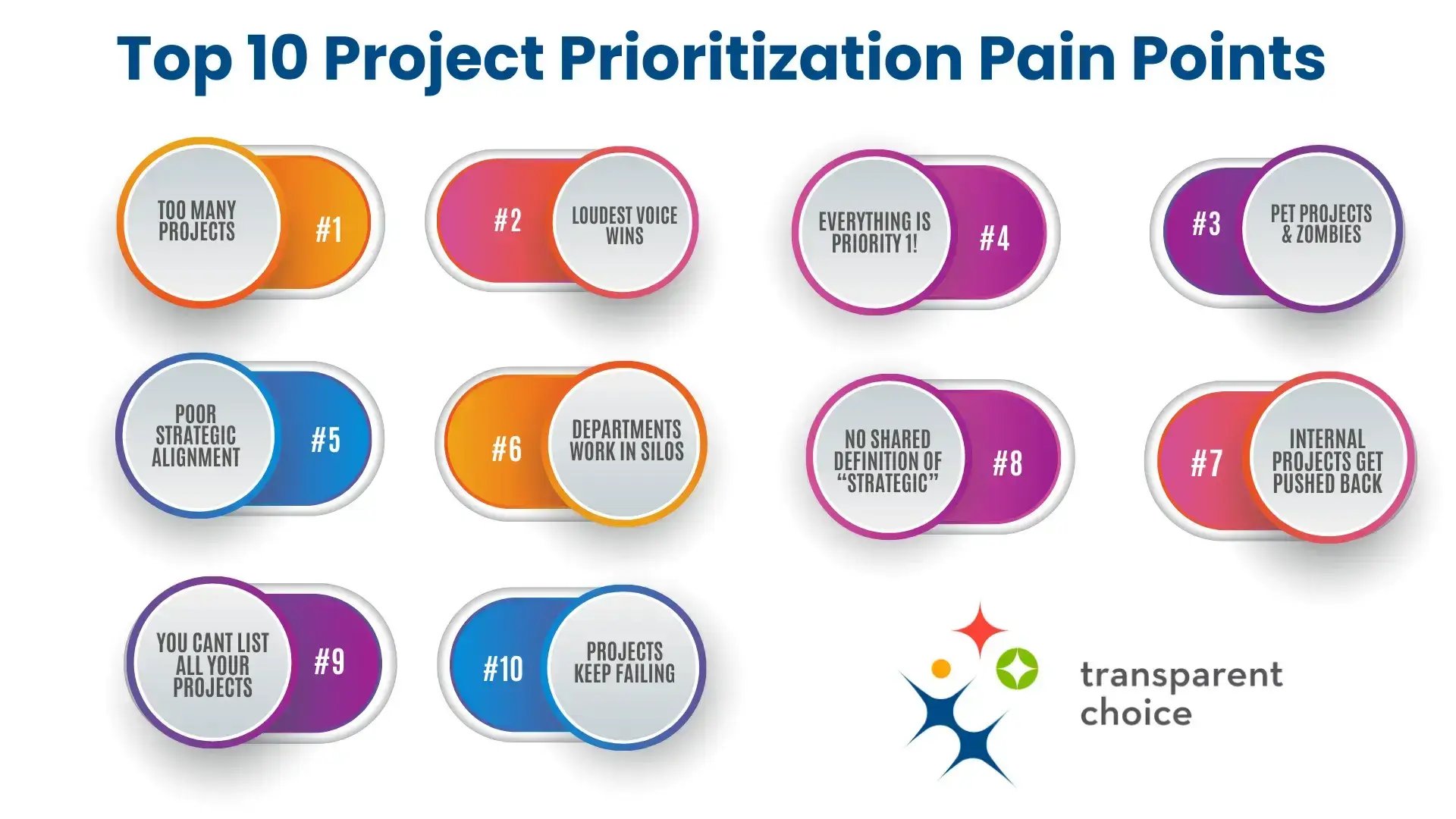
10 — Projects Keep Failing
The Pain
When prioritization is broken, delivery looks bad.
You approve the wrong projects based on poor decision making. You approve all the projects, based on poor organizational discipline. You approve risky projects based on optimism bias presented as a nice PowerPoint.
And yet when the inevitable postmortem happens, you look for operational explanations that suggest better execution could somehow have resolved the failures of the planning process. Then the PMO gets a beating. For a closer look at what goes wrong before delivery, see why project failure cannot be blamed on execution alone.
Why This Matters
If you want to explore project failure in detail, research on IT project “black swans” shows how serious the consequences of underestimated risk can be.[1]
For a broader perspective on project failure, see a PMI conference paper on the “system of work”. It explores how organisational structure, team dysfunctions, multitasking and planning horizons can contribute to poor project performance.[2]
Or simply think about when you last saw a project tank, and be honest; was it really a surprise?
How to Fix It
You can dramatically reduce the probability of failure before delivery begins:
- Translate strategy into weighted criteria → Use AHP (Analytic Hierarchy Process). It’s a Decision Science solution you can learn more about here.
- Assess every project → Include mandatory work in value and capacity assessments, while keeping non-discretionary obligations explicit as constraints.
- Require benefits ownership → Get commitments prior to approval to link resource to outcomes from the offset.
- Score risks for value and risk → Create data points for modelling selection
- Run capacity and scenario modelling → Use leadership priorities with funding and capacity constraints to compare feasible choices. Leadership decides what to commit to.
Real Example
“Around one third of projects were obsolete before they were even finished… with a combined investment of around €20 million.”
👉 Energinet used prioritization to eliminate €6m of waste and build an aligned, deliverable portfolio.
9 — You Can’t List All Your Projects
The Pain
If asking “How many projects do we have?” triggers a scramble for 5 different models and a catch up with an elusive director, then you don’t have a portfolio — you have a liability.
Why This Matters
For a PMO there are three reasons to care:
Firstly, it’s about not wasting time on manually chasing lists and updates.
Secondly, it’s about control. Without basic visibility even the lightest touch of governance models is out of reach, and with it any hope of the PMO adding value.
Thirdly it’s about joining the dots. Spotting duplication, resource conflict and other potential efficiency gains that come from oversight.
How to Fix It
Visibility comes first — everything else depends on it:
- Create one portfolio list → Capturing ALL initiatives. Split into sub-portfolios for more complex use-cases but always retain the ability to compare and consolidate. For the wider set of information needed to make portfolio decisions, see our 10 portfolio data sources.
- Require standardized intake → For any new work but use common sense to make this light touch if you include smaller projects.
- Categorize work → e.g. Strategic, regulatory, capability, operational so you can apply the right governance frameworks.
- Surface shadow work → Keep process simple to avoid scaring people into hiding
- Be smart with de-duplication → Join the dots to avoid parallel work. Once work is visible, check suspected overlaps with the relevant owners. AI may help flag possible duplication, but it does not decide what to stop.
- Apply Stage Gates → Give structure, transparency and control.
Real Example
“There were so many projects going on that nobody knew exactly which projects were currently live.”
8 — No Shared Definition of “Strategic”
The Pain
Everyone says their project is “strategic”. Without a common definition, prioritization becomes a competition between equally confident people, equally convinced the other is an idiot, and eventually agreeing that the PMO should do everything.
Why This Matters
Research on strategy execution helps explain this problem.
Strategy Execution fails because there is too much ambiguity inherent in the strategy itself, creating potential for conflict that undermines deliverability.
This disjoint is amplified down the organization. Research published in 2015 found that only 55% of surveyed middle managers could name even one of their company’s top five priorities.[3] That lack of shared understanding makes day-to-day decisions and cross-functional collaboration harder, while local optimization steps in.
The research dates from 2015, but if you’ve experienced bottlenecks and internal resistance, you’ll recognize the problem today.
How to Fix It
Fixing strategy alignment means making it measurable.
- Run leadership Strategy → Criteria workshops build and quantify alignment at the top to provide unambiguous direction to delivery teams
- Turn each strategic driver into a measurable criterion with scale → Strategic alignment is not a yes-no data point. See how to define and weight strategic goals.
- Use AHP to weight criteria → Forcing real trade-offs that mean “nice to haves” end up where they belong, on the bottom of the To Do list.
- Publish the scoring model organization-wide → Landing a strategy is internal marketing. Create an accessible narrative then show you really believe it.
- Review annually → As strategy evolves be flexible: but don’t rush to a solution then flip-flop when it becomes evident it doesn’t make sense.
Real Example
“We had two PMOs, two processes, two definitions of ‘strategic’… and decisions were painfully slow.”
7 — Internal Projects Always Get Pushed Back
The Pain
Your IT and Ops teams feel like Cinderella — doing essential work but never invited to the prioritization ball, while the Ugly Sisters of Pet Projects and Short-Term Panic gobble up all the resources. Prince Charming (Value) remains unmoved.
Why This Matters
KPMG’s 2023 Global Tech Report found that 67% of technology leaders surveyed were expected to do more with smaller budgets than the previous year.[4] That puts pressure on lower-profile infrastructure investments, even as expectations of IT services continue to grow.
But the chances are you don’t need to read more; you just have a growing sense of anxiety when it comes to risk and technical debt, and the pressure you’re under to deliver the ever- growing list of “must have” requests incoming.
How to Fix It
Internal work must be measured — and valued — correctly.
- Introduce value criteria for enabling work→ Cyber risk reduction, tech debt removal & data governance for example. There is no growth up-side but there may well be a strong ROI in preventing today’s base from going backwards.
- Score internal projects using the same criteria and weights→ High value internal work is more important than marginal external projects.
- Use cost-of-delay thinking→ On foundational capabilities. Can we afford to ignore this? Can we accelerate later by adding capacity now?
- Protect enabling capacity → Ring fence a minimum share of bandwidth, then model scenarios to compare workable portfolio choices. Big Rocks planning shows why operational and enabling work needs room alongside major strategic initiatives.
Real Example
“Nobody was getting their things done — it was only the things coming through our unit that we saw the value in.”
6 — Departments Work in Silos
The Pain
Every team is perfectly prioritized… until they need each other. Then everything grinds to a halt, as they wait for their bottlenecks to clear.
Why This Matters
HBR reports Gartner research on collaboration drag and the obstacles to effective cross-functional work.
That research found that 78% of organisational leaders reported collaboration drag: too many meetings, excessive feedback, unclear decision-making authority and time spent getting buy-in.[5] Yet these problems are often left for people to sort out ad hoc rather than addressed through clearer decision rights and governance.
On a personal level, you’ve probably experienced the sheer stupidity of it.
An agile developer team is waiting for the data guy, who is prioritizing fixing his data, which another developer team broke. Because downstream QA wasn’t a priority.... 🙃
How to Fix It
Fixing silos means building a single system of truth.
- Add complexity to your model → Involving more teams adds complexity: recognize this and favor simpler projects with fewer dependencies.
- One intake funnel→ Again, not death by Form, but just enough structure to mean conflicts can be resolved with data rather than blood (or worse, a long meeting).
- Shared scoring across teams → Let your stakeholders join your scoring.
- Cross-functional capacity modelling → Prioritization needs capacity, so get better at forecasting. Even if you're wrong, it’s better than ignoring. Explore the skills, operational demands and other hidden constraints on delivery capacity.
- Unified governance cadence → Bring teams together to resolve blockages in a timely fashion.
Real Example
“Cross-functional work was a nightmare. Teams had their own priorities, and nothing aligned.”
👉 A US life sciences company unlocked growth by aligning business and technical priorities.
5 — Poor Strategic Alignment
The Pain
You know your portfolio should align to strategy, but it’s really hard when that strategy keeps changing every 5 minutes, as yet another executive initiative kicks off (but few seem to stop).
Why This Matters
Strategic Alignment is critical to project success, but all too often is assumed to be in place after superficial consultation has passed, or a box has been ticketed in a spreadsheet.
Research on strategic alignment describes a gap between leaders’ sense that the organisation is aligned and employees’ understanding of what the strategy actually means.[6]
McKinsey’s research on transformations also emphasises employee buy-in, clear communication and meaningful participation beyond the C-suite.[7] An agreed strategy still has to become understandable and actionable for the people delivering it.
You can explore this topic in greater detail in our Guide to Strategic Alignment.
How to Fix It
To stop U-turns, make decision-making transparent and collective:
- Leadership Alignment → Radical (potentially career limiting) thought: Don’t let leadership approve projects until they agree on their criteria.
- Structured scoring models → Not a box with Yes-No (always ticked Yes, of course) but nuanced alignment of projects to strategy using a scales rating.
- Scenario modelling→ Show trade-offs. None of which is just do everything, plus more later.
- Planning cadence→ Aligned with governance cadence. Ideally more than once a year.
- Delegated Portfolio Planning → Enable teams to quantify their preferences independently, applying frameworks approved by the leadership, but retain shared resource where there are teams whose expertise is needed in multiple places.
Real Example
“Quick decisions kept getting walked back — and nobody understood why.”
4 — Everything Is PRIORITY 1
The Pain
If everything is P1, nothing is P1. It’s like you’re responsible for traffic in a road system where everyone is speeding and the traffic lights don’t work. Crashes are on you, but it’s not your job to point out people are driving horribly.
Why This Matters
McKinsey reports that change programmes emphasising effective prioritization and planning were 1.7 times more likely to achieve and sustain improvements in performance.[8]
By contrast, shouting that everything matters and must be done now has no research validation, but remains popular with stressed out executives.
What happens when every department has its own priority one but everyone needs the same people? In this conversation with Bill Dow and Stuart Easton, they discuss how a shared priority order changes executive attention, team focus and the work that actually gets finished.
How to Fix It
Priority inflation stops when you replace labels with numbers:
- Weighted scoring models → Give projects scores to show relative value, then test which combination fits the available funding and capacity. A ranked list is not the final portfolio choice.
- Cost–value analysis → Estimate Effort + Cost and compare to Value. Tornado, cumulative value-for-money and prioritization charts – all beat a free-for-all with Post-It notes.
- Capacity-based thinking → Understand constraints. Use them to compare feasible portfolios. Improve bottlenecks where hiring, process changes or investment in enabling capacity make sense.
- “Not now” becomes a valid outcome → Stagger start dates to work on the top priority work and create an orderly (but dynamic) line of what comes next. Trust that starting later can equate to finishing earlier with the right approach to delivery.
Real Example
“When 60 projects have top priority, you can say there is no priority.”
👉 A European utilities company discovered €6m in waste hidden inside its “priority 1” list.
3 — Pet Projects Sneak In, Zombies Refuse to Die
The Pain
You’re not managing a portfolio — you’re running a retirement home for bad ideas.
Why This Matters
Harvard Business Review explores why leaders persist with a failing course of action, often described as escalation of commitment.[9] Three problems are especially relevant here:
- Admitting defeat is psychologically challenging, especially for ego-heavy leaders who remain one step removed from the pain.
- Being able to distinguish the need to double down from the need to pull the plug takes judgement: the two can look awfully alike.
- Winning organizations are the ones who can pause, review and pivot. This capability takes deliverable leadership commitment to develop – it is not innate.
How to Fix It
Apply simple principles of data-led Governance with constraints-based prioritization:
- Team scoring → Avoid “I think your idea is stupid” and shift to “We have scored your project below other opportunities”. See three ways to challenge a sponsor-protected idea without making it personal.
- Quarterly portfolio refresh → Annual planning leaves a lot of scope for project drift. Enforcing regular reality checks reduces this risk. Stopping existing work can still be difficult, even when the case for reconsidering it is clear.
- Cut down WIP → If you start too many projects the probability of drift rises sharply. Start fewer, close them sooner, then look for what’s next.
- Constraints base approval → Stop signing off projects one at a time, without overlaying bandwidth to deliver. Pets whither vs. proper priority needs in an “either-or” choice (we’ve seen it).
Real Example
"I have currently 134 projects lined up in a big bucket pile and they’re like, oh, they’re from 2017, five years old."
2 — The Loudest Voice Wins
The Pain
Your prioritization process is powered by decibels, not data.
Why This Matters
MIT Sloan explores decision-making by the Highest Paid Person’s Opinion and the value of drawing on expertise beyond the most senior person in the room.[10] This helps explain why the loudest voice is a poor substitute for a transparent process.
- Leaders have bias and blind spots. Independent judgements followed by structured discussion can help expose differences. Noise is variation between judgements, not simply another name for bias.
- Gut instinct undermines the value of experimentation, analytics and intelligent iteration in favor of a bias to action.
- Decision Science favors structured criteria, for a balanced rational approach that builds both decision quality and buy-in from the wider team.
How to Fix It
Neutralize politics by making assumptions and judgements visible. Data > Ego, but leadership still makes the call.
- Mandatory business cases → Apply proper scrutiny to requests with a level playing field which shows up half-baked ideas for what they are – liabilities.
- Transparent, criteria-led scoring → Remove the emotion, replace it with data.
- Bias-busting SME inputs → Sponsors don’t make great scorers. Ask the experts what they think, then have the align as a group to get “wisdom of the (small) crowd”
- Published results → To accept “no” people need to know that they next guy isn’t getting a “yes” through better negotiation. Publish the data, show it’s fair.
Real Example
“It used to be the loudest voice… or the IT people would just grab the project because it was cool.”
👉 A US retailer replaced politics with data — and with it transformed PMO credibility.
1 — “Too Many Projects” Is Driving Waste
The Pain
Everything is started. Nothing is finished. Everyone is exhausted. Governance is bloated. The PMO gets disbanded.
Why This Matters
This is relatively self-evident to anyone involved with an overloaded portfolio. HBR describes how leadership teams can keep adding initiatives without recognising the cumulative demands on the people responsible for delivery.[11]
If “the essence of strategy is choosing what not to do,” as Michael Porter famously said,[12] then the essence of execution is truly not doing it. That sounds simple, but it’s surprisingly hard for organizations to kill existing initiatives, even when they don’t align with new strategies. Instead, leaders keep layering on initiatives, which can lead to severe overload at levels below the executive team.
We go into more detail in our Too Many Project Guide.
How to Fix It
Overload is a flow problem. Fix the flow.
- Calculate true capacity → Not theoretical headcount or budgets.
- Identify bottleneck teams → Solving blockages unlocks capacity, so might just be your #1 priority project.
- Think Productivity → Multi-tasking undermines deliver cadence. Find the right level to make your delivery capability flow faster
- Use scenario modelling → With credible inputs, software can help compare workable portfolio choices as priorities or constraints change.
- Set WIP limits → One in, One Out. Don’t overload your portfolio.
- Track Throughput as a KPI → En route to measurable benefits, a PMO needs to demonstrate that their portfolio is getting things finished.
Real Example
“We like to say yes… so a lot of resources were promised that may not actually materialize.”
👉 The RNLI used prioritization to break the cycle of overload and restore throughput.
Next Steps: Fix Prioritization
You may recognize one or two of these pain points, or perhaps all of them are familiar. The point is that they are all solvable with better prioritization.
To achieve this takes three things:
- Leadership Buy-In
- A Charter for Prioritization
- Fit-for-purpose tooling
This means your next step will be to convince leadership. For this we recommend you speak their language – that means ROI not P3M. We can help you in this process. We have templates, slides and experience.
So, if you’re ready, let’s prioritize prioritization.
- Read More: Ultimate Guide to Project Prioritization
- See how TransparentChoice software compares feasible portfolio choices
- Contact Us
We’ll help you quantify the pain, build the internal narrative, and implement prioritization that aligns strategy, resources, and delivery.
Frequently Asked Questions (FAQ)
- What are the most common signs of a project prioritization problem?
Common signs include missed deadlines, frequent project delays, unclear goals, decision fatigue, team burnout, and constantly shifting priorities. - How can I tell if my team is struggling with project prioritization?
Look for symptoms like confusion over what to work on next, duplicated efforts, low morale, and frequent changes in direction. - What causes project prioritization problems in organizations?
Typical causes include unclear business goals, lack of stakeholder alignment, poor resource allocation, and ineffective decision-making processes. - How do poor prioritization decisions impact project outcomes and ROI?
They can lead to wasted resources, missed opportunities, budget overruns, and lower overall project success rates. - How can I measure if my project prioritization process is working?
Track KPIs such as on-time delivery, resource utilization, stakeholder satisfaction, and the number of projects completed versus started. - What are the risks of not addressing project prioritization issues early?
Risks include project failure, team burnout, loss of competitive advantage, and decreased profitability. - How can I fix a project prioritization problem once it’s identified?
Start by clarifying goals, involving stakeholders, using proven frameworks (we recommend AHP as a Decision Science enabled approach), and leveraging project management tools. - What are the best practices for effective project prioritization?
Best practices include aligning projects with business strategy, using data-driven decision-making, regular reviews, and transparent communication. - How can software and automation help with project prioritization?
Software can help compare feasible portfolio choices once priorities, resource inputs and constraints are explicit. Automation can reduce repetitive analysis, while leadership validates the assumptions and makes the final allocation decision.
References
- Flyvbjerg, B. and Budzier, A. (2011). Why Your IT Project May Be Riskier Than You Think. Harvard Business Review, September 2011. ↩
- Rączka, M. (2015). Do your projects fail? Don’t change the methodology or people. Change the system! PMI Global Congress 2015, EMEA. Project Management Institute. ↩
- Sull, D., Homkes, R. and Sull, C. (2015). Why Strategy Execution Unravels—and What to Do About It. Harvard Business Review, March 2015. ↩
- KPMG (2023). KPMG Global Tech Report 2023. ↩
- Cantor Ceurvorst, S., LaRocca-Cerrone, K., Mazumdar, A. and Naski, A. (2024). Why Cross-Functional Collaboration Stalls, and How to Fix It. Harvard Business Review, 24 June 2024. Reporting Gartner research. ↩
- Mittal, V., Piazza, A. and Malshe, A. (2023). Is Your Company as Strategically Aligned as You Think It Is? Harvard Business Review, 1 May 2023. ↩
- McKinsey & Company (2017). The People Power of Transformations, 10 February 2017, within McKinsey's transformation research collection. ↩
- McKinsey & Company (2019). How Prioritizing Initiatives Fuels Performance Turnarounds. 26 August 2019. ↩
- Vermeulen, F. and Sivanathan, N. (2017). Stop Doubling Down on Your Failing Strategy. Harvard Business Review, November–December 2017. ↩
- Gallagher, D. (2012). The Decline of the HPPO (Highest Paid Person’s Opinion). MIT Sloan Management Review, 1 April 2012; reporting comments by Andrew McAfee. ↩
- Hollister, R. and Watkins, M. D. (2018). Too Many Projects. Harvard Business Review, September–October 2018. ↩
- Porter, M. E. (1996). What Is Strategy? Harvard Business Review, November–December 1996. ↩