
Strategic Clarity: Your Transformation Superpower in the AI Era
About this webinar
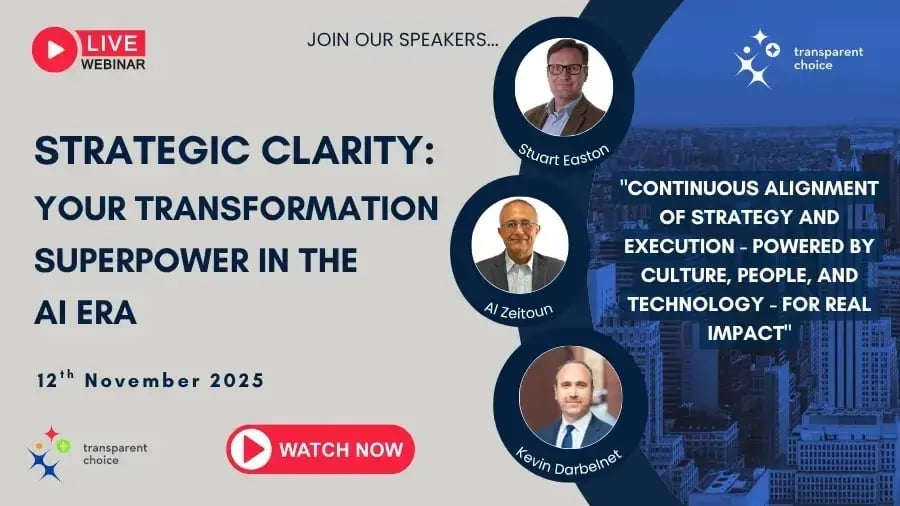
Strategic clarity gets harder when connected decisions are made through separate functional systems. Innovation, transformation, CapEx and cost-saving portfolios may each have their own priorities and approval processes while drawing on the same people and resources.
Kevin Darbelnet makes the problem concrete. In his corporate experience, one innovation project also needed capital investment and supported a finance-led transformation. Because marketing, manufacturing and finance each ran their own workflow, it had to pass through all three, on three different solutions.
Stuart Easton, Dr Al Zeitoun and Kevin explore how organisations can respond: keep humans in the loop, make competing priorities explicit and build enterprise agility so investment choices can change when conditions do.
What you’ll hear
- See the cost of setting priorities in isolation. Kevin argues that separate portfolio priorities can lead to lost focus, overloaded teams and burnout.
- Recognise the shadow organisation. Informal networks can help work move, but can also allow pet projects and zombie projects to keep consuming scarce resources.
- Expose the real disagreement. Leaders arguing over investments may actually disagree about which organisational goals matter most. Making those priorities explicit is central to strategic alignment.
- Keep humans in the loop. Bring diverse voices into decisions, move appropriate choices closer to the front line and give people a clear purpose to guide them.
- Separate enterprise agility from Agile delivery. Kevin's challenge to PMOs: the executive question is not how projects are run, but whether the organisation is working on the right ones and can stop the ones that no longer create value.
- Connect transformation with the wider organisation. What counts as transformation at one level is business as usual at the next, so direction, investment, execution and adaptation need to stay connected.
The discussion closes with diagnose, align, activate and embed: understand where strategy, culture and execution are out of sync; align around the priorities that matter; build the capabilities needed to act; and embed them so the organisation can keep adapting.
Research in context
Conflicting priorities can be an investment problem, not just an alignment problem. In Deloitte's 2022 survey of 1,364 C-suite executives, 72% cited conflicting priorities as a barrier to achieving expected outcomes from corporate investments, ahead of lack of talent (62%) and lack of finance (56%). Kevin's three-workflow example shows one way this happens: each function sets its own priorities for work that draws on the same people.
The shadow organisation also hides capacity. Kevin places pet and zombie projects in the shadow organisation, outside formal priorities. A 2026 International Journal of Project Management review of 46 articles found that unofficial projects can draw on resources also needed by official work, leaving actual available resources lower than management perceives. Much of that activity is incremental improvement, so making it visible does not mean it should all be stopped.
How this connects to TransparentChoice
Separate functional approval processes do not remove the enterprise decision underneath them. When innovation, CapEx, transformation and other portfolios draw on the same people and funding, leadership still has to decide what matters most and which combination of commitments the organisation can actually support.
TransparentChoice gives leadership one decision model across those portfolios. Leaders weigh the organisation's goals first, independently or together, so differences about what matters are visible before individual projects are compared. Leadership can then allocate funding or shared capacity between portfolios, see which combinations of work each allocation can support, and recompute when priorities, assumptions or constraints change to see what remains supported and what is displaced.
Work outside the formal portfolio can be included too. BAU, maintenance or departmental demand can be represented as work items or reserved capacity once identified, so the model does not overstate the capacity available for new commitments.
Learn more
Join the next live webinar

Build a cross-functional decision capability
Prioritization, governance and collaboration sets out what Finance, Strategy, business leaders and Delivery need to share so priorities become resource commitments that can be challenged and revisited.
Decide what gives way
In Bridging the Strategy–Execution Gap, Dirk Withake and Stuart Easton discuss what a PMO should do when a new executive request arrives and capacity is already committed: make current demands visible and ask leadership what stops.
See a portfolio rebalanced
The RNLI case study describes previously hidden work being surfaced, several credible portfolios being compared, and criteria being reweighted to rebalance the portfolio when COVID changed priorities.
Speakers

Al Zeitoun is a global leader in strategy execution and programme management, with expertise in operational excellence, organisational development, and sustainable transformations. A PMI Fellow and trusted strategic advisor, he has supported Fortune 500 companies, government agencies, and global enterprises in delivering complex transformations. He is also an author, keynote speaker, and executive coach recognised for helping organisations achieve lasting impact.

Kevin Darbelnet is a transformation and innovation strategist with 20+ years in global CPG. He helps organizations bridge strategy and execution through Change Agility, R&D leadership, and operational excellence.

Stuart Easton is Founder & CEO of TransparentChoice. He works with leaders and portfolio teams on decisions about which investments and initiatives to fund, continue, change, defer or stop when priorities compete for limited funding and capacity. His work combines structured decision-making with practical portfolio choices.