
When Strategy Stalls – The PMO’s Role in Getting It Moving Again
About this webinar
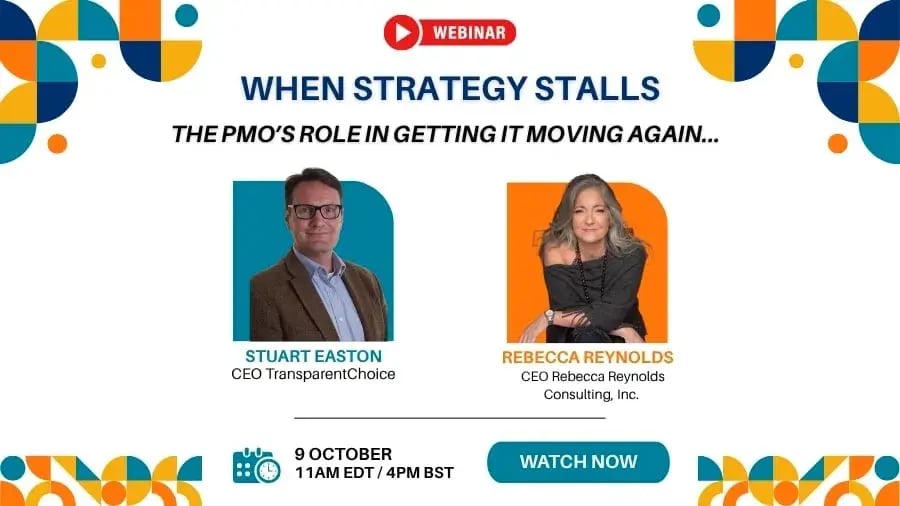
Leadership says execution is failing. The PMO says priorities keep changing. What if both sides are missing something? Rebecca Reynolds and Stuart Easton challenge PMOs to work on the part of the strategy-execution gap they can influence, rather than wait for leadership to fix the relationship. They tackle the difficult "no", the PMO's place in executive decisions, and why information that makes perfect sense to a delivery team may mean very little to leadership.
What you'll hear
- Can you name leadership's top three priorities? Stuart asks this question of PMOs and finds that many struggle to answer. Rebecca challenges teams to examine their own assumptions before blaming executives for the disconnect. For PMOs without a seat at the table, she also suggests a practical route into leadership conversations: help establish the process through which priorities are evaluated and decisions made. The accompanying slides include questions to work through within your PMO and questions to take to leadership.
- Are priorities really changing, or just the projects getting attention? Stuart argues that strategic goals tend to be more durable than the apparent importance of individual projects. The churn often comes from never having assessed those projects against properly agreed strategic goals. Rebecca adds an important distinction: well-set criteria may stay relatively stable even when their weights change.
- How do you stop being the person who says "no"? Rebecca describes involving hundreds of people in developing prioritisation criteria for US federal-government work. Stuart explains how AHP and pairwise comparison can make leadership judgements more explicit. The point is not to remove difficult choices, but to give them a visible basis so the business owns "yes", "no" and "not yet", rather than leaving the PMO as the process police.
- Why wasn't the CIO invited into leadership conversations? Rebecca recalls a client whose CIO spoke almost entirely in technical terms, leaving executives unable to connect with what he was saying. The discussion explores how to replace project jargon and activity updates with explanations of business value, consequences and decisions leadership needs to make.
- What does a shower pass have to do with strategy? Rebecca describes a homeless shelter where persuading someone to accept and use a shower pass was meaningful progress. Its funder, meanwhile, wanted to measure self-sufficiency: people living in apartments with jobs. Rebecca shows why leadership needs to understand the starting reality, but also why the delivery organisation must explain how those first steps contribute to the ultimate goal.
Research in context
Stuart's challenge is not hypothetical. In a 2018 MIT Sloan Management Review study across 124 organisations, only 28% of executives and middle managers responsible for strategy execution could list three of their organisation's strategic priorities. Top teams also rated strategic alignment more favourably than managers below them did.
For a PMO, this changes what a good status report proves. A project can be on schedule without that telling leadership whether it is still the right work to prioritise. Before presenting a portfolio as strategically aligned, the PMO needs to understand which priorities the work serves and how those priorities shaped the choices. Otherwise, execution reporting can look precise while the strategic rationale remains unclear.
How this connects to TransparentChoice
Even when leadership agrees what matters, someone still has to decide what fits. Two initiatives may both make a strong case, but compete for the same funding or scarce specialists. If leadership insists on including one, what other work would have to give way?
TransparentChoice takes the structured judgement discussed in this webinar a step further. It uses AHP to make leadership priorities explicit and assesses initiatives against them. It then considers funding, capacity and other constraints to compare feasible combinations of work. Leaders can examine different portfolio choices, including what gets displaced when a particular initiative is included.
That does not make "no" automatic. It gives leadership alternatives and consequences it can examine and own, with the PMO supporting the decision rather than becoming its owner.
Learn more
Join the next live webinar

See business-owned prioritisation in practice
At Harbor Foods, business leaders rather than IT set the criteria weights and assessed project requests from a substantial backlog. The case shows how a developing PMO brought business judgement into the prioritisation process instead of owning every difficult choice itself. Read the Harbor Foods case study.
Turn a project update into an executive decision
How do you explain a project problem when leadership doesn't want another technical status report? This short article shows how to connect delivery information to business outcomes, options and consequences, including when the real decision involves competing commitments. Read: Why Executives Don't Speak Project Language.
What if the real problem is overload, not execution?
Rebecca Reynolds joins Mike Hannan, Frederic Casagrande and Stuart Easton to explore why PMOs get trapped in firefighting, how conflicting priorities and too much work create problems that look like delivery failures, and how to get executives talking about the underlying causes. Watch: Breaking the Cycle of Overload.
Speakers

Rebecca Reynolds is a reinvention expert, systems innovator, and author with over 30 years of experience guiding leaders and organizations through large-scale transformation. She has developed and applied innovative models for advancing change capability across government, non-profits, and communities. Her new book, Thresholds of Change: The Way Through Transformational Times, distills her proven approach to navigating disruption with clarity and confidence.

Stuart Easton is Founder & CEO of TransparentChoice. He works with leaders and portfolio teams on decisions about which investments and initiatives to fund, continue, change, defer or stop when priorities compete for limited funding and capacity. His work combines structured decision-making with practical portfolio choices.