
What has the PMO ever done for us?
About this recording
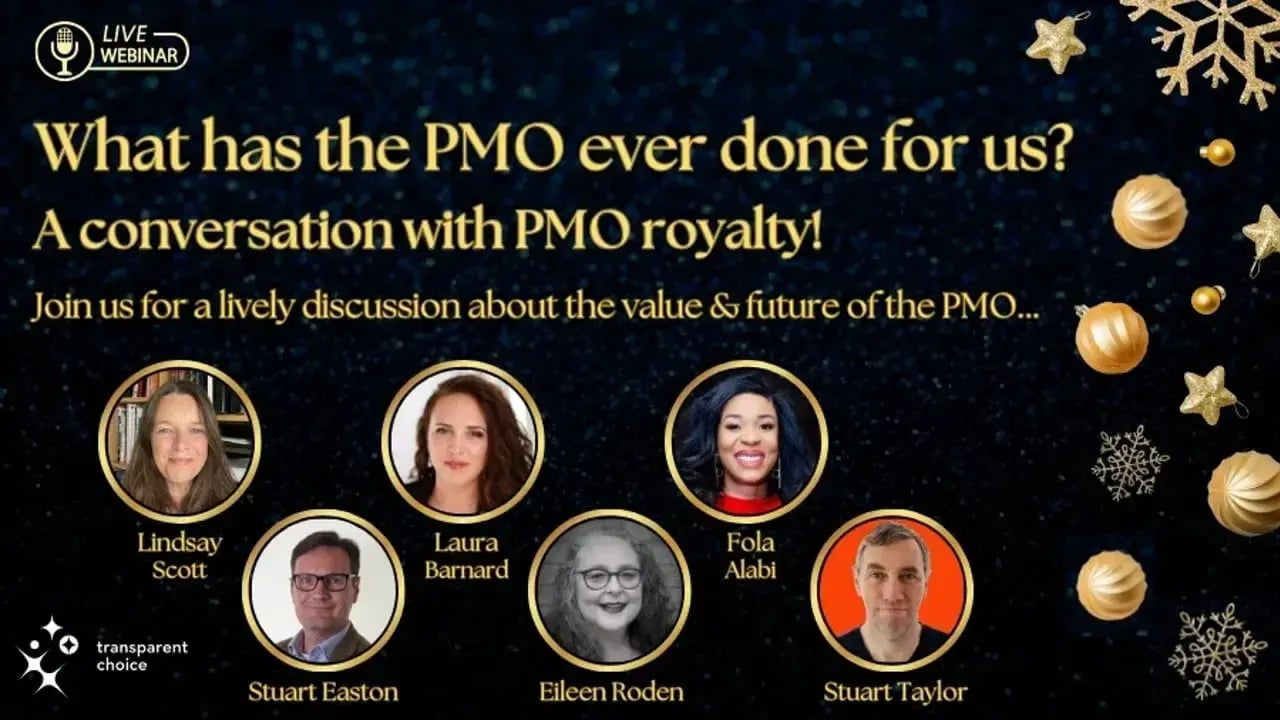
What has the PMO actually done for the organisation? In this December 2024 year-end panel, Lindsay Scott, Eileen Roden, Fola Alabi, Laura Barnard and Stuart Taylor join Stuart Easton to discuss what makes PMOs valuable, what AI might change, and how practitioners can develop from junior support roles to positions of greater influence. The conversation is lively, but some of its strongest moments come when the panel disagrees.
AI meets unfinished PMO fundamentals
Fola Alabi encourages PMO professionals to embrace technology and understand the changing needs of the business. Lindsay Scott offers a contrasting picture from conversations in the PMO community: despite the excitement around AI, many organisations were still struggling with resource management, business cases, benefits and reporting.
Stuart Taylor describes an experiment in which he asked ChatGPT to act as a project manager while he followed its instructions. It was good at turning rough ideas into usable documentation. But when he challenged its decisions, it repeatedly backed down and asked him what to do instead.
Does everyone in a PMO need to become strategic?
Laura Barnard argues that PMOs need to focus on solving business problems rather than simply producing reports and enforcing processes. Fola adds that understanding financial drivers, market conditions and wider business consequences is essential to making a meaningful contribution.
Eileen Roden challenges the assumption that everyone should be aiming immediately for strategic leadership. Organisations still need capable administrators, analysts and delivery-support professionals, and newcomers need a realistic path to develop. Fola offers a practical distinction: an administrator who notices an unchanged project status or spots the same risk appearing across different reports can ask useful questions without being the executive who makes the final decision.
Developing skills and making value visible
Eileen and Lindsay explain how the House of PMO Competency Framework supports development from administrator through analyst and manager to director, recognising the different demands of project, programme and portfolio offices. Eileen illustrates why skills alone are not enough: a PMO manager who introduces monthly reporting without consulting project managers has committed other people to work without involving them in the decision.
Stuart Taylor describes losing his PMO role during organisational cuts in 2024. The organisation also let go of a change manager and a colleague advocating Agile. His argument is that roles whose contribution decision-makers do not understand become especially vulnerable when budgets are squeezed. Doing valuable work matters, but so does making that contribution visible.
The panel closes with practical advice on learning the organisation's strategy, building relationships and identifying the skills needed for the next stage of a PMO career.
Research in context
The difficulty of making PMO value visible is not new. In PMI's 2013 research among 533 PMO leaders, 30% cited a lack of awareness of the PMO's benefits as a reason its value was not being fully realised. The finding gives historical context to the visibility problem Stuart Taylor describes in the webinar, more than a decade later.
How this connects to TransparentChoice
From PMO reporting to a portfolio decision. Laura Barnard challenges PMOs to solve business problems rather than simply produce reports. One such problem arises when leaders have more worthwhile initiatives than their funding and capacity can support. TransparentChoice helps structure leadership priorities, apply funding and capacity constraints and compare feasible portfolios, making it easier to see what stays and what gives way under different choices. The PMO can support that discussion, while leadership makes the final decision. Explore the software.
Learn more
What makes a PMO valuable when budgets shrink and AI changes the work?
Laura Barnard, Rebecca Reynolds, Dr Al Zeitoun and Mickey Nakamura examine what leadership would lose if the PMO disappeared, and debate how automation, restructuring and changing expectations could reshape its contribution. Watch The New Role of the PMO in a Disrupted World →
How can an operational PMO earn greater strategic influence?
Louise Gardner and Pedro Balsa explain why reliable delivery information, credible reporting and useful control can be the starting point for earning a broader mandate, rather than obstacles to it. Watch PMOs: Change Is Not a Choice, But It Is a Challenge →
How can a PMO turn visible value into executive support?
Alexander David explains how to uncover the business problems leadership wants solved, develop a living case for change, deliver useful improvements in 90-day cycles and maintain sponsorship beyond initial approval. Watch Winning Executive Buy-in for Your PMO →
Speakers in this recording

Lindsay Scott is the Co-founder of the House of PMO, the professional body for PMO practitioners, and Director at PMO Learning, a specialist training company dedicated to PMO professionals. With a career spanning community-building, training, and career development, she has been instrumental in creating platforms like PMO Flashmob and The PMO Conference to support and advance the PMO profession.

Laura Barnard, PMP, CAL, Prosci, IES is the Founder and CEO of PMO Strategies and author of The IMPACT Engine: Accelerating Strategy Delivery for PMO and Transformation Leaders. Recognized as the 2021 World PMO Influencer of the Year, she has nearly three decades of experience helping organizations close the strategy-to-execution gap. Laura is also host of the PMO Strategies Podcast and Co-Founder of Project Management for Change, where she champions raising the profile of project management worldwide.

Fola F. Alabi is a global authority in strategic leadership and project management, serving as VP of Strategy & Projects. With over 20 years of experience across energy, finance, and IT, she has led billion-dollar portfolios and delivered keynotes worldwide, helping organizations close the strategy-to-execution gap.

Eileen J Roden is Co-founder and Director of the House of PMO and PMO Learning, where she focuses on building, connecting, and upskilling the PMO community worldwide. With extensive experience in consulting, training, and standards development, she is passionate about applying project, programme, and portfolio management in practical ways that deliver measurable business value.

Stuart Taylor has over 20 years of experience helping organizations strengthen governance, improve project delivery, and build high-performing project teams. A judge for the PMO Global Awards and a regular content creator, he is passionate about supporting project professionals to succeed and ensuring PMOs deliver real business value.

Stuart Easton is Founder & CEO of TransparentChoice. He works with leaders and portfolio teams on decisions about which investments and initiatives to fund, continue, change, defer or stop when priorities compete for limited funding and capacity. His work combines structured decision-making with practical portfolio choices.