
PMOs: Change is Not a Choice, But it is a Challenge
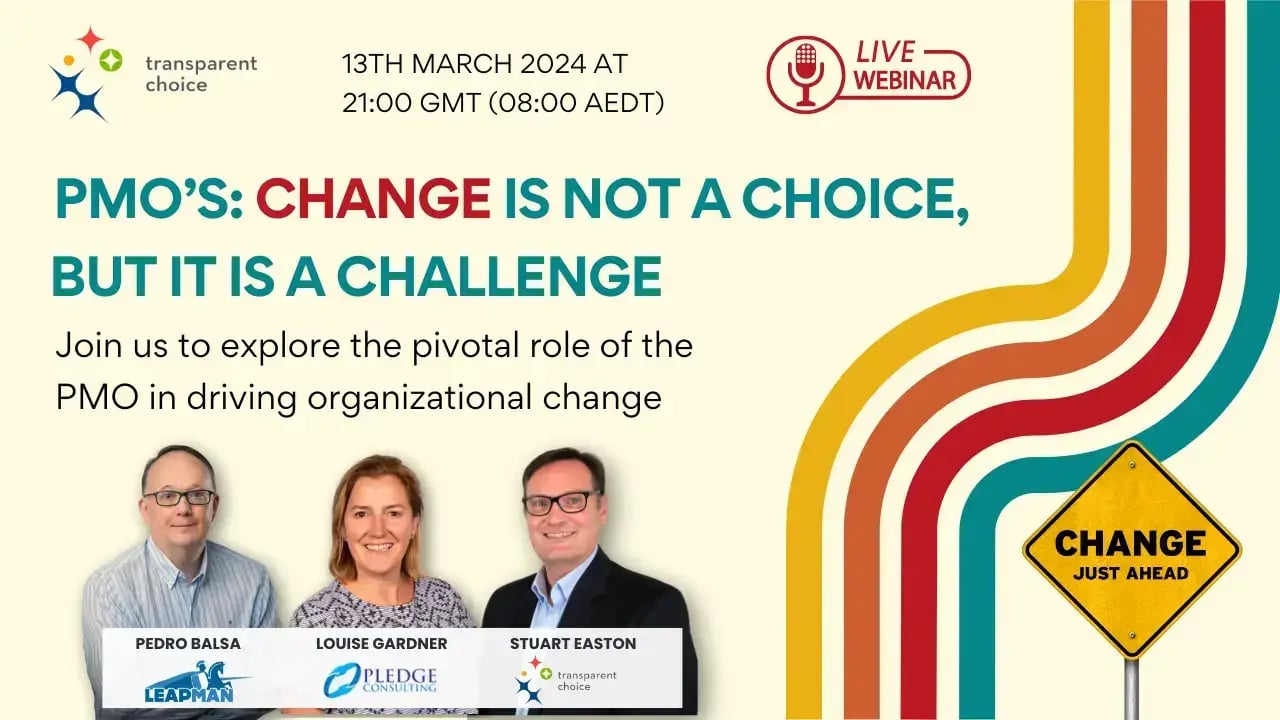
About this recording
What gets a PMO invited into real business decisions? Stuart Easton's instinct is to start with business goals. Louise Gardner and Pedro Balsa take a different starting point: when a PMO has little strategic influence, credible reporting and useful control may be how it earns that conversation.
Five moments worth watching
- Controls first, not a long process rollout. Pedro recommends a control PMO built around forecasts, deadlines and risk, rather than spending months on processes and training before executives see value. Louise describes earning a wider PMO mandate by solving the first problems leadership needs addressed.
- When a project is green on paper and red underneath. Louise argues that reliable cost, schedule, risk and issue data must start with project managers; the PMO then consolidates it for leadership. Pedro wants project and finance figures to agree. Louise warns that reporting can expose projects that appear green but are actually red. She distinguishes two reasons a PMO may face resistance: a lack of clear purpose or sponsorship, or opposition to the uncomfortable problems its reporting reveals.
- Authority matters more than titles. Drawing on his experience overseeing around 100 projects in a multinational petrochemical business, Pedro explains why sponsors need enough authority to give projects strategic direction. Someone responsible for a permit sign-off can also determine whether a project proceeds, regardless of organisational rank.
- Resistance follows responsibilities. Pedro describes engineering and production managers who swap roles and then begin defending positions they previously opposed. The example challenges the stereotype of change-friendly executives and resistant middle managers.
- A finished project is not a realised benefit. Pedro contrasts starting everything at once with delivering selected work in focused waves. His delayed hotel-opening example shows the cost of benefits arriving late. He argues for business ownership of benefits and monitoring after project closure. Louise sees helping leaders track and realise benefits as one of the PMO's best routes to the leadership table.
Research in context
When leadership changes, the PMO may have to change too
In research reported to PMI in 2008, Hobbs and Aubry examined 500 PMOs and found wide variation in their structures and functions. Familiar categories such as industry and organisational size did little to explain those differences. Their preliminary analysis of 17 PMO transformation cases also identified changes in top management among important reported drivers of PMO change.
Why it matters: A PMO cannot assume its mandate and sponsorship will remain unchanged as the business evolves. That gives Louise and Pedro's discussion an added dimension: earning influence is not necessarily a one-off achievement.
More scrutiny can mean less honest reporting
In a 2014 study, Keil and colleagues examined nine IT projects in one US state government using 118 interviews. In some projects, teams experienced auditor scrutiny as unfair, became defensive in their reporting, and faced even greater scrutiny as distrust grew.
Why it matters: Louise wants PMOs to give leaders a reliable picture, including bad news. But additional oversight may produce more defensiveness rather than better information when the relationship with delivery teams has already become adversarial.
How this connects to TransparentChoice
Pedro's hotel-opening example makes the portfolio problem tangible: when too much work competes for limited capacity, delays can push expected benefits further into the future.
TransparentChoice helps leaders compare portfolio options and test start timing against their priorities, time-phased resource capacity and other constraints. It makes resource pressures and alternative sequences visible so leadership can decide what starts now, what waits and what needs reconsideration.
Explore TransparentChoice software for portfolio decisions →
Learn more
How do you make it safe to report a troubled project?
Dawn Mahan explains how sponsor reactions can teach teams to report green when projects are red. Her Projectland examples show why sponsors, project managers and opponents respond differently to trouble, and what this means for PMO credibility. Watch Creating a Strategic PMO Is a Zoo
How can a PMO expand its mandate without outgrowing its value?
David Dunning, Alexander David and Annette Smith explore how a PMO can widen its remit beyond project administration into portfolio value and resource choices, with increasingly senior sponsorship as its responsibilities grow. Watch Is Your PMO a Cost Centre or Value Generator?
How should benefits affect investment decisions after approval?
Steve Jenner challenges portfolio management that produces better reports without changing decisions. His discussion of benefits-led governance, staged funding and reviewing existing commitments extends Pedro's argument about business value beyond project completion. Watch Portfolio Management: Influencing the Weather?
Speakers in this recording

Louise Gardner is the founder of Pledge Consulting with over 20 years’ experience leading projects and PMOs. She helps organisations build PM capability and deliver greater business value through effective project leadership.

Pedro Balsa is an international project management leader with deep expertise in PMOs, portfolio management, and ESG strategy. Through Leapman, he helps organizations optimize project selection and execution to achieve strategic objectives.

Stuart Easton is Founder & CEO of TransparentChoice. He works with leaders and portfolio teams on decisions about which investments and initiatives to fund, continue, change, defer or stop when priorities compete for limited funding and capacity. His work combines structured decision-making with practical portfolio choices.